



 0
0

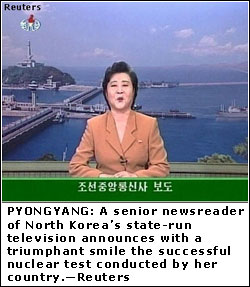 SEOUL, Oct 9: North Korea conducted its first nuclear bomb test on Monday, sending a shudder around the world and triggering calls for a tough UN response as it joined the select club of nuclear-armed powers.
After an emergency session on the crisis, the Security Council ‘strongly condemned’ Pyongyang’s action and vowed a ‘strong and swift’ response, its president said.
Japan’s UN envoy Kenzo Oshima, the council president for this month, told reporters that the council also urged North Korea ‘to refrain from further testing’ and return to six-nation disarmament talks.
Earlier John Bolton, his US counterpart, said Washington sought action under Chapter Seven of the UN charter, setting in motion a process that could lead to sanctions or even, as a last resort, military action to ensure compliance with council resolutions.
The blast underlined North Korean leader Kim Jong-Il’s willingness to test the nerve of the international community, which had warned Pyongyang just last week that it would pay a heavy price if it tested a nuclear device.
North Korea called the blast a ‘historic event’ carried out for the betterment of security and peace.
“The nuclear test was conducted with indigenous wisdom and technology, 100 per cent,” the official KCNA news agency announced.
Russian Defence Minister Sergei Ivanov said officials estimated its size as anywhere between five and 15 kilotons — the higher end of the estimate being greater than the US bomb that destroyed Hiroshima at the end of World War II.
China had a 20-minute advance warning, South Korean officials said.
The officials said the test appeared to have been carried out at 0136 GMT (6.36am PST) at Hwadaeri, near North Korea’s north-eastern coast.
The South Korean presidential office said the state intelligence agency had detected a 3.58-magnitude seismic tremor at that time.
In an immediate retaliatory move, South Korea, still technically at war with the North since the 1950-1953 war, suspended a scheduled shipment of 4,000 tons of cement in flood aid.
There was also speculation of a possible second test — South Korea’s Yonhap news agency quoted the country’s spy agency chief as telling parliament of unusual activities at a site at Punggyeri, about 30 kilometres northeast of Hwadaeri.
Japan’s Prime Minister Shinzo Abe, who rose to prominence by taking a tough line on North Korea, said Japan and the United States would step up joint work on a missile defence system.
“We need to make a stern response, and North Korea will be responsible for all the consequences,” he told reporters in Seoul, the South Korean capital.
Intelligence officials told South Korea’s parliament the test appeared to have been carried out in a horizontal tunnel in a 360-metre-high mountain northwest of the Musudan missile base, according to lawmaker Chung Hyong-Keun.
The US Geological Survey said it had detected an earthquake in North Korea of a magnitude of 4.2 degrees on the Richter scale.
A USGS geologist said the quake was a ‘shallow event or very close to the surface’.
There were no reports of radioactivity, in line with what the North Korean news agency also claimed.
Pyongyang had announced last week that it intended to carry out a test in what it called a self-defence measure against US aggression, saying then that it stood ‘at the crossroads of life and death’.
There are some 29,000 US troops stationed in South Korea alongside 650,000 South Koreans, facing off across one of the most heavily militarised frontiers on earth against about 1.2 million North Korean troops — the world’s fourth-largest army in terms of numbers.
Monday’s test marks a definitive moment for the stalled six-nation talks, which had appeared to progress last year when Pyongyang said it would abandon its nuclear programme in exchange for security and other guarantees.
However, it walked out of the talks last November following US sanctions, and was slapped with separate, limited sanctions by the Security Council after test-firing seven missiles in July this year. —AFP



























