0
0

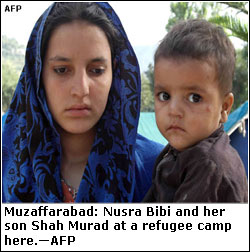 MUZAFFARABAD, Oct 3: Shah Murad’s first birthday is on Sunday but there will be no cake and few celebrations — it’s also the anniversary of his father’s death in last year’s earthquake.
The grubby-nosed baby was born three hours before the 7.6-magnitude quake scythed through northwest Pakistan and Kashmir on Oct 8, 2005, crushing his father beneath the ruins of a shop.
More than 74,000 others also died.
As a miracle ‘quake baby’ Shah should be a symbol of hope and regeneration, but his mother Nusra Bibi finds it hard to think so as she contemplates his upcoming birthday crawling around their shabby tent.
“He doesn’t weep, he doesn’t shout, he doesn’t make a noise. He’s like a lost child,” 18-year-old Nusra says at a refugee camp overlooking the capital of Azad Kashmir.
“Obviously I have to be hopeful about his future, like all parents. I think about his education, about his growing up, his fate. But there are going to be big problems.”
The refugee camp overlooks the mountain-fringed city from what was once its prettiest park. It is now filled with 250 tents encased in blue and white plastic marked Unicef, 161 latrines and mounds of rubbish.
The camp is for people like Nusra whose plots of land were wiped out by the quake, leaving them nowhere to build new homes with the compensation they get from the government.
Nusra gave birth to Shah, her first child, at 6am on the day of the disaster in Sumba Tharari village 40km from Muzaffarabad. Her husband Shahzad Hussein, 19, was staying overnight in the city.
At 8:50am the quake struck.
“My husband was in the bakery where he worked — he died there. His brother also died in our house,” says Nusra, wearing a dirty orange tunic, a blue and black headscarf and fluorescent green plastic shoes.
“We were in trauma, in shock. Then I was in a very critical condition after giving birth. I had to remain under open skies for two days next to a stream. It was raining, I was very sick. The situation was terrible.”
Shah plays with his toes or just stares.
Nusra, Shah and 15 relatives got to Muzaffarabad and set up tents supplied by a charity. Electricity and water were eventually provided at the camp, while aid agencies have provided medicines and healthcare for Shah.
“But life has been very tough. The rainy season was very bad, the tent was always wet. Then the summer was scorching, it was terrible too,” adds Nusra.
Shah’s grandmother says she fears for the little boy during the coming winter, the second they have spent homeless, because the authorities have ordered them to move to a camp on a river bank in central Muzaffarabad.
“The river is a very cold place, we are very scared,” says Nagina Bibi, 45, whose son was Shah’s dead father. “We have been harassed to evacuate this camp.”
Despite their predicament, Nagina doesn’t look to this world for explanations. “God took a son from me and gave my daughter-in-law a newborn baby. That is the blessing of Allah,” she says, gesturing to the sky.
Baby Shah’s mother does not know what to expect from the future. Asked what she hopes he will grow up to be, she says: “It’s up to God. We are just trying to get by.”
Children suffered terribly in the earthquake. The authorities said a whole generation was wiped out — almost half the total deaths were under 18s — many dying in collapsed schools.
Hundreds of thousands of youngsters were left homeless, their lives threatened by disease and cold as they struggled through winter in the Himalayan foothills.
Many lost at least one parent, and several hundred lost both, prompting fears that some orphans could fall prey to child traffickers. Most though were taken under the wings of their extended families.
A few were taken in by charities and orphanages, or, as in the case of six-year-old Mohammed Tanvir, madressahs.
Mohammed’s father, mother and baby sister were killed when the quake wrecked their home in Dabban, a remote Kashmiri village.
His maternal uncle’s family took him in and became his guardians, but he is currently one of eight boys being cared for at the Jamia Ishaqia Faizul Islam in Muzaffarabad.
“I was playing outside and there was a lot of shaking. I cried when I heard my parents were under the house but then my uncle’s family took me in,” says Mohammed, wearing a prayer cap.
“Now I like it here,” he adds before running off to play with his friends.
The madressahs have been controversial due to claims that they fan extremism, but the chief of this one says he is too busy seeking donations to repair damage from the earthquake to even teach the holy Quran.
The main concern is to help young victims like Mohammed get over their trauma, school head Maqbool Rahman Faizi says.
“He is very bold, very courageous. Of course there is some sort of psychological effect but he does not really talk about it,” he says.—AFP