0
0

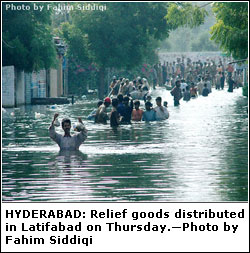 HYDERABAD, Sept 14: Mohammad Tahir mops the fevered brow of his one year old and looks anxiously out of the stone lattice window of his bedroom. It has been seven days since the monsoon downpour turned his Latifabad residence into an island surrounded by stagnant and foul-smelling flood water. He knows he will have to wait perhaps for hours before a rescue boat comes by.
“Rescue boats have been plying about Latifabad and Qasimabad since last Friday’s rains but sappers supervising the relief operation humiliate you before they let you board their vessel. If my son had not been unwell, I would never have turned to them for help,” says Tahir as he squats uncomfortably on his haunches in a small rowing boat, the baby clung to his chest.
Over 10 people have lost their lives since swirling floodwaters inundated several towns in Hyderabad amid driving rain on Sept 8, causing the civil administration to deploy military helicopters and boats to help thousands of marooned people. Despite tall claims of prompt and successful relief efforts, the government has not been able to drain out flood water from Latifabad and Qasimabad, two of the four talukas of the Hyderabad district.
“Sindhi-speaking residents of the Qasimabad taluka complain that the MQM-led district government is discriminating against them. They should come to Latifabad and see how those who voted the candidates of the Muttahida Qaumi Movement to power are in distress now,” says another occupant of the rescue boat, his clothes dripping wet after an exhausting walk in chest-high water.
“Hyderabad District Nazim Kanwar Naveed spends more time in London than in his own constituency. While he lives in Latifabad, he has done little to provide succour to the rain victims of Hyderabad,” he continues.
But Mr Naveed asserts that his frequent visits to the London headquarters of the MQM should be delinked from the rescue efforts being made in calamity-hit Hyderabad.
“There is no point in politicising the rescue operation,” says Mr Naveed. “And let me tell you that in my last three visits to the MQM international secretariat, I stayed in London only for one night. And whenever I take part in high-profile political talks, I plead the case of Hyderabad as forcefully as I can.”
“Hyderabad’s average annual rainfall has been 1.75 inches for the past many years. On Sept 8, rainfall totalled 10 inches – and that too within a space of 18 hours. No amount of planning could have prepared us for a natural disaster of this scale,” he explains.
Most marooned residents of Latifabad and Qasimabad agree that they have been hit by an unprecedented calamity. What they, however, cannot understand is why they must swallow their pride to get hold of relief goods being distributed by philanthropists.
“We do not have drinking water. And we have consumed whatever stock of food we had on Sept 8. But why must the middle-class residents of Latifabad, who set great store by pride and honour, be made to run after trucks containing relief goods like refugees?” wonders an elderly woman who struggles to keep her balance as the boat heaves.
Army officers operating the rescue boats say they cannot help feeling that their relief operation is a thankless task.
“Whatever we do, is not enough. We are criticised for improperly rowing the boats. We are blamed for not providing food to the victims. And we are asked why such a huge defence budget is spent on us. And still we feel sorry for the rain victims. It is a pity that the number of children who used to work with us has decreased over the past few days. Since they spent a lot of time bathing in the stagnant water, most of them are now down with water-borne diseases,” says an army officer.