After no-confidence vote
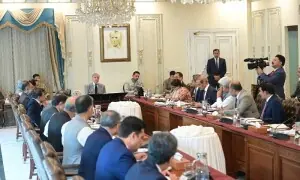
THAT the opposition’s no-confidence motion against Prime Minister Shaukat Aziz should have failed is no surprise. The treasury benches had what the opposition called “an artificial majority” of 201 votes, while the combined opposition could muster only 136 in a house of 342. The government might celebrate the occasion — even though there is nothing to celebrate, given the state of the nation — but the opposition must have felt disappointed if they had banked on some disgruntled MNAs on the government side voting for the motion. Had the issue been decided by secret ballot, the so-called forward bloc would perhaps not have missed the chance to switch sides, but the issue was determined through division, and that sealed the fate of the resolution. The opposition must now be wondering whether it was able to achieve a propaganda victory, because the no-confidence motion was taken up at a time when Nawab Akbar Bugti’s killing was dominating the national and parliamentary scene, and that sealed the fate of the opposition’s strategy whose sole aim was to focus the nation’s attention on the alleged wrongdoings of Mr Aziz.
The prime minister called Tuesday’s vote a victory for truth — a retort to the opposition’s claim that it had won a moral victory — and branded the opposition’s charges, contained in a 500-page annexure to the no-confidence motion, “a bundle of lies”. He referred specifically to the opposition’s allegations against him on the privatisation of Pakistan Steel Mills, the stock market crash earlier this year and the cement and sugar crises and said he had given detailed answers in the National Assembly on these issues. He then went on the offensive and said the country was on the brink of being a failed state when President Musharraf took over and today’s opposition was then in power — a broadside on the PML-N. One must also take notice of Speaker Chaudhry Amir Hussain’s performance. As Speaker, he must stay neutral and conduct parliamentary proceedings impartially. However, the way Mr Hussain handled some recent parliamentary sessions leaves much to be desired. One, for instance, does not know why on Monday he chose to disallow a discussion on the killing of Nawab Akbar Bugti and adjourned the session within five minutes. Heavens would not have fallen if a discussion had taken place in the assembly of an issue which the entire nation was talking about; and on Tuesday he termed the vote against the no-confidence motion a victory for truth and democracy.
The defeat of the no-confidence motion should not lull the government into a false sense of wellbeing, for the future is murky. The country’s largest province is in turmoil, with its daily toll of death, besides widespread acts of arson and violence. Once again, what is needed is a political approach. While the intensity of violence may wane, the situation in Balochistan is likely to remain unstable. How long the post-Bugti stir will continue, what form it will take and whether the ‘mega’ development process will proceed without hindrance and sabotage depend on how the government goes about handling the situation. The late Akbar Bugti had warned that if the government failed to come to terms with the old guard, it would find it a lot more difficult to satisfy the impatient, younger generation. Meanwhile, the government must try to retrieve the late Bugti chief’s body and have the last rites performed in the presence of his family members.
Freedom of speech — and action
SPEAKERS at a Karachi University seminar on promoting the “culture of discussion” were of the opinion that freedom of speech is a basic requisite of a democratic society. There is no disputing the fact that the democratic process can only work successfully if the people are allowed to express their points of view on a given issue and society is tolerant of diverse opinions and encourages a free debate. As the vice-chancellor of the university pointed out, democracy is not primarily a political process; it is inherently a social one too. One wishes that Pakistan had accepted these precepts much earlier and developed the culture of discussion and dialogue that is now being demanded. Had this been the case the country would not have been subject to the oppression of authoritarian governments and the tyranny of a society that is socially undemocratic and intolerant. Pluralism has not been our wont and the universities themselves, which are organising such seminars, were at one time clamping down on academic freedom in the name of discipline. Not forgotten are the days when professors were sent to prison for expressing opinions that challenged the establishment’s point of view. That the vice-chancellor now speaks of a change in culture is a welcome development indeed.
There is another factor that must be taken note of when one speaks of freedom of speech and expression. It is the need for developing supportive institutions to translate into tangible measures the concept of freedom of speech. There has been much talk of the freedom of the press being basic to democracy. But without a strong parliament, an independent judiciary and an accountable executive what can a free and lively press achieve? Similarly, academic freedom can inculcate a measure of tolerance and a willingness to listen to another point of view. But it will not bring about any substantial change in social environment if the universities are not independent enough to resist pressures from the government and the political parties which do not want any change in the status quo. Freedom can only make an impact if it permeates all levels and sections of society and becomes instrumental in bringing about a change.
Containing rural migration
PROVIDING valuable insight into how migration from rural areas puts enormous stress on the urban infrastructure, speakers at a recent seminar in Karachi said that the deteriorating socio-economic conditions in Pakistani cities could be attributed to unchecked urbanisation. The state of our cities testifies to this view — one that can be applied to many other developing countries where the influx of people from rural to urban areas is on the rise. According to the 1981 census, Pakistan’s urban population was close to 24 million. In 1998, when the last headcount was held, this had risen to 43 million — an addition of almost 20 million people. In 2006, it is difficult to obtain reliable figures, but judging by the steady flow of migrant labour into the cities, one can safely assume that there has been no let-up in rural migration.
It is obvious that the government needs to work on providing the urban population with better facilities, expanded housing and greater employment opportunities in order to create improved socio-economic conditions. But it is equally important to focus on the rural areas which have been woefully neglected and continue to be the hub of poverty, illiteracy, unemployment and poor social services. While there is greater inequality in income distribution in the cities, the percentage of people below the poverty line in rural areas is 32 per cent as opposed to 17 per cent in the cities. The rural-urban disparity is also reflected in figures for education and health services. This is not to ignore the argument in favour of providing the urban population with better services and living conditions. The purpose is to stress that such a strategy can work only in conjunction with a similar one aimed at uplifting the rural areas and creating better conditions that could slow down the rural exodus.
Reviving economic boycott
TO counter the onslaught of a giant gone berserk, the prospect of a revival of the Arab Boycott, however logical, is unrealistic, but equally so is reliance on an extraordinary but still very small guerilla group. A new initiative, not by recalcitrant governments but by the people, is needed.
Blair (LA Times August 20): “The policy on the Middle East is for a values change and the benefits of democracy, free markets and the rule of law.”
Bush (news conference, August 20): “What’s interesting about the violence in Lebanon and the violence in Iraq and the violence in Gaza is this: they are all groups of terrorists who are trying to stop the advance of democracy.”
Ah! So it is not retribution for the purported terrorist attacks of 9/11, nothing to do with regime change, nothing to do with oil, nothing to do with Israeli expansionism, and nothing to do with settling scores. The state of big power foreign policy defies comprehension except to the neocon cabal that rules the world in the first decade of the 21st century.
Back in the 1980s, the world enjoyed the periodic antics of a conservative president (Ronald Reagan) with a predilection for public gaffes (‘We begin the bombing of the Soviet Union in five minutes’, or when reading from the German chancellor’s speech instead of his own welcome at the White House) and amusingly dropping off to sleep at public functions.
These were matters of concern but somehow seemed benign. The present condition, starting from the manipulation of the infamous hangings chads on to the draconian response to 9/11, coupled with the impervious disregard for the rule of law and even public opinion, is altogether different. It seems as though the inmates have finally taken over the asylum.
Outrage and anger boil over on a daily basis as we are reminded constantly of the pervasive injustice being perpetrated on beleaguered Lebanon and the brazen occupation of Iraq and Afghanistan. Iran simmers under constant threat of retribution for a sin neither committed nor apparently contemplated.
Meanwhile, we continue to hear the harrowing tales of Kurds and other victims of the ruthless Saddam Hussein. Daily television catalogues the memory of hapless villagers seeking to escape the cascading bombs, the permeating napalm, and protecting themselves from jackbooted security men hell-bent on enforcing the will of a ruthless power. But then, isn’t that exactly what the Bushs and the Blairs stand accused of in Iraq? Can this hypocrisy escape even the most jingoistic?
So the scorecard reads as follows: four years after its ‘liberation’, Afghanistan, occupied by a coalition army, is largely lawless and produces 90 per cent of the world’s heroin whilst the imposed democracy is laughable at best and security and development a chimera. But somehow, despite this abysmal failure, the invasion of Afghanistan is no longer a front-page item. Iraqis suffer over 100 civilians being killed daily and the country is riven with insurgency, on the verge of a civil war, whilst a toothless administration fumbles on. Lebanon pulverised back to the Stone Age by the US-sponsored Israeli expansionism is under a tenuous ceasefire. And so it goes on. So what’s new?
Actually there is something new — a change in the constituency of unbelievers. Opponents of American imperialism are not divided along national or even ethnic lines. The peace movements within Israel itself and liberals and progressives worldwide are as exasperated as are the victims of war. Previously, as for example in the 1970s, no one in the West became pro-Arab on the imposition of the Arab oil embargo.
There was no widespread support in the Christian West for Egypt’s offensive in the Six Day war of 1967. But, in those more naive days, no one could imagine the extent and pervasiveness of lies, fabrications and manipulation that governments use to serve their own ends. Perhaps a bit of fudging, but bland lies to Congress? Falsifying documents to initiate a war? Manipulating the minds of their own constituencies? And, when all that fails, simply ignoring the will of the people. So now the Bostonian has turned as sceptical as the Bengali and even if rulers without legitimacy, whether monarch or military, turn their spineless backs on the truth, the people today seem capable of action.
The following is a quote from a 29-year old, US educated Pakistani lawyer: “Over the past five years, I have witnessed the illegal invasion of Iraq, the targeted killing of Muslim leaders by Israel in the West Bank and Gaza, the refusal to adhere to the roadmap, the utter disregard of international treaties and the explicit support of heinous Israeli actions by the US government. My pro-western liberalism has slowly but inevitably eroded... we will strike back, by the only means available to us.”
Is then the only response to be the sacrifice of dazzling youth now full of despair and frustration? Or, is there a more efficient, more effective tactic aimed at the softer underbelly?
Ex-PM Mahathir Mohamad of Malaysia is purported to have proposed a scheme where every person who can must sell 1,000 US dollars and persuade another 10 to do so. Accordingly, so the email campaign suggests, after 10 such rounds, over one trillion dollars will have inundated the market causing huge financial anguish to the US. However impractical, the scheme does have merit in that it introduces some lateral thinking to a seemingly intransigent problem. It recognises the real motive of the Bush doctrine, and as Blair explained in early August that “protectionism, isolationism, nativism” were now the central issues — in other words, access to markets, free trade and control of resources. Therefore, it would seem that a response which thwarts these very objectives would have greater effect than picking off a few unfortunate soldiers.
The Arab Boycott was formerly launched by the Arab League in 1945 and stated that “Jewish products and manufactured goods shall be considered undesirable to the Arab countries”. The secondary boycott prohibited business with companies that did business with Israel. The central boycott office still exists in Damascus but the boycott is no longer centre-stage and all but suspended in its application. During the early years, and specifically after the oil embargo of 1973, the boycott did have a dramatic effect on the economy of Israel but it had even greater ramifications for over 6,000 companies on the boycott list.
The boycott had real teeth. Even if the whole of the Arab consumer market was minuscule the emerging dollar strength of the oil economies was making the boycott list troublesome. American interests in the huge infrastructure projects mushrooming all over Saudi Arabia and the Gulf were being undermined. British and European companies less constrained by Jewish lobbies were winning the lion’s share. Household names like Coca-Cola, McDonald’s, Walt Disney and a host of technology, aircraft and military suppliers were affected. Obviously, this could not be permitted for long and under the banner of free trade, the GCC countries yielded and ended the secondary boycott in 1994; the following year the Taba Declaration ended the boycott by Egypt, Jordan and Palestine.
Even if the revival of the Arab boycott is more effective — the market for military goods, technology and consumer items is more substantial — the propaganda effect, however, would be immeasurable. Nevertheless even without the legal obstacles of WTO commitments, the political will amongst the majority of Arab countries, as evidenced by the majority of the Arab League’s initial condemnation of the Hezbollah, is weak. Are we then left only with the David and Goliath struggle of the Hezbollah, the resistance of Hamas and the rhetoric of George Galloway? Or can the peoples of not just Arabia, not just Muslims, but of the world, disgusted at this modern world, degraded by their own governments, be somehow galvanised?
Gandhi took up the challenge and faced down the then superpower and mobilised the people to boycott foreign cloth and British goods. He promised that ‘swaraj’ (home rule) was inevitable if the people embraced the call for boycott and ‘swadeshi’. And it was the people who rallied to the call. The damage to the Lancashire textile industry was substantial (a loss of Rs20 crores from a total export of Rs60 crores) but the damage to British prestige was even greater. Hugo Chavez of Venezuela stands tall in his solitary defiance of the great power and exploits oil, his sole resource, to make his point clear. Whatever the economic consequences, the symbolism is resonant.
Self-preservation, not courage, is the hallmark of governments and no initiative can be expected from the governments of modern day Muslim and even the non-Muslim Third World. But today, no government can contain the power of modern communication technology.
The answer, therefore, may lie in the revival of the boycott but adapted to make it quickly effective. Harness the power of technology through NGOs with a call for a selective boycott of some high profile businesses, big business being the real Bush-Blair constituency. Identify a few business houses, then focus on lobbying both the private and public sectors, enjoining decision makers to recognise the targeted boycott list, cajole management and inform as many as possible of the need for a new ‘swadeshi’.
Just the mere selection and subsequent surrounding publicity will create the discomfort, which in turn will generate the pressure that may result in a review of national interests. Activists and organisations can determine tactics and initiate a campaign that would enrol a public now determined to act on behalf of the victims of injustice. Perhaps even bringing in regime change where regime change is most needed.