Issues that matter
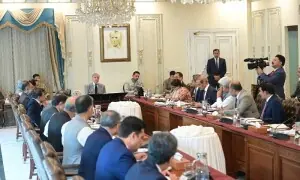
THE opposition now seems finally united on a one-point agenda — the exit of the army from politics. Addressing a news conference on Wednesday after handing a no-confidence motion to the Speaker’s secretariat, Makhdoom Amin Fahim and Qazi Hussain Ahmad said that the ARD and the MMA and others in the opposition had united to “send the armed forces back to performing their constitutional duty”. The no-confidence resolution also contains a 500-page “charge sheet” against the government - but with a surprising focus on Prime Minister Shaukat Aziz, accusing him of corruption, violations of the Constitution and favouritism in the Pakistan Steel Mills sale, Karachi Stock Exchange and some other cases. The MMA President Qazi Hussain said that Mr Aziz was “an imported man” who had no stakes in Pakistan. If Mr Aziz is an “import”, so was Mr Moeen Qureshi, a green card holder, as prime minister of an interim government, and it goes without saying that as head of this caretaker government the former World Bank Vice-President did many good things for Pakistan. Mr Aziz should, therefore, be judged by his performance and not by his antecedent which Qazi Hussain Ahmad holds up as a disqualifying factor.
As an economist, Mr Aziz has been a great success, and as prime minister his style of governance has been characterised by lack of flamboyance and personal projection, and most domestic and international observers regard him as an impeccably honest person. But the problem lies elsewhere - in his position as head of the cabinet under a Constitution which has been disfigured by the army and deprived of its democratic and parliamentary character. As a rule, by virtue of being an elected leader of the house, Mr Aziz should be the most important person in the government, but in reality he has perforce to play second fiddle to the army chief because the Legal Framework Order has made the army chief, who is also the president, the real wielder of executive authority. Over the National Security Council, which is the nation’s highest decision-making body, it is General Musharraf who presides. The army chief also being an “elected” head of state has made a joke of democracy. So long as this anomaly persists, Pakistan will never be considered a member of the world’s democratic states. The president should have discarded his uniform long ago - as he had then pledged. The MMA’s support for the 17th amendment and its abstention from the 2004 parliamentary session that gave him a vote of confidence came in handy for the general to go back on his word. The election next year will be meaningless if President Musharraf and those around him contrive his continuation in office as both president and army chief for another five years.
The other issue that the ARD and the MMA should have the common sense to unite on is the need for repealing the Hudood ordinances. The MMA members’ action in tearing up the draft of the relevant bill seems to indicate a state of mind that is anything but rational. The issue calls for cool-headedness, because what is being sought is not something that goes against Islam; instead, the government’s much-delayed move aims at undoing the injustices to which women have been subjected since the imposition of the Hudood ordinances in by Ziaul Haq. A new law reflecting a national consensus and framed by parliament is a much better way of dealing with sex crimes than laws imposed by a dictator.
Brutality against teachers
THINGS took an ugly turn on Tuesday in Karachi when teachers protesting against the ban on teachers’ union activities in Sindh were treated to the usual highhandedness of the police — baton charged, tear-gassed, beaten and over 40 protesters detained. While the education department had warned the teachers of strict action if they participated in any protest against the government’s action, it was downright wrong and thoughtless to rough them up and mistreat them the way they were on Tuesday. No wonder some rights groups and political parties have condemned the police brutality. The group was protesting in a peaceful manner but the administration claims that they were not granted permission to march towards the chief minister’s house and that action was taken against them for creating a “public nuisance”. That the police action was uncalled for is not surprising for it typifies the strong-arm tactics that are usually employed to silence those seen as trouble-makers. The protesting groups announced a province-wide boycott of classes for an indefinite period which may prove disastrous for government schools. This makes it all the more necessary for the government to address the protesting teachers’ concerns immediately so that loss of valuable academic time affecting the future of thousands of students can be avoided.
Both the chief minister and the provincial education minister are adamant that their decision is not likely to be changed and they remain adamant on taking action against those who are agitating for the lifting the ban. Given the unhappy experience with student unions, the government may have some reason to believe that teachers unions too may become politicised, for that is bound to have adverse effects on education. However, an outright ban is not the answer. The best option is to enter into negotiations with teachers’ representatives, concede to their right to form unions but expect them to keep the unions free from politics. Besides, the Sindh government must take note of the fact that no other province has banned such unions as they are well aware of the valuable role teachers play in shaping the future of the country through education. The Sindh government must engage the protesting groups in a constructive dialogue and find a way out of this quagmire so that classes can commence at the earliest.
Death of a cricket wizard
WHEN he clicked, Raja ruled the game. Even in a more laid-back era, he was a breed apart. Wasim Raja played cricket for the sheer joy of it. It is in some ways befitting that his last moments in this world were spent on the cricket field. In his prime, he enjoyed a cult following. His stay at the crease was invariably exhilarating and if he got out early, which was known to happen, a major part of the match seemed to be over. Raja may not rank high with those who measure greatness by numbers and statistics, but his carefree approach to the most testing of situations made him the undisputed darling of the crowds. Though one of the hardest hitters of his era, Raja was elegance personified when batting, dispatching balls with regal disdain. In the field he exuded a feline grace then associated more with the Caribbean than the subcontinent. His whirling run-up when bowling leg-spin was a treat in itself and mimicked by schoolboys across Pakistan. Later in his career he started sporting a beard, which in those days suggested a touch of the renegade and the bohemian.
Odd man out that he was, Raja was not the favourite son of the country’s cricket establishment. He was in and out of the team but still managed to leave an indelible mark on the game. The high point of his career came, most appropriately, in the West Indies in the spring of 1977 when he topped both the batting and bowling averages. Typically, Raja reserved his best for a contest against a side hailed by many as the greatest in the history of cricket. Wasim Hasan Raja, one of the most gifted cricketers produced by Pakistan, died of a suspected heart attack on Wednesday while playing a friendly match in England.
Challenges to Islam
AN attempt is made here to touch upon some of the serious challenges exclusive to Islam. The first point that irks humans about religion, per se, is that religion tries to control and guide human conduct.
It defines piety and impiety; right and wrong. It lays down dos and don’ts, thereby depriving humans of their freedom of action. The resultant discomfort is therefore understandable.
However, this complaint is generic. It is not Islam-specific. But the vehemence in relation to Islam is more pronounced. This, too, is understandable. Actually the “anger” Islam’s code of conduct triggers is proportionate to the volume and force of the curbs that it places on its followers. For example, it goes into specifics and prescribes precise details covering such everyday chores as eating and drinking, greeting and salutation, speech and deportment, conjugal relations, marriage, divorce and inheritance as well as the larger issues of war and peace, lending and borrowing, trade and commerce.
This plethora of restrictions apparently leaves no space for free movement. This is the basic drawback associated with religion, all religions, that Hamlet is reflecting upon in his soliloquy, when he says; “Thus conscience does make cowards of us all,” for conscience is the child of religious belief.
In Islam’s case this postulate applies with double force. It is not the uncertainty, the “dread of ... the undiscovered country from whose bourne no traveller returns, that puzzles the will,” that determines the conduct of Muslims. In a Muslim’s case on the contrary, it is the certainty that holds him back from sin and crime. He knows what will happen after his death. His deeds, good or bad, will pursue him to eternity and will be taken into account. He will be shown even an atom’s worth of good or evil deed he has done during his lifetime (Zilzal: 7-8). And he will be judged. In fact, on the Day of Judgment his “hands will speak” and “his feet bear witness” to everything that he did on this earth. (Ya Sin: 65). And there are actions — for example homicide — for which, in addition to punishment in this world, he would also be penalized in the Hereafter.
Therefore, if simply the dread of the unknown makes cowards of us all, then Islam, with all the above warnings, should make Muslims the most cowardly among the humans. A Muslim is hamstrung even in the matter of retaliation and revenge. What torment he must experience when he is strictly forbidden from “exceeding” the balance of injury? A tooth for a tooth; an eye for an eye, a life for a life and not an iota more! End even then he is induced to spare the life of the assassin for recompense.
A shining example of how literally this sanction is to be applied was offered by Ali ibn-e-Abi Talib. Having been fatally wounded by Ibn-e-Muljim, he specifically ordered that in executing the death sentence for homicide on the culprit, care must be taken that he is struck only once, because he had struck Ali only once.
A comparison will reveal the difference between Islam and others. Look at what the US did in Iraq and Israel in Lebanon. One follows Christianity, the other Judaism. Both killed people indiscriminately and remorselessly. Their victims comprised largely innocent, noncombatant, unarmed civilians including old people, women, children, infants and babies.
Israeli troops did not spare even a pregnant woman as the first person account from a Lebanese, Roger Assaf, from Beirut of an Israeli commando operation in Baalbeck, reveals.
“The parachutists landed on a hospital: Dar el Hekmat. ... Inside the car that rushed out of the hospital area and that was chased and filmed by the Israelis were a man and his wife, eight- months pregnant. The first rocket hit the back of the car. The two passengers leave the car screaming for help. The helicopter makes a U-turn and shoots again. The man manages to escape, the woman doesn’t. A little bit later, the neighbours rush to the car and find her dead, with an exploded belly and the fetus projected outside”. (Adjusting the Heroic Commando Raid Story).
But such actions, which constitute a “war of annihilation,” called herem in Hebrew, are fully endorsed in the Jewish Scriptures. Richard Bonney, in his masterpiece, Jihad: From Quran to Osama bin Laden, (pp 15-16) discusses this topic in detail quoting chapters and verses such as Deuteronomy 7 and 20; 13: 16- 18; 4:26-27; 7:1; as well as I Samuel 15:1-3. And in conclusion remarks, “There was no concept of limitation in the conflict or restriction to the violence, which is the main distinction between herem in the Hebrew Scriptures and the jihad of Islam.”
The New Testament is silent on the topic but Christians follow the Jewish practice where their Book provides no guidance as reflected in their wars of conquest through history.
Even in regard to retaliation, though the Torah prescribes an eye for an eye, a tooth for a tooth yet, Israel, apparently found it inadequate. It has therefore performed a kind of ijtehad of its own to dismiss those curbs on its freedom. Thus, Washington Post columnist Richard Cohen, a Jew, lambastes international outrage at Israel’s “disproportionate” response to Hezbollah’s provocation. He hails Israel’s new policy as “You slap me; I will punch out your lights.” (No, It’s Survival; WP, July 25, 2006)
Here a Muslim faces a grave challenge. He is offered inducements, exhorted time and again to fight and even warned of punishment should he refuse to, yet, the restrictions imposed are more daunting than the actual fighting. A Muslim warrior is also human. He, too, would instinctively wish to — what New York Times columnists, Safire and Friedman, gleefully call, “pulverise” — the enemy. But for him there can be no My Lai, no Operation Orange defoliation, no destruction of standing crops, et al. The list of don’ts is indeed so long that it is surprising how a Muslim can fight at all.
But a Believer realises that, like all other restraints, these are also meant to kill the animal in him and prepare him to meet his Master. Therefore Muslims have been fighting and giving an amazingly good account of themselves, in the battlefield throughout history.
Anti-Americanism in Russia
THE Bush administration’s imposition of sanctions on two Russian companies this month for selling military technology to Iran certainly sends the Kremlin a message — but it won’t be the one the White House has in mind. The penalties will only deepen the hostility that Russia’s political establishment feels toward the United States.
That attitude came through loud and clear in many discussions I had with Russian academics, foreign policy specialists and senior officials during a recent trip to Moscow. President Vladimir V. Putin echoed it in his caustic dismissal of Vice-President Dick Cheney’s recent complaint that Russian democracy was eroding. And his condemnation of the sanctions as an “illegitimate” attempt to foist US laws on Russian companies was no less acerbic. He will doubtless respond in kind.
The anti-American nationalism so palpable in Russia today is rooted in the 1990s, the decade of Boris N. Yeltsin, whom many Americans credit with ending Soviet totalitarianism and introducing the country to democracy. Russians have a different take on those years. They remember the chaos; the economic contraction; the extreme poverty; the robber barons who, with the connivance of the government, made billions after taking over state-owned industries at bargain-basement prices; and the Yeltsin family’s rampant corruption. Rightly or wrongly, they associate these bad experiences with the United States. As one Russian official told me, “We followed your advice, and look where it landed us.”
Nato’s expansion also feeds Russian anti-Americanism. During the debate here, US experts confidently predicted that Moscow would adjust to the induction of its former Soviet republics Estonia, Latvia and Lithuania into the alliance just as it had when Hungary, Poland and the Czech Republic joined. They were wrong.
The Russians I met see the US drive to enlarge the North Atlantic Treaty Organization as unfriendly and unnecessary, undertaken when Russia was weak and without regard for Russian sensibilities. They believe that the US continues to trample over vital Russian security interests, particularly in the post-Soviet republics, where, as they see it, Russia has the right to be dominant by virtue of history and geography.
The democratic revolutions in Georgia, Kyrgyzstan and Ukraine, hailed in Washington, are viewed in Russia as a US gambit to undercut Moscow’s influence in its own backyard by creating what one official sneeringly called “puppet governments.” Russia, I was told, would never allow Georgia to retake its breakaway statelets in Abkhazia and South Ossetia; “blood would flow” if it tried. And were Ukraine admitted to NATO, the consequences would be dire: Russia would throw in its lot with China, demand that Ukraine return the Crimea and show Europe who’s boss when it comes to energy.
Russia’s anti-American nationalism also reflects current circumstances. Although their country has many problems, Russians feel stronger and more confident than they did in the 1990s and are determined to be taken seriously as a great power. The economic disaster of the previous decade is over. Russia’s gross domestic product has annually increased, on average, by 5 per cent under Putin. Yeltsin’s drunken antics, which made Russians cringe, have been replaced by Putin’s authoritative and confident air on the world stage. One young Russian, who finished high school and college in the US, told me, with evident admiration, that Putin conducted himself at the G-8 summit with the assurance of an adult tending children.
When Russians look ahead, they feel that they are on a roll. Thanks to sky-high oil prices, Russia is flush with cash. It has paid off much of its foreign debt ahead of schedule. Europe is increasingly dependent on Russian energy, and Western oil and gas companies want to partner with their Russian counterparts, most of which are under state control. The West is desperate for Russian help on Iran and North Korea, and the US is bogged down in Iraq and hated in much of the world. All this makes Russians determined to push back when they feel that they are pushed.
It’s folly to assume that a new, post-Soviet generation will seek greater harmony with the US or that Russia’s accession to the World Trade Organization (certain to occur) and market forces will necessarily integrate it into the West. When I asked the US-educated Russian whether he shared the anti-American nationalism, he said he did.—Dawn/Los Angeles Times