BERLIN: The European Union has long resisted US calls to ban Hezbollah as a terrorist organisation and is not about to change that stance in the throes of a Middle East war, diplomats and analysts say.
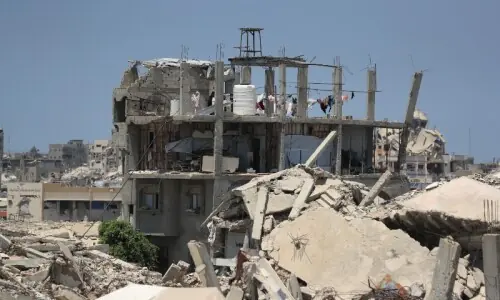
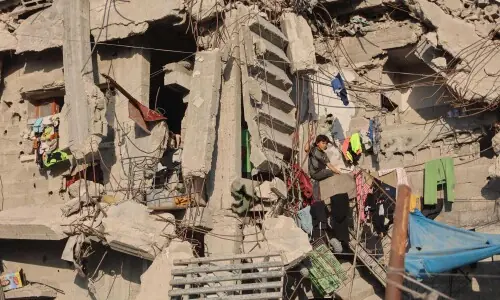
With Israel pounding Lebanon in a 10-day bombardment sparked by Hezbollah’s capturing of two soldiers, the EU is focusing on diplomacy aimed at an immediate halt to hostilities.
Its foreign policy chief Javier Solana made clear in Jerusalem this week that listing Hezbollah as a terrorist group — a step which would mean freezing its funds in Europe — was not on the current agenda.
“We have not analysed the list of terrorist activities or terrorist organisations in the last period of time and we have no intent in the foreseeable future to look into that again,” Solana said.
While the United States has long regarded Hezbollah as a terrorist group, the 25-member European Union has never reached unanimity on blacklisting it and that prospect receded further after it gained seats in Lebanese elections last year and entered the cabinet, where it holds two seats.
EU diplomats and officials said now was the wrong time to review the bloc’s stance on Hezbollah, which a senior US official described as “regrettable” as recently as last month — three weeks before the current crisis erupted.
“It would be perceived as blindly following Israel’s and the US’s demands,” one EU diplomat said. Another official noted it would close off a possible channel of communication.
Security analysts said Hezbollah’s July 12 seizure of two Israeli soldiers was a guerrilla operation, not a terrorist action and therefore it was hard to argue for a change in the EU position on that basis.
“Hezbollah has launched military operations, it triggered a war against Israel, not terrorism,” said Olivier Roy, an expert on militant Islamism at the French National Centre for Scientific Research.
“It’s possible the Europeans decide the crisis can only be resolved by the total demilitarisation of Hezbollah, and in that case there will certainly be measures against Hezbollah, but more political than anything else.”
He said this could take the form of “political pressure... maybe a boycott of Hezbollah”, rather than a crackdown with arrests of Hezbollah supporters in Europe.
Magnus Ranstorp, a Hezbollah expert at the Swedish National Defence College, said one factor restraining the EU was the difficulty of tracing who pulls the strings in the group, which is backed by Iran and Syria.
“The complicating factor is that the terrorism machinery sits with one foot in the Hezbollah leadership and one foot in Iranian intelligence,” he said.
But Ranstorp added there were other arguments the EU could use to justify a ban, including Hezbollah’s backing for Palestinian militants Hamas. “Almost on those grounds alone, in terms of assisting Hamas in carrying out attacks against civilians, they should be a banned organisation,” he said.
From time to time Hezbollah has also recruited Europe-based operatives and sent them to Israel to plan or carry out attacks. Steven Smyrek, a German, was jailed there in 1999 for planning a suicide bombing but released in 2004 in a prisoner swap.
Frenchman Roy said there was no sign of a Hezbollah threat to Europe itself, even if security services routinely monitor the group’s supporters here.—Reuters