The blame game
EVEN though devoted mostly to domestic issues, President Pervez Musharraf’s televised address to the nation on Thursday also touched upon the Mumbai blasts and expressed his concern over the repercussions they are having on the process of normalisation of relations between Pakistan and India. The president was obviously referring to the postponement of the secretary-level talks and the cancellation of the prisoner swap in the wake of some highly irresponsible talk in India. What is astonishing is the contradiction in the Indian stand: had it blamed Pakistan officially for the July 11 bombings and then put the normalisation process on hold, there would be some logic in it. However, New Delhi has not accused Islamabad officially of involvement in the Mumbai carnage, and that makes one wonder why it has chosen to cancel the secretary-level talks and the prisoners’ exchange. There is no evidence at all of Pakistan-based elements’ involvement in the Mumbai tragedy, and even the western media — ever so eager and always quick to discover a Pakistani connection in every act of terrorism — has refrained from doing so.
Let us recall here Pakistan’s offer to jointly investigate the attack on the Indian parliament building in December 2001. America, too, had offered the services of its intelligence agencies for a probe into the attack, but the Indian government turned down both offers. Now again, Pakistan has extended its cooperation to India if any information about the elements involved in the Mumbai blasts is shared by New Delhi. Regrettably, without finding any concrete evidence of a Pakistani connection, it has indulged in a bit of diplomatese and repeated the convenient and archaic idiom so popular with Washington and Kabul — Islamabad should “do more”. What those who dole out this advice ad nauseam do not realise is that Pakistan has to fight, and is fighting, terror in its own interest because it has suffered enormously at the hands of all sorts of terrorists, especially those militants who kill in the name of religion. We need not repeat here the carnage carried out by extremist elements in all major cities of Pakistan. Those acts have ranged from the murder of French engineers and Chinese experts working on development projects to bomb blasts in mosques and at religious gatherings. The crimes at Madrid, Bali, Istanbul, Sharm el-Sheikh, London and now Mumbai appear more sensational and tragedy-laden because of their names and the extra attention and over-exposure they got from the sensation-loving electronic media. But the total number of casualties Pakistan has suffered is higher than those in India from similar acts of terrorism.
As President Musharraf correctly pointed out, calling off the normalisation process would be a victory for extremists in both Pakistan and India who were never happy with the rapprochement that over the last two years has proceeded so well and achieved successes that one could not expect in the summer of 2002 when the two countries’ troops were facing each other across the border in what could have turned into a deadly war. Going by India’s policy, one feels that the normalisation process is hostage to terrorism. It is true that Indian leaders must play to the gallery for reasons of internal politics, but let not the “blame game” to which the president referred sabotage the pursuit of the composite dialogue to which the two sides stand committed.
Conspiracy of silence
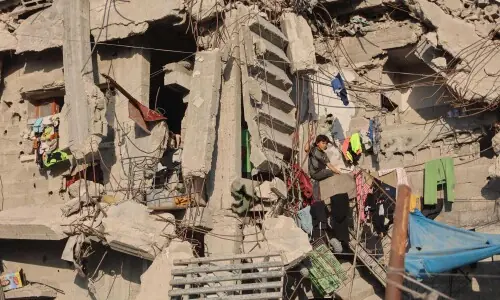
THE US-backed Arab monarchs and Muslim leaders elsewhere in the world have issued the customary statement or two condemning the Israeli air attacks on Lebanon and Gaza. The United Nations has voiced its routine concern. The US-dominated western world meanwhile remains hostage to a conspiracy of silence over Israel’s brutal assault on Lebanese civilians and their country’s already fragile infrastructure. Instead of lending their weight to efforts aimed at ending the offensive, European and North American countries seem to be concerned primarily with evacuating their citizens from the war zone — a natural response, no doubt, but in itself a clear sign that no pressure will be brought to bear on Israel, at least not yet. The reason is that Israel’s interests, annihilating Hezbollah and Hamas and sending a message to Syria and Iran, happen to ‘coincide’ with those of America. Some analysts go so far as to suggest that Israel is actually fighting a proxy war on behalf of the US. That may or may not be true. But there is no disputing the reports that Tel Aviv acted only after receiving the green signal from Washington. That much is pretty clear.
This conspiracy of silence has deep roots. In the words of a US academic, “Israel has become a myth in the American mind, to the point where it is perceived by many as being actually part of America.” Criticism of Israeli policy is a taboo in the US Congress, thanks to the clout of the American Israel Public Affairs Committee. Elsewhere in America, a country currently in the grip of a McCarthyist witch-hunt against ‘liberals’, anyone pointing out the injustices suffered by the Palestinians runs the risk of being branded an anti-Semite. Two top professors recently caused an uproar in the US with a paper titled ‘The Israel Lobby and US Foreign Policy’. Among other things, they pointed out that “because America’s blank-check support for Israel arouses enormous Arab and Muslim rage, Israel is a strategic liability, not an asset.” For this they were immediately labelled bigots. The relentless bombing of Lebanon is further proof that the Muslim world is no match for Israel militarily. As a result, “Arab and Muslim rage” will be vented through clandestine channels and the terrorists’ primary target will continue to be America.
Rise in poppy cultivation
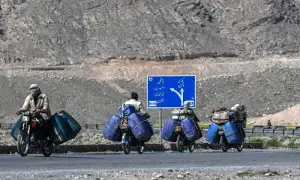
IT is a matter of great concern that Pakistan should be witnessing a resurgence of poppy cultivation in areas bordering Afghanistan which is expected to produce a bumper crop this year. Government officials often try to convince the people that the acreage under cultivation is on the decrease, as Minister for Narcotics Control Ghous Bux Mehar did the other day. However, with no end in sight to the opium problem in Afghanistan, Pakistan has no option but to work harder at removing the scourge from its territory. Poppy cultivation in Afghanistan witnessed a drastic reduction under Taliban rule, a fact that no doubt helped Pakistan earn the ‘poppy-free’ label in 2001. But with the ongoing war on terror and the increasing lawlessness in Afghanistan, where the procurement of illicit arms depends heavily on the narco-trade, poppy cultivation has assumed unprecedented proportions. For Pakistan — a major transit route for narcotics from Afghanistan — the spillover has been inevitable in areas that share a similar terrain with bordering Afghan villages. Political unrest, especially along the border, has compounded the problem, making it difficult for law enforcement agencies to crack down on those growing poppy.
The border with Afghanistan is long and porous, and despite the presence of some 80,000 troops, cross-border smuggling and incursions by militants are rampant. Pakistan will have to enforce border control measures more strictly if it wants to bring down and eventually eliminate poppy cultivation on its territory. More than that, it must develop the backward areas where farmers are growing the crop because of widespread poverty and the absence of any alternative means of livelihood. As long as the government turns a blind eye to the harsh living conditions in those areas, it will have only itself to blame for a rise in poppy cultivation.
The seamy side of the Hudood laws
“THE Hudood Ordinance was authored by one man and it can be changed” profoundly observes General Pervez Musharraf after ruling Pakistan for almost seven years. The “one man” who enacted the Hudood Ordinances was General Ziaul Haq, a dictator who discovered “Islamic law” to secure his tenuous position.
No public debate preceded the enactment of the Hudood Ordinances. No parliament ever examined them, not even Zia’s Majlis-i-Shoora. Through these ordinances, however, Quranic law was purportedly enacted. Hadd is the term used for the offences and punishments which are mentioned in the Quran. It is a travesty to refer to Zia’s Ordinances as ‘Hudood’ Ordinances since Zia did not follow what the Holy Quran prescribed.
The offence of Zina (Enforcement of Hadd) Ordinance, 1979, stipulated, that “Whoever is guilty of zina (adultery) shall ... be stoned to death at a public place.” However, the Holy Quran stipulates “a hundred stripes” as punishment for an act of zina (24:2). If a particular sentence is prescribed in the Holy Quran, a harsher one cannot be imposed.
The Old Testament explicitly depicts various adulterous sexual acts and prescribes that those indulging in them be “put to death” (Leviticus 20:10-21). If a husband accuses his wife of not being a virgin when he married her “and no proof of the girl’s virginity is found, then they shall bring her out to the door of her father’s house and the men of her town shall stone her to death. She has committed an outrage ... by playing the prostitute in her father’s house: you shall rid yourself of this wickedness.”
If, however, the accusation turns out to be false, “they shall fine him a hundred pieces of silver because he has given a bad name to a virgin of Israel, and hand them to the girl’s father” (Deuteronomy 22:20-21). “When a man is discovered lying with a married woman, they shall both die, the woman as well as the man who lay with her: you shall rid Israel of this wickedness”.
Ibn Khaldun noted that ignorant Muslims tended to apply Judaic law: “They turned for information to the followers of the Book, the Jews ... so when these people embraced Islam, they retained their stories which had no connection with the commandments of the Islamic law ... commentaries on the Holy Quran were soon filled with these stories of theirs” (Ulum al-Quran, Muqaddamah). The Holy Quran mandates that four eye witnesses must testify to prove the charge (24:4). Since the Quranic requirement can rarely, if ever, be met, Zia decided to water down the words of the Quran and did away with the four witnesses requirement by referring to the hadd offence as tazir.
The Quran also stipulates grave consequences for making false allegations of zina. Those who accuse a woman but fail to “produce four witnesses”, are to be flogged 80 times. In the 27 years that this law has been applied in Pakistan can the law or religious affairs ministries cite a single case where the accuser having failed to produce the required number of witnesses was flogged? And if they can’t explain, why then has this mandatory requirement of the Holy Quran been brazenly violated?
Zia created a distraction based on religious orthodoxy. Sexual fascination got people running to police stations and lodging cases rather than demanding an end to Zia’s dictatorial rule. The offence of shame became a spectacle. Many FIRs have been lodged on the complaints of men; a case of women seeing no evil or one of using the law for settling scores? Every day there are stories in the press about how this law is being misused. A fair amount of the Supreme Court’s time is taken up in coming to the rescue of those who bear its brunt. But for every such rescue attempt there must be a hundred more which do not come to the court’s notice.
Pakistan has seen a spate of accusations by husbands against wives, but in this matter too Zia’s Ordinances violate the very clear and specific language of the Holy Quran. If there are no witnesses and a husband accuses his wife of adultery, he has to repeat his testimony and on the fifth invoke the “Curse of Allah” on himself if he is lying (24:6-7). The punishment is averted if the wife similarly swears (24:8-9) that she is innocent.
These Ordinances not only opened up further possibilities for graft but also eroded the performance of the police. A lot of the time of the entire police force is spent determining who got married when and to whom and who has been having sex with whom. As a result, terrorists, bombers, kidnappers, hijackers, robbers and thieves get a lucky break.
Each of Zia’s Ordinances has taken the nation far from the teachings of the Quran. Zia laid the foundation of an environment that has come to tolerate scandals involving women and we have successfully built on it. The distinction between adultery and rape has become blurred. Sections 375 and 376 of the Pakistan Penal Code, which respectively define ‘rape’ and mandate its punishment (which could extend to life imprisonment) were repealed. In their place both ‘adultery’ and ‘rape’ were placed side by side in the Offence of Zina (Enforcement of Hadd) Ordinance, 1979. Rape has thus become a type of adultery. To be able to do that Zia twisted words. The Offence of Zina Ordinance coined a new term for ‘rape’, ‘Zina-bil-Jabr’. As it sounded Arabic the people were fooled. ‘Rape’ in Arabic is ightasab, ightasab imra (rape of a woman), ightasab bakara (rape of a virgin) or hatak alardh (plundering virtue); it is not ‘Zina-bil-Jabr’. Adultery in Arabic is simply zina. Zia’s term for rape absurdly and translated its into ‘adultery-with-force’. Combining the term adultery, which is consensual, with rape, diminishes the force associated with rape. In adultery the woman is always culpable, but never in rape. The juxtaposition of ‘adultery’ with ‘force’ was simply dishonest.
As a result, victims of rape are damned. Reporting a rape often results in the victim being prosecuted for adultery. The law has become a handy tool in the hands of policemen who are often induced by rapists to transform rape into adultery. Lack of evidence may acquit a rapist but the victim is often convicted for adultery.
Raped women in Pakistan first suffer the indignity of assault, then the ridicule of disbelief and are thwarted at every step in getting justice and retribution. The Quran admonishes in the most explicit terms those slandering women. “Those who slander chaste women ... are cursed in this life and in the Hereafter: for them is a grievous penalty” (24:3).
General Musharraf is under pressure to deliver on his ‘enlightened moderation’ agenda but there is no clarity of thought, purpose or objective and these words are without substance. Having finally acknowledged the fallibility of General Zia’s Hudood Ordinances, he passes the buck to the Council of Islamic Ideology and asks it “to draft an amendment”, but he does not disclose what change he seeks to bring about or commit himself to repeal the Ordinances as demanded by the people.
General Musharraf has also set the council another impossible task. He wants the council “to take along all the schools of thought while preparing the amendment”. Significantly, there is no advice to council to follow the Holy Quran!
The ‘Hudood’ Ordinances contravene the Quran in so many ways and are so badly drafted that they cannot be salvaged by a little amendment here or there. Complete repeal is the only way forward. The Islamic hadd provisions may easily be added to the Pakistan Penal Code. There is no need for a subject-specific legislation.
Bankers in shackles
FROM the orange-boiler suits of Guantanamo to the arm and leg shackles worn to court by the British bankers extradited to Texas last week, America’s way of doing justice can shock. The images of the three men in chains in Houston only served to fuel uproar about their extradition under a 2003 treaty which saw Britain give away more than it gained.
Thanks to a double parliamentary humiliation which saw the government lose in the Lords and forced to abstain in the Commons, the issue has been on the agenda though a week packed with other astonishing news. The impression has grown of three unfortunate men who have been dragged from their families to face injustice abroad.
What has been overlooked is that the bankers are not the first people to be extradited since the treaty came into force in 2004: 13 have been sent and other cases are under way. The treaty is certainly unfair and Britain is currently applying it when the US is not. But it is hard not to suspect that some in the City and at Westminster object less to the terms than to its use against well-spoken men accused of commercial crime. Previous, less controversial, extraditions were mostly for offences such as drug trafficking, theft and murder.
This applies more to the Conservatives — who did not object to the treaty when enacted — than to the Liberal Democrats, who led the debate and who have objected to it from the start. Whether the three men are guilty is now for the US courts to decide. But the uproar points to a classic point of friction in a globalised age. The Enron scandal certainly involved serious criminality. This newspaper reported details of alleged emails which suggest that the men may at least have a case to answer.
— The Guardian, London