0
0

Getting out of the trap
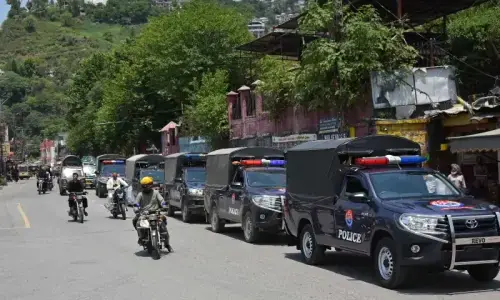
WHETHER or not it was the work of a suicide bomber, the result of Friday’s attack on an army convoy near Bakakhel was the death of five more soldiers. The incident occurred in the Bannu Frontier region and highlights the phenomenal rise in terrorist activity in the Waziristan area. The Bakakhel suicide-bombing was the second in a week, for a similar attack had taken place the previous Sunday near Datakhel, killing two soldiers. Sources at the Inter Services Public Relations discounted the possibility of suicide-bombing, insisting that two suicide bombers for one target did not make sense and that the soldiers died because two grenades were thrown at them. However, the mode of action is a pointless debate from the point of view of the gravity of the situation and the guerilla trap into which the security forces occasionally walk. Those in the West and nearer home in Afghanistan who accuse Pakistan of not doing enough and expect Islamabad “to do more” should see the price this nation is paying for the war on terror. This price became inevitable once Pakistan decided to cast its lot with the US-led coalition that attacked the Taliban-ruled Afghanistan and, partly, because Islamabad has mishandled the situation on its side.
The decision to deploy 80,000 troops in the Federally-Administered Tribal Areas has not paid off. Guerilla activity not only continues unabated, there are reports that the Taliban’s influence has increased in areas outside Fata. What is more, since Afghanistan has failed to do its part of the duty, saboteurs — sometimes trained and encouraged by Afghan officials — enter Pakistan to carry out terrorist acts. In fact, as recent events show, the Taliban are especially strong in the Helmand province, which borders Pakistan and where they recently engaged the Nato-led security forces in heavy fighting. Against these harsh realities, Islamabad would do well to think afresh and draw up a new strategy to extricate itself from what looks like an unwinnable guerilla war and help pacify the troubled tribal area. NWFP Governor Ali Muhammad Jan Orakzai, however, seems to believe in a continuation of the present strategy, which relies on force alone. The new governor presented his thoughts on the issue when he told a council of tribal elders on Friday that the army would remain in Fata until peace was restored. Since he gave no timeframe for a withdrawal of the troops, the governor himself seems to believe that victory is nowhere near. He also said that President Pervez Musharraf had approved of the appointment of military officers as administrators in Fata.
This is a wrong approach and will amount to perpetuating the mistakes of the past. Let us be realistic: there can be no military solution to the Wana conflict, because the militants have shown extraordinary tenacity. Only a political approach can prove useful. Fata people, he said, were peace-loving and that it was a handful of foreign terrorists who were creating trouble. Most tribesmen are indeed peace-loving, only a small section of them sympathises with the Taliban. Without the shelter and help provided by those sympathetic to them, foreign militants simply cannot survive in those harsh topographical conditions. Let the authorities concentrate on involving all sections of the Fata leadership in the task of pacification and in winning over the tribesmen by improving the quality of life for them and giving them a sense of stake in peaceful conditions in their area.
Loan spending priorities
THE $6.5 billion loan approved by the World Bank for Pakistan for spending on infrastructure building over the next four years has come with well-defined priorities laid down by the bank. On top of the economic agenda is the reconstruction effort in the earthquake-hit areas, followed by development projects, mainly in Punjab and the NWFP, aimed at achieving sustainable growth. The bank has been cautious in welcoming government policies in the last two years, expressing a fear that the high growth rate of 8.4 per cent achieved during the fiscal year 2004-05 may not be sustainable in the years ahead unless certain prerequisites are met. These include investment in the economy as well as in human resource development. On the economic front, the WB says the country must attract $500-600 million new investment per annum to have the desired results. Calling into question the existing dismal state of the power and transport sectors, it warns against further weakening of these two areas of basic infrastructure. Any further deterioration in the power distribution and transmission networks and the transport system will discourage potential investors, it says. The bank also notes that any new investment in the economy must also work towards improving the people’s living conditions, especially of the poor and vulnerable sections of society, for the proposed loan to make any meaningful impact.
These indeed are the right priorities and must be pursued with the required amount of determination on the part of the government. According to the plan, a good 50 per cent of the loan will be spent on bolstering Punjab’s education, irrigation and municipal service sectors, and on carrying out reforms in areas such as fiscal, governance, devolution and procurement policies and procedures in the Frontier, besides one billion dollars going to reconstruction in the earthquake-hit districts in the north. With the entire loan amount so precisely earmarked for relevant areas, the government should have enough fiscal space available to it to undertake basic infrastructure building projects. If these conditions are not met, it is obvious that the country will end up with yet another expensive loan, which is a losing proposition.
Water shortage in quake areas
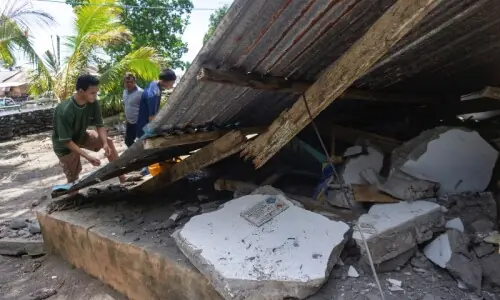
IT is tragic that seven months after the earthquake, an acute shortage of water continues to persist, causing suffering to survivors. According to a report by IUCN, survivors are demanding not only drinking water but also water for bathing purposes as there are very few bathroom facilities around. This points to the lack of hygiene which has caused multiple illnesses over the last several months. Water supply networks were badly damaged and massive landslides caused pollution in rural water sources but the problem has not been seriously tackled. As a result of the unhygienic conditions, survivors, particularly children, remain vulnerable to health problems as contaminated water pools and untreated excreta have become breeding grounds for diseases. It is shocking to hear that because of the unavailability of proper bathrooms, many survivors have not had a bath for months. Not only is this a hygiene problem but a psychological one too, as survivors need to muster all their courage to focus on rebuilding their lives. The IUCN has recommended the building of 160,000 washrooms; such a large number only indicates the magnitude of the problem.
It is important that the relevant authorities do not overlook the issue as they are in the process of finalising the reconstruction process. Survivors’ problems — from lack of water and sanitation to the more complicated ones regarding compensation and reconstruction — should remain the authorities’ main concerns. Granted that many of these issues will ease up once survivors are relocated to their new homes, but since that is a long drawn-out process, the authorities need to work with NGOs and the local community to ensure that survivors’ needs are adequately met. This does not seem to be happening as is apparent from complaints about drinking water, hygiene and sanitation. These must be rectified without the least delay.
Need for debate on defence budget
THE demand for opening up the defence budget and giving more details of it to parliament has grown over the years. Currently, legislators belonging to the government party are required to dutifully get the defence budget passed as a one-liner item, without any changes. The growing assertion of opposition leaders in defence matters is indeed a manifestation of the problem of the military’s dominant role in national affairs and the underlying tension in civil-military relationships.
As the struggle to establish a normal political system in the country gains momentum, this subject will acquire greater significance. Politicians want their due role in defence policy formulation, their views on the acquisition of major weapons systems and, above all, greater transparency in and oversight of the military affairs. They also feel that controlling the purse would be the most effective way of asserting their authority and reducing the influence of the army.
On the contrary, the armed forces maintain that there is nothing unusual about the current system, as many democracies too give few details of their defence expenditures. The example of India is cited but that country too is not very transparent about its defence spending.
It is argued that providing details of the budget would compromise security. In any case our politicians are so uninformed and disinterested that they can hardly contribute to the debate. There may well be some truth in all this, but the problem needs to be understood and addressed in a wider perspective. There are distinct advantages in giving more details about the defence budget.
Firstly, the politicians and the public in general would be more confident that the money apportioned for defence is being well spent and if there are differences over defence policy or priorities, these could be settled through debates and discussions.
Defence is an issue where national consensus and public support are vital. Besides, a major part of the defence expenditure does not justify secrecy. Approximately, 75 to 80 per cent of defence allocations relate to administrative expenses. The irony is that foreign countries, and especially our adversaries, are better informed about our defence expenditures than our own people.
In any event, where secrecy is justified it can be ensured by masking the provisions and providing details to the select committee on defence or any other appropriate body designated by the parliament or by the government.
Experience of other countries has shown that politicians once associated with defence matters, gradually acquire an understanding of the sensitivities involved even develop a high standard of expertise, which enables them to take the lead role in the parliament on defence matters.
It is important that our politicians take greater interest and develop an understanding of defence matters if they want to command respect and assert their parliamentary responsibilities of supervision. There are enormous benefits of having both military and civil input to the formulation of strategic policy and the allocation of resources.
Moreover, opening up the defence budget for debate and scrutiny could remove misunderstanding about several military issues and help in bridging differences between the civil and the military.
There is no doubt that armed forces are exercising a high level of departmental oversight and all defence expenditures are being subject to both internal and external audit, which largely ensures professional ethics and combat effectiveness.
The scrutiny carried out by the auditor-general is comprehensive, so that major irregularities, if any, are brought before the notice of the Public Accounts Committee. But what is lacking is the principle of checks and balances, which is the fundamental basis of a democratic polity.
Even in the existing pseudo-democratic scenario certain changes could be made to improve the level of transparency. As a beginning, the tri-service distribution of budget allocations could be made public. Payment of pensions should revert to the defence head as it logically falls under it. By hiding legitimate expenditures governments do not gain anything, apart from indulging in self-delusion.
Revenue and capital expenditures could also be shown separately. Parliament could be taken into confidence on major defence acquisitions and programmes. Expenditures on civil armed forces, Rangers, Coast Guards could be shown clearly.
Additionally, every effort should be made to reduce inessential expenditure. The lavish Cold War standards that was set by the Americans, when money was not an impediment, found their way with our military services as well during the 1980s and ‘90s and still continue to some extent.
Moreover, there are specific areas, such as logistics, training and personnel, where a combination of joint and lead-service approaches could result in substantial savings and enhanced efficiency. No doubt, restrictive policies of the world’s major weapon suppliers have restricted to a single source of purchases eliminating possibilities of competition.
Still there is considerable scope for streamlining our acquisition procedures and systems to achieve savings. Pakistan’s plans of progressively undertaking indigenization of sophisticated weapon systems such as armoured vehicles, fighter and trainer aircraft, missiles and submarines should be pursued and efforts to find export markets continue to amortise investment and reduce costs. Most of our defence industries require thorough restructuring and modernization to affect savings and remain competitive. The organisations concerned need greater autonomy and, at the same time, have to be subjected to greater accountability.
Regrettably, defence spending by India has increased manifold over the last decade. India’s increased spending is attributed to its ambitious modernisation programme that includes purchases of multi-role aircraft, submarines, airborne radars and other strategic and conventional systems.
To keep a relative balance Pakistan has also been increasing its defence allocations. The military feels that to defeat any credible offensive, our capabilities need to grow, because Indian military capabilities are growing and becoming more sophisticated at an incredible rate.
With India growing at a raped both economically and militarily, it will be harder for Pakistan to retain the relative balance of forces that it had tried to maintain in the past.
Military spending takes up nearly one-third of Pakistan’s budget and is one-sixth to one-seventh of India’s budget. This year it is expected to be 22 to 25 per cent higher than the 2005-2006 budget allocation of 223 billion rupees.
Pakistan armed forces are also engaged in new acquisitions. It is believed that the government has requested America for the purchase of 18 F-16s, with the option to buy another 18 aircraft in due course. Pakistan Air Force already has a long-term contract for the acquisition of J-17 multi-role aircraft from China.
Pakistan Navy is interested in obtaining F-22 Frigates from China and possibly a new class of submarines from France. Purchase of airborne radars from Sweden is likely to materialise soon. All this would be an additional burden of eight to nine billion dollars spread over the next five to six years on the exchequer.
No peace process can be durable unless India and Pakistan seriously address the problem of restraining their defence expenditures and move toward a conventional and strategic restraint regime. Meanwhile, the nature of threat in the region is changing. India and Pakistan face less danger from each other, but more from within.
The growing menace of insurgency facing Pakistan in Balochistan and the tribal belt are the result of years of neglect, fragile political institutions, lack of economic development and a highly volatile neighbourhood. The cumulative effect of these adverse factors has alienated some groups to a point where their anger has reached a bursting point, threatening peace and stability in large parts of country.
Similarly, India is beseeched with a surging insurgency covering nearly 116 districts and posing a great challenge to state authority. It is important for both states that while modernising their armed forces, they also adopt the concept of comprehensive security that encompasses economics, energy, and food and water security. Both states need to channel larger portion of their resources and energy in human and infrastructural development and relatively less in the acquisition of expensive weapons systems. For this a significant change in thinking and attitude on the part of the political and military leadership of the two countries is required. In the light of India’s global aspirations prospects of this materialising in the near term appear remote.
The writer is a retired lieutenant-general.