0
0

KARACHI, June 3: Speakers at a workshop stressed the need for conducting research on allergic diseases and for developing technologies to control the disease that was on the increase significantly.
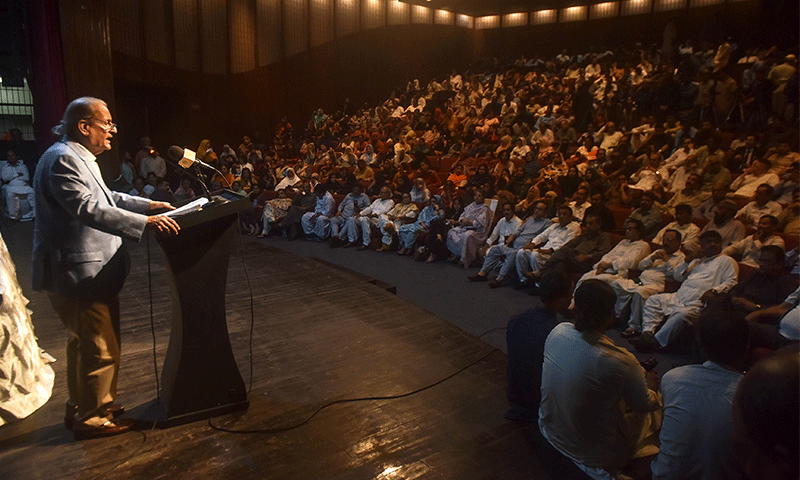
The national workshop on "Biotechnology Training Activities in Allergy Vaccines Development in Pakistan" got under way on Saturday under the joint organization of the Dr Panjwani Centre for Molecular Medicine and Drug Research, University of Karachi, and the Higher Education Commission, Islamabad. The Chairman HEC, Dr Atta-Ur-Rahman, was the chief guest at the inaugural session.
In his keynote address, Dr Syed M Hasnain of the King Faisal Specialist Hospital and Research Centre highlighted the impacts of environmental and biological factors on allergic diseases, airborne pollen grains and outdoor spores as well dust mites, animal fragments as the causative agents of respiratory allergy.
He said that 50 per cent of the prevalent allergies could be related to environmental and biological factors, while the remaining 50 per cent were due to genetic predisposition.
Discussing the types of allergies, he said that anaphylaxis allergy could kill a person, while chronicle asthma had also been a source of concern for patients.
He said that there had been a considerable increase in asthma cases in Saudi Arabia, while Australia and New Zealand had the maximum number of asthma patients in the world.
He said the world's 20 per cent population was suffering from one or the other kind of allergy.
Underscoring the need for research and monitoring of the disease and development of allergic disease-related data, he remarked that India in South Asia, and Iran, Turkey, Malaysia and Indonesia in the Islamic world were making valuable research on allergic diseases.
Pakistan, on the other hand, neither had any meaningful information on prevalence of the disease nor information on prevention guidelines.
He also referred to the affects of pollen allergy in Islamabad but deplored that since scientific basis or relevant data was not up to the mark, it was difficult to say if the paper mulberry allergens were the only reason behind the seasonal increase in allergic diseases in the capital.
He said the quality of airborne allergens or aero-allergens varied from place to place and region to region, and fluctuated with geography, climate, temperature and humidity. As such, the knowledge of regional allergens including seasonal and circadian appearances was extremely important for a proper diagnosis.
The chief guest, Dr Atta-Ur-Rahman, said the workshop was a start in the area of allergic diseases.
He referred to the use of biotechnologies in the fields of health, economics, genetics and environment and hoped that the Panjwani Centre, the first of its kind in the region after India, would go a long way in training highly qualified manpower in the emerging fields of molecular medicines and drug development.
Coming to the efforts of the HEC during the last about three years, Dr Atta said the Commission was bringing a silent revolution in the higher education sector and the momentum in the field would ultimately become irreversible.
He said the government would earmark about Rs16.3 billion for development expenditures in the higher education in the coming budget, in addition to making an increase of up to Rs15 million in the recurring budgets of 60 universities of the country.
While mentioning that no true poverty alleviation could be brought about in the country without ensuring quality education among the masses, he emphasized introducing specific programmes and paying attention towards training of young scientists.
The Vice-Chancellor of KU, Dr Pirzada Qasim Raza Siddiqui, lauded the efforts of the organizers of the week-long national workshop for making it an occasion of bringing experts in the field of allergies and biotechnology under one roof.
This workshop will help young researchers to learn from the experiences of seniors, he added, saying that there was a great need for undertaking researches in allergies.
He also called for developing an allergy society or group in the country and urged the government to provide further facilities to scientists working in the field of allergy medications.
He said that allergic conditions and their diagnosis, and research and development of technologies were vital aspects, which should be taken up well during the workshop.
Dr Iqbal Chaudhry, the Acting Director of the ICCS, and Dr Anwar Waqar, the organising secretary of the workshop also spoke.