0
0

Our pattern of budget-making
SUCCESSIVE governments in Pakistan have tended to use the annual budgets to gain political mileage rather than promote any particular economic plan or strategy. The present incumbent is no exception to this questionable practice. Year after year, governments have used budget documents to make grandiose promises, knowing very well that the country had neither the financial wherewithal nor the human resources to deliver on these promises. Take, for example, the present military-led government’s announcements from day one that it was allocating more resources to the power sector than before to narrow the widening gap between demand and supply. But in seven years it has succeeded in adding only about 10 per cent to the installed capacity that had existed in 2000 against the estimated annual average increase in demand of eight per cent. Similarly, it has been talking all these years about allocating billions to the drinking water sector. This claim has been partly belied by the current countrywide outbreak of gastroenteritis, a disease directly linked to the drinking of non-potable water. Despite tall claims year after year of a massive increase in the allocation for the social sectors, the state of the health and education sectors remains precarious. Indeed, the list of broken promises and distorted policies is very long, and the man in the street has stopped taking pre-budget promises seriously.
There are, of course, many reasons for the relegation of the budget-making exercise to the level of petty political games. But the utter lack of accountability of this exercise at the level of parliament is perhaps the most serious one. In many other countries, a special parliamentary committee starts interacting with various stakeholders immediately after the announcement of a new budget to find out what the people are thinking and what they want in their next budget. Then the ministries start sending their proposals to the finance ministry at least six months before the finalisation of the budget.
Parliament debates the measures for at least four months before putting its seal of approval on the budget. Strong and capable committees enable the legislature to develop its expertise and play an effective role in budget decision-making. Legislative budget deliberations last up to 75 days in India. In Germany, it takes four months, and in the US, even longer. The legislature and its committees have access to independent expertise for proper scrutiny. In India, for example, parliamentary committees are supported by secretarial functionaries; the US Congress benefits from the competent staff of the appropriation committees as well as the services of the congressional budget office, and is assisted by the general accounting office with audits and an information programme on compliance and performance. In Germany, the budget committee interacts with government departments through regular departmental briefings and expenditure reports. But in Pakistan, despite having no access to such expert help, our legislators are called upon to approve of the budget within two weeks with almost half a week wasted because of quorum problems. That being the extent of scrutiny of the budget documents by parliament, it is hardly surprising that the executive feels no qualms about using them to delude the teeming millions condemned to a life of subsistence.
Factors behind the rally
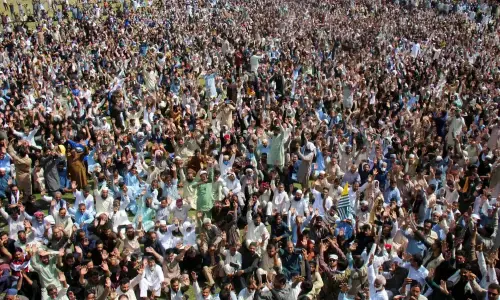
FRIDAY’S rally in Karachi, organised by the Pakhtun Action Committee, succeeded in bringing life in the city to a standstill, but whether it accomplished any of its goals will depend on how the city administration will address the issues at stake. It is unfortunate that an aggrieved party — be it political or ethnic — feels that the only way to draw attention to its problems is by paralysing a city and causing the kind of disruption and chaos that was witnessed on Friday, with people locked in a traffic jam for hours on end. Yet for a senior police official to say that they were unaware of the rally must be something of a joke, for permission for the rally had been granted some time ago and its route was known to all. Better traffic management too could have made some difference, but the traffic police were nowhere to be found. While every aggrieved group has its right to protest in a peaceful and orderly manner, that was not the case on Friday. For the future, the city administration must chalk out realistic strategies to ensure that such events do not disrupt everyday life. This can be ensured by giving organisers of protest rallies specific routes in each case and requiring them to stick to these and avoid spill-overs and widespread disruption.
As for Friday’s rally, its aim was to highlight the Pakhtun community’s grievances in Karachi — from the recently announced decision to keep smoke-emitting, noise-making vehicles and rickshaws off the road to demolishing katchi abadis; from the transporters’ complaints of police harassment to non-admission in Karachi colleges. How strong the grievances on these scores are, were brought to the fore by hundreds of thousands participating in Friday’s rally, accusing the government and the local administration of the discriminatory treatment being meted out to them in such matters. Whatever the truth of such allegations, it is important for the provincial government and the city administration to look into their grievances and take remedial action where called for. Unless done so, this kind of resentment could lead to a volatile situation reminiscent of the ethnic violence Karachi had witnessed in the 1980s and 1990s. It is imperative that the administration take every group’s concerns seriously into account so that no particular ethnic group feels discriminated against.
Another conviction stunt
THE conviction of Sgt Santos Cardona, who was found guilty of using his dog to intimidate a detainee at Iraq’s Abu Ghraib prison, can hardly be seen as a victory for the proponents of human rights. Acquitted on other serious charges, the US soldier was sentenced to three months of hard labour by a military court, but escaped imprisonment unlike some of his other colleagues involved in the prison scandal which broke in 2004. So far, 11 members of the US military have been convicted for their role in the torture perpetrated on prisoners in Abu Ghraib, but, for the most part, their sentences — ranging from demotions to imprisonment — have been light. The process of justice has been flawed throughout. While junior-ranking members of the US army have been convicted, the military top brass has been exonerated of any wrongdoing. That the senior commanders had no idea of what was going on in Abu Ghraib, flies in the face of reality and is contrary to the statements of junior officers that the army high-ups were also involved.
Abu Ghraib is not the only area of concern. American military officers routinely employ abusive interrogation tactics against suspected militants held in Guantanamo and at the detention facilities of Bagram air base in Afghanistan. Although international pressure on the Bush administration to rein in its military personnel is growing, Washington seems to be least bothered by its worsening human rights record in the war on terror. While it is inconceivable that Washington will rectify the situation in the near future, it can prevent further damage to the military’s reputation by strengthening the process of accountability and cracking down on all errant officers, regardless of their rank.
President’s re-election: legal aspects
IT may be recalled that the last general elections in Pakistan were held during the fourth quarter of the year 2002. The Constitution of Pakistan prescribes that the life of an assembly, whether provincial or national, is five years from the date of the first meeting of such an assembly. On the completion of its tenure an assembly stands automatically dissolved. While the term of an assembly may be cut short by dissolution, according to one or other provision of the Constitution, its term cannot be extended.
There is, however, an exception in the case of the National Assembly of Pakistan whereof under Article 232 (6), it may, by federal law, be extended while the proclamation of an emergency is in force. Such an extension itself is not to exceed a period of one year and in no case may go beyond six months after the proclamation has ceased. It, therefore, follows that the tenures of the five assemblies, one national and the other four provincial, may, from time to time, differ.
In practice, however, these have rarely failed to synchronise because at no time has the term of the National Assembly been extended nor — where the National Assembly has been prematurely dissolved — have the provincial assemblies escaped the same fate. The president in office has ensured that his counterparts (governors) in the provinces follow suit by dissolving the provincial assemblies as well.
The aforesaid assemblies together with the Senate constitute the electoral college for election of the president whose term in office is a period of five years from the date he enters upon the presidency [Article 44 (1)]. By and large, therefore, the scheme of the Constitution has been and remains such that, thereunder, the election of the president is to follow the general elections in the country. This, again, is not an inflexible rule because, at times, the office of the president may fall vacant before the end of the tenure as in the case of General Ziaul Haq who died in an aircrash.
The event occurred on August 17, 1988. As envisaged by the Constitution the chairman of the Senate, Ghulam Ishaq Khan, took over as acting president. Because the assemblies already stood dissolved, the general elections, as scheduled, were held in November, 1988. This, in turn, led to the regular election of Ghulam Ishaq Khan as president but only after the electoral college had been put in place. In August 1990, Ghulam Ishaq Khan, following his mentor, General Ziaul Haq, dismissed the Benazir Bhutto government and cut short the life of the National Assembly with a predictable onslaught on its provincial counterparts.
The ensuing national elections threw up the government of Mian Nawaz Sharif. The next general elections took place against a similar background, but with a difference when President Ghulam Ishaq Khan and Prime Minister Nawaz Sharif had to go simultaneously. This transpired in 1993 upon their mutual understanding, following the restoration of the dissolved National Assembly by the Supreme Court of Pakistan. The National Assembly, upon compact between the said incumbents, was yet again dissolved, but this time on the advice of the prime minister.
The Senate chairman, Wasim Sajjad, took over as acting president and a caretaker cabinet was appointed. Premature general elections were held and, the requisite electoral college having been inducted, a new president, Farooq Ahmed Khan Leghari, emerged on the scene. As inevitable in Pakistani power politics, he and Prime Minister Benazir Bhutto (second term) soon fell apart and President Leghari, once again resorting to Article 58(2)(6) of the Constitution, prematurely dissolved the National Assembly (1996).
At this stage, a smaller bench of the Supreme Court, as distinguished from the full court on previous such occasions, heard the petition of the prime minister. The bench was constituted and headed by Chief Justice Sajjad Ali Shah. Justice Sajjad Ali Shah who had dissented on the restoration of Mian Nawaz Sharif on the previous such occasion, inter alia, on the grounds that a prime minister hailing from Sindh was not restored but that the one from Punjab was being accorded relief, himself did not restore the same prime minister from Sindh.
There is a lesson here: the full court needs to frame rules whereby, in high profile political cases, as conventional before this occasion, the full court itself and not a mere full bench addresses and decides the issue. The US supreme court never works in benches and always as a full court, thereby ensuring consistency in adjudications, on the one hand, and obviating the administrative discretion of the chief justice on the other. Be that as it may, upon fresh general elections Mian Nawaz Sharif once again became prime minister, and soon President Leghari and Prime Minister Nawaz Sharif were at loggerheads.
Apprehending that once again the president would resort to dissolution, the government and the opposition parties jointly engineered a constitutional amendment whereby from Article 58 (2) (b), paragraph (b) was deleted, shearing the president’s power to dissolve the National Assembly and to remove the prime minister. Collaterally, a petition was pursued in the Supreme Court. Once again, not the full court, but a smaller bench, headed by the same chief justice as above, took up the petition.
At this time, Prime Minister Nawaz Sharif was more entrenched. A bench of the Supreme Court, sitting in Quetta, chose to throw down the gauntlet. There are background stories about the event but that need not detain us. Another bench of the apex court, sitting in Peshawar, followed suit. A revolt or at least a virtual revolt by the majority of the Supreme Court judges surfaced. Parallel proceedings in two competing benches, one of 10 judges and the other of five, each of the Supreme Court, ensued. An attack on the smaller bench headed by Sajjad Ali Shah was ex facie sponsored by the federal government.
The larger bench, questioning the out-of-turn appointment of Sajjad Ali Shah as chief justice, declared the appointment to be illegal and the office of chief justice to be vacant. This they did by following the earlier Al-Jihad case which had recognised the principle of legitimate expectancy of senior judges for all judicial promotions in the superior courts but, apparently to save Chief Justice Sajjad Ali Shah, deferred the aspect of promotion as chief justice of the Supreme Court to a future date.
Following a declaration of the said 10 judges’ bench that the principle of legitimate expectancy applied equally to the office of the chief justice of Pakistan, Justice Sajjad Ali Shah was sidelined but continued as a judge of the court. Correspondingly, because President Leghari and Justice Sajjad Ali Shah could not muster support of the armed forces both of them were shown the exit, the first upon resignation and the second upon superannuation. Election to the president’s office was subsequently held and Mohammed Rafiq Tarar, a former supreme court judge, and a PML supporter, was inducted in office, midway through the term of the assemblies.
The long and short of the matter is that presidential elections through the electoral college have taken place for the whole of the presidential term of five years and never for the unexpired term of an outgoing president. Likewise, elections to the assemblies as well have been held for full five-year tenures, irrespective of their dissolution before the end of their tenure.
Indeed, there does not appear to be any provision in the Constitution whereby anything other than a full term can be conferred. The only eventuality which seems to have been ensured is that no single electoral college can elect designated nominee(s) of the presidential office twice during its tenure. In other words, an electoral college may elect a president only once during its tenure and not twice over unless a presidential tenure is cut short (by resignation, removal or death) sooner than stipulated and the electoral college is yet to complete its own term. Such situations occurred in the cases of President Leghari, who resigned, and his successor President Tarar. The latter, having continued in office following the military takeover of 1999, was himself eased out on June 20, 2001.
Thereupon General Pervez Musharraf wasted no time in also donning the presidential cap, even though he had already styled himself as chief executive (the equivalent of prime minister) and continued as chief of army staff. Preceding the general elections of 2002, General Pervez Musharraf promulgated the Legal Framework Order on August 21, 2002, whereby a number of constitutional amendments were introduced. Subsequently, when the Seventeenth Amendment was passed by the newly inducted parliament it impliedly took cognisance of the amended version of the Constitution and operated on that base. Quite plainly, our lawmakers had not learned from a similar lapse embedded in the advent of the Eighth Amendment proceeding on the amended version brought about by the Revival of Constitution Order (PO No. 14 of 1985).
Now that the incumbent president as well as the current assemblies will be completing tenures during the last quarter of the year 2007, questions have arisen as to whether the outgoing president can get himself elected by the current electoral college before its lease expires. Concomitantly, those concerned have made it clear that President Pervez Musharraf would be seeking a fresh term. — To be concluded
The writer is a former chief justice of the Sindh High Court and judge of the Pakistan Supreme Court.