0
0

Terrorists strike again
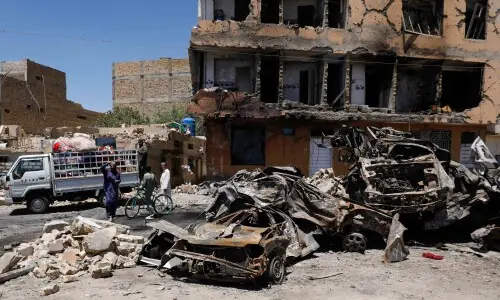
TERRORISTS have struck in Balochistan again, this time targeting the Anti-Terrorist Force in Quetta, killing six policemen and wounding 13 others seriously. The incident took place at Police Training College on Thursday morning when five powerful blasts, triggered in quick succession by remote control, sent bodies and flesh flying. There were two other acts of terrorism also on Thursday: first, saboteurs blew up a power transmission line, cutting off the supply of electricity to three main towns in the Kohlu and Mawand districts, and, then, a Frontier Constabulary checkpost was attacked in the Karmo-Wadha area. While no one has claimed responsibility for the other two attacks, the Balochistan Liberation Army has said that it had caused the blasts at the Police Training College. The victims of Thursday’s terrorist act were all security men, but rebels who have been active in Balochistan for more than a year make no difference between civilians and security men. As facts show, most victims of the blasts at railway stations, crowded bazaars and gas installations have been civilians. So far this year, nearly 90 people, most of them civilians, have been killed in attacks, besides 72 militants killed in shoot-outs with security forces. The worst tragedy involving civilians occurred in the Dera Bugti area on March 10 when a land mine explosion killed 28 people, mostly women and children who were on their way to a wedding.
Balochistan has several justified grievances. It is the country’s largest province territorially and is endowed with a variety of minerals, including gas, cold and copper. It also has a long coastline, which remains undeveloped, and its fishery potential has not been exploited to the advantage of its people. Most of it is desert, but there is scope for agricultural development if water is made available. The rate of literacy is the lowest in the country, and lack of industries has inhibited the growth of a politically-conscious middle class which could fight for Balochistan’s causes. The result is that the social and political scene is monopolised by feudal sardars, most of whom resist development and the growth of a middle class which could challenge their hold on society. The current wave of violence has come at a time when a number of ‘mega’ projects are under completion and some of the sardars are again going through another rebellious phase.
On its part, the government, too, seems to attach more importance to the use of force than to political means for defusing the situation. The recommendations made by two parliamentary committees contained some useful provisions, but nothing is being heard about them anymore. While some sardars may have a negative attitude towards talks and may believe in what they would love to call an “armed struggle”, this is not true of all Baloch leaders. To create a congenial atmosphere for ending the crisis and pave the way for talks, the government could perhaps think in terms of releasing the hundreds of suspects who have been languishing in jail without being tried or any specific charges being made against them. At the same time, those killing innocent people and blowing up gas, railway and power installations should know that Balochistan has no future except as an integral part of the federation of Pakistan. Acts of terror and subversion only undermine the Baloch cause and lose the sympathy of those in the other provinces who sincerely believe that Balochistan deserves a better deal.
Lanka’s hour of reckoning
WITH the military and the rebels engaged in pitched battle, Sri Lankans once again find themselves being sucked into a vortex of violence. Things had started looking up in 2002 when the rebel Tamil Tigers and the government had agreed to a ceasefire brokered by the Norwegians. There was optimism at that time that a peaceful resolution would be found to the protracted civil war which started in 1983 and which has to date claimed more than 60,000 lives and displaced a million people. But while the truce has remained tenuous and has been frequently violated, it is only since the last presidential polls in November 2005 and the election of hardliner Mahinda Rajapakse that hopes of finding a durable solution to the crisis have been dashed. The intransigence of the Tigers, who want self-rule in the north and north-east of the island, seems to have taken a turn for the worse — especially because President Rajapakse opposes Tamil autonomy in these areas. The rebels pulled out of peace talks last month and have since resorted to frequent attacks on army installations. In the latest bout of violence on Thursday, at least 60 people were killed in a suicide attack at sea, following which the military bombed their positions.
The truce monitors are holding emergency talks with the rebels in an effort to stop the violence, but with anger growing within government and among the Tigers, the fear is that their advice will not be heeded. It is unfortunate that in moments of crisis, the broader picture is often lost sight of. Sri Lanka’s economy is in the doldrums and the island is still struggling to recover from the devastating effects of the 2004 Asian tsunami. Unstable political conditions could well delay the billions of dollars pledged by the international community for reconstruction. Moreover, the on-going harassment of ordinary Tamils by security forces and other government personnel will deepen the ethnic divide. Together, these factors will cause long-term instability and violence. Both sides have to recognise this reality and work together at finding a solution to ward off this eventuality.
Adiala visit
A recent surprise visit to Adiala Jail by a parliamentarians’ commission on human rights revealed facts that are hardly surprising but which are deplorable nevertheless. The prison was found to have a capacity to house 1,964 inmates but is currently holding 5,400. The problem of overcrowding is not restricted to Adiala jail, nor is the issue of gross abuse and rights’ violations that prisoners are routinely made to suffer. Only last month, inmates of Adiala had gone on a hunger strike to protest against a ban on sentence remissions as well as against the poor living conditions there. It was their protests that prompted the parliamentarians’ team to visit the prison and warn jail authorities of dire consequences if the situation was not improved soon. But it is unlikely that the parliamentarians’ visit — or their warning — are going to have the desired effect as the jail authorities themselves have a myriad of problems to deal with. They too are understaffed and underpaid. Wholesale reform of the prison system is required.
Numerous proposals have been made to address the issue but most have remained unimplemented. Holding trials on jail premises, for example, can reduce the waiting time for an under-trial prisoner. Properly designed rehabilitation programmes can play a role in ensuring that a criminal goes through a process of reform while in prison. Instead, the vicious conditions amidst which they live turn them into even more hardened criminals. This explains much of the unrest and violence that has been witnessed recently in Sukkur and other prisons. It is hoped that the legislators who went to Adiala will bring up these issues in parliament and a serious attempt made to initiate jail reforms.
America’s game in the Middle East
IT cannot be just a coincidence that every time George W. Bush paints himself in a tight corner a new recorded message of his nemesis, Osama bin Laden, pops up out of the blue to come to his rescue and remind an increasingly sceptical American people that the danger to US security is well and truly scary. Nothing works as redoubtable as this to keep the chimera of ‘war on terror’ alive and kicking.
The latest Osama tape, telecast on Al Jazeera on April 23, perfectly fits into this pattern, especially with Bush sinking, by the day, into the bog of public disapproval of his presidency, especially the mess in Iraq.
Which informs the obvious inference that Bush and Osama are in a symbiotic relationship: both are feeding off each other’s idiosyncrasies and foibles and desperately seeking to stay in international limelight.
But Bush, with his back to the wall, is trying another tack, virtually his last throw of the dice, to stem the rot in Iraq and rally the client states in the Arab world round the American totem on the shibboleth that Iran is hacking away at Iraqi unity and trying to rob it of its Arab character.
On any given day, there is no dearth of Arab states and potentates, from Morocco to Jordan to Oman, ready to oblige the sole pretender to the world’s imperialist throne at the drop of a hat. But Bush is picky and choosy and knows exactly which among the wilful Arabs vassals would measure up to delivering on the chores expected of them.
In this case of a new coalition-building against Iran — Bush’s recurring hangover and prime villain in his ‘axis of evil’ charade — it’s Egypt and Saudi Arabia that are being worked upon to stick their necks out for Uncle Sam in the name of the elusive Arab unity.
The choice of these two major Arab players to act as regional proconsuls of US imperialist power in the Gulf and the Arab world makes sense in more ways than one. These are the two largest Arab states, with assets that can be useful to an American military overstretched in terms of men and material. Egypt has the largest military force among the Arabs, besides being the principal recipient of US largesse outside Israel, the number one beneficiary of American military and economic assistance.
Saudi Arabia, though short in manpower, has the financial clout to cushion the buffeting effects of the Iraqi misadventure on US military budget and the gaping federal budgetary deficit, currently in excess of $400 billion and ballooning all the time.
President Hosni Mubarak of Egypt, ever the most trusted ally of the US, was the first to speak like a Jeremiah and raise the alarm that, in his fertile imagination, the loyalties of the Iraqi Shias were more arrayed on the side of Iran than Iraq. Interestingly, Mubarak’s chest-thumping for Pan-Arabism was done in an interview with the Saudi-owned Al-Arabiyya news channel. He was roundly condemned by the Iraqi leaders of all persuasions, especially Shias and Kurds, for his brazen and snide attempt to further fan the Iraqi sectarian fires ignited by the continued US military occupation of that country.
The American-fed theme of the Iraqi sectarian threat to that country’s Arab character and its overall Arab context, increasingly perceived and articulated by some regional players — not excluding a redoubtable western votary like King Abdullah of Jordan — was picked up by the Saudis, in quick succession to Mubarak. The Saudi foreign minister, Prince Saud Al Faisal, in remarks that made bold headlines in the American and other western media, lamented: “The threat of break-up of Iraq [can be] a huge problem for the countries of the region, especially if the fighting is on a sectarian basis ... this type of fighting sucks in other countries.”
It is obvious that Egypt and Saudi Arabia are being prompted to view the Iraqi slide into anarchy as a sectarian problem triggered by alleged Iranian interference in Iraq. But their espousal of a one-sided and skewed vision of the Iraqi imbroglio fosters only a haemorrhaged version of the Iraqi scene. Neither Mubarak, nor Saud Al Faisal, had the gumption to allude to the stark reality that it’s primarily the fallout from the on-going American military occupation of Iraq that is clouding the Iraqi national horizon and unleashing a divide that wasn’t there before the Americans went into that country.
For Bush, it is a Machiavellian ploy to hold someone else responsible for the mess his myopia has created in Iraq. But pinning the blame on Iran smacks too overtly of his lust for yet more bloodletting in the region, notwithstanding the carnage that goes on unabated in Iraq because of the American presence there.
For an American policy to transform the Gulf, in its totality, into an American lake and dominate its political and economic spheres without a challenge from any regional player, it makes eminent sense to point the finger at Iran for Iraq’s widening sectarian divide. The drums of American propaganda against Iran’s nuclear ambitions beating incessantly, have failed to stir a sympathetic chord among the Arabs because of Israel sitting over a huge arsenal of nuclear weapons; every child on the Arab street is aware of which powers helped Israel become a nuclear power on the sly. So the Washington neocons are now wielding the Iraqi sectarian card and hoping that the Arabs, predominantly Sunnis, would bite the bait. They may have good reason to feel elated that major players like Saudi Arabia and Egypt have fallen for it and seem inclined to play along the US guidelines. There is a history of the Arab knee-jerk reaction to an Iranian ‘threat’ howsoever unreal.
Back in the early ‘80s, when Saddam was unleashed against the Iranian revolution in the hope that the danger from a rejuvenated Iran would be nipped in the bud, the oil-rich Arab states of the Gulf were induced to create a defensive forum of their own. The Gulf Cooperation Council (GCC) was born and baptised to stand on guard against revolutionary Iran and, also, against an unreliable Iraq under Saddam Hussein. The Gulf potentates, with their pockets bulging with oil wealth, were encouraged to lubricate Saddam’s war machine with petro-dollars in the hope that both combatants would drain out one another’s strength, thus taking the sting out of the ‘threat’ they posed to the wealthy Gulf states.
But there was also a strong undercurrent of sectarian prejudices prompting the Gulf Arab rulers to bankroll Saddam’s war against Iran: he was perceived as fighting the war on their behalf too in order to prevent the Shia Iran from dominating them. The Saudis, the Kuwaitis, the Bahrainis, with a heavy admixture of Shias in their demography, felt compelled to hitch their wagon to Saddam’s in order to roll back a possible Iranian ideological and sectarian onslaught.
The ground realities remain unchanged for these Gulf rulers. Half of the Kuwaiti population is of Shia origin and hails from Iran. More than 70 per cent of Bahrainis are Shias, with strong emotional and ethnic ties bonding them with Iran. The oil-rich eastern coast of Saudi Arabia, where all the mineral wealth is located, is predominantly Shia.
The Iranian influence and clout over the Arab Gulf’s Shias has manifestly increased since the end of the Iran-Iraq war. GCC has failed to contain the ‘menace’ of either Iran or Iraq; after a quarter century of its founding, it remains at best a pompous club of potentates as much at sea about either of their two perceived adversaries as they were at its birth.
In fact, George W. Bush’s Iraq caper, and his unrelenting brinkmanship against Iran, has enormously helped bridge the gulf that Saddam’s aggressive posture vis-a-vis Iran had toiled to aggravate. The Gulf Arab rulers were wrong in betting their money on Saddam a quarter century ago; they would be committing an even bigger blunder by ganging up against Iran at Bush’s bidding.
A policy of keeping Iran out of the Gulf fold serves no interest of the regional countries. The only beneficiary of division in the Gulf on sectarian or linguistic basis would be the hegemonic power that seeks to become its arbiter as much as of the rest of the world. The myopia of the Gulf rulers hasn’t served its peoples’ interest ever since US inherited the imperialist mantle from Britain in the early ‘70s.
For the moment, though, it seems that the Arab Gulf rulers, egged on by Egypt, are content to do exactly as told. The Arab League, which had shunned much contact with the Shia-dominated interim Iraqi government of Ibrahim Jaffari, has decided to reopen its office in Baghdad. A Moroccan diplomat has arrived in Baghdad to head the League office. Several Arab countries, which had thus far refused to oblige the Iraqis with their diplomatic presence in Baghdad, are believed to be rushing in with staff to reactivate their diplomatic missions.
But a much bigger American bait that Arab countries seem ready to swallow is their apparent willingness to agree to deploy an Arab peacekeeping force in war-torn Iraq.
US Vice-President Dick Cheney had made a special foray into Saudi Arabia, Egypt and Jordan earlier in January this year to coax them into forming an Arab multinational force in Iraq in order to relieve the hard-pressed Americans. The formation of such a force, largely led by Egypt as its biggest component, is now being touted as a possibility under the Arab League banner. The Iraqi government may accept an Arab force minus soldiers from the neighbouring countries.
All indicators suggest that Bush is about to rope in his Arab allies into his plan to isolate Iran in the region and pull his chestnut out of the fire with their help. Rich Arabs of the Gulf have never had much courage to resist succumbing under pressure. History is repeating itself. But the Arabs made a farce of themselves when they fell sfor Saddam’s offensive a quarter century ago; it would be a tragedy for them to be blinded by Bush’s imperialist ruse. Some people never learn from history, not even from their own blunders.
The writer is a former ambassador.
The intelligence failures
THE British government’s account of the London bombings does not compete with the size and scale of America’s national commission on 9/11. Yet for all the familiarity of the events the two documents describe, they pack the same sickening punch.
Each starts with a terse account of an ordinary day in a great city — a cloudless eastern seaboard autumn day in New York, an unsettled and showery summer one in London. Each meticulously tracks the timings as the undetected terrorists make their way towards their unsuspecting victims, normal people starting a normal day’s work, some of them about to join the killers on a final journey.
But at this point the rush-hour banalities suddenly give way to the sum of all modern fears. In the space of a few minutes, all four bombers killed themselves, taking 52 others with them and causing 700 injuries. An attack of some sort was not unexpected, but the form of it caught the authorities by surprise.
The account published by the Home Office on Thursday tells the British people something about how all this happened. A separate report from the Commons intelligence and security committee also tries to answer both how and why. Both reports are conscientious and significant. Yet there is no point to the reports if all they do is send a shiver down the spine as we read and remember last year’s dreadful deeds.
The purpose of such reports is to draw lessons and point to ways of improving the public’s safety. In this respect neither report is entirely satisfactory. Each report leaves important questions hanging in the air. Each report tells a story of serious official failure.
The failures were particular and general. Two of the 7/7 gang, Khan and Tanweer, were known to the security services. Both had visited Pakistan for extended periods in the months before their suicide mission.
—The Guardian, London