Defence vs development
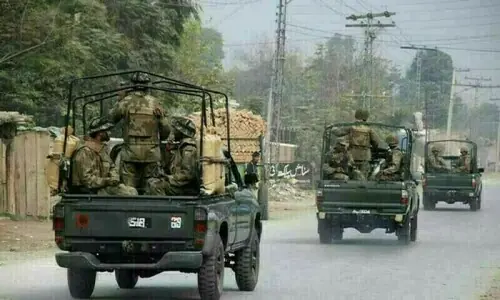
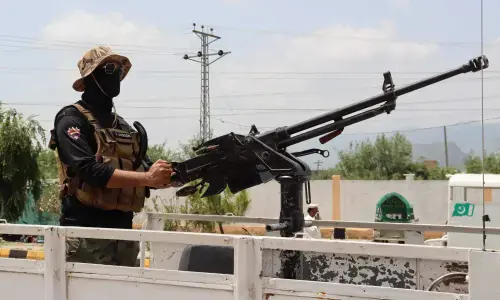
THE government has traditionally adopted an ambiguous stance on its defence budget. While it has reaffirmed on different occasions that it will not enter into an arms race with India, it has also not been very categorical about committing itself to cutting down its defence expenditure. From this point of view, Prime Minister Shaukat Aziz’s statement to a visiting delegation of South Asian media persons that the country’s defence spending is gradually decreasing will be well received. Mr Aziz also pointed out that the government’s social sector development spending was growing rapidly. His statement is significant because it indicates that the national leadership is becoming aware of the heavy burden of defence that has been imposed on the country to provide security to the people of Pakistan. This has had a big impact on the national economy since nearly 27 per cent of the federal budget goes towards meeting the defence needs. It also seems that the government has come to see the wisdom of channelling more funds into the social sectors that address the need for developing human resources. Investment in health and education yields greater benefits than military hardware. An educated, skilled and healthy society ensures economic progress, political stability and the social development of the people, which guarantee security better than an oversized arsenal.
Given its limited resources, the government can raise its social sector spending only by diverting a sizeable part of the allocations from defence to other areas of national life. Spending on defence accounts for 4.4 per cent of GDP while education gets only 1.8 per cent and health even less at 1.1 per cent. One hopes that this ratio will change in the next few years as the balance shifts in favour of human resource development. While no one disputes the need to educate the people and give them a better life, it is also felt that the factors that had fuelled Pakistan’s defence drive are gradually melting away. With the national defence being India-centred, it was natural for the size of our arms budget being contingent on the state of relations with India. When the two countries were locked in a state of mutual hostility, they were inevitably drawn into an arms race. Now that the two countries are engaged in a composite dialogue and tensions between them have been abated, it is felt that they can lower the level of their military preparedness. Islamabad has said a number of times that its military strategy is founded on the doctrine of minimum deterrence. This is a sensible approach since a country does not need a big stock of nuclear weapons for defence purposes. Even a few of them give a country an overkill capacity that is not really needed.
It is also important that governments should develop their foreign policy strategy in such a way that they do not have to take recourse to war and military weapons for security. Through skilful diplomacy and economic and trade relations states are known to better protect their strategic and geopolitical interests. The main disadvantage of using force or adopting the technique of sabre-rattling and brinkmanship is that a government can lose control over events destabilising an entire region. This is a dangerous scenario especially if it is remembered that weapons of mass destruction are not the preserve of a handful of nations. That is why it is felt that there is no need to develop such weapons on a big scale except for deterring a potential enemy.
Oil price hike
THE increase in the prices of motor spirit, hi-octane, kerosene oil, light diesel and diesel by between 2.5 and 7.17 per cent announced the other day for the 15-day period from May 1-15 indicates that the government has succumbed to pressure from the oil marketing companies to raise petrol prices. A spokesman for the Oil and Gas Regulatory Authority (OGRA), which now determines oil prices and not the oil companies themselves, has been quoted as saying that the government will still bear a loss of two billion rupees despite the increase in prices. Presumably, this relates to the fact that oil prices in the international market are very high and there seems to be no indication that they may fall in the short run. The spokesman further said that since May 2004, the government had borne a loss of Rs 66 billion on this count, by not raising prices in proportion to the increase on the international market.
Two major questions can be asked in response to the price increase. The first relates to the government’s oft-repeated claim that it has been bearing a loss by keeping domestic oil prices in check. How can this be reconciled with the fact that on every litre of petrol, the government places a petroleum development surcharge, sales tax, excise duty and an ‘inland freight equalisation margin’ which reportedly all add up to over Rs24? This means that over 40 per cent of the price of a litre of petrol that a consumer pays goes into the government’s coffers. How can it then claim to have suffered a loss of revenue of Rs66 billion? Or is this what the government would have earned if it were not to lower its petroleum development surcharge, whose imposition is questionable in any case? The other point of concern is that petrol price increases disproportionately affect those with lower incomes and are also a major cause of inflation since petrol is used in most industries as a fuel and for transportation. At a time when the government is speaking of controlling inflation and fighting poverty, increasing the price of a basic necessity such as petrol, which is already heavily taxed, defies logic.
Plight of women councilors
WHILE the NWFP is not exactly known for encouraging its women to participate in any kind of public activity, much less one that involves administrative decision-making, it is a matter of shame that some women councillors in Dir have been stopped from performing their duties. It is even more appalling that the male relatives of these women attend council sessions on their behalf. Apparently, the local political and administrative leadership is responsible for this and provincial authorities are not bothered by this situation. All along it has been an uphill struggle for women there who have been actively prevented from participating in local politics. Most are not allowed to cast their vote during polls and those aspiring to positions in the administration are forcibly stopped from filing their nomination papers. Even the representatives of liberal political parties have often colluded with the local leadership to prevent women from taking part in polls — both as voters and candidates.
The law is certainly on the women’s side and the judiciary has censured moves to obstruct women from participating in elections. The media and the NGOs, too, have condemned efforts to keep women away from the political process. But all this seems to have fallen on deaf ears as the local administration in various districts of the NWFP continues to follow regressive norms that restrict the presence of women in public life. Sadly, this marginalisation of women is apparent in other areas of national life as well, and the NWFP has some of the worst human development indicators for women in the country. These are not likely to improve unless there is female involvement in decision-making and women councillors are allowed to perform their duties without let or hindrance.
Nature of resistance in Iraq
ONE day last October, police responding to reports of a disturbance at an army recruitment centre near New York’s Times Square were confronted with an unusual spectacle. Young anti-war protesters — the usual culprits — were hardly in evidence.
The troublemakers weren’t even middle-aged. They were all women, and they were mostly in their 80s. One was 90. They were doing their bit for the nation by blocking the entrance and insisting that they be enlisted rather than young men.
No, of course they weren’t serious — about enlisting, that is. They were members of a group called Grandmothers Against the War, and they were deadly serious about making their point. They refused police requests to disperse and were taken into custody, along with their canes and walking frames.
The grannies’ case was taken up by a prominent civil liberties lawyer, Norman Siegel, who won them an acquittal last Friday. Joan Wiles, who set up the group two years ago, commented after the verdict: “Our goal was to put the war on trial, and I think we did that. Mission accomplished.”
The last two words were a conscious echo of George W. Bush’s premature declaration of victory three years ago this week, when he flew in a fighter jet to an aircraft carrier anchored offshore and announced: “Major combat operations in Iraq have ended.” In fact, they hadn’t even begun. “When Iraqi civilians looked into the faces of our servicemen and women, they saw strength and kindness and goodwill,” noted the president. Fallujah and Abu Ghraib still lay ahead.
“We’ve begun the search for hidden chemical and biological weapons,” Bush announced, “and already know of hundreds of sites that will be investigated.” Not long afterwards, the weapons ceased to be an issue. But not before Bush was able to declare — about four weeks after his warship peroration on May 1, 2003 — that “we have found the weapons of mass destruction”.
These were the same trailers that Colin Powell had described as mobile biological warfare laboratories in the run-up to the war. Unfortunately for Bush, a team of US and British weapons experts had examined the trailers and concluded that they were unrelated to biological or chemical weapons. As the White House admitted last month, their findings were communicated to Washington two days before the president’s contrary pronouncement. And Dick Cheney was still claiming several months later that the trailers may have been used to manufacture anthrax.
Back on the warship, Bush also described the “liberation of Iraq” as a “crucial advance in the campaign against terror”, saying: “We’ve removed an ally of Al Qaeda and cut off a source of terrorist funding.” Cheney and some of the more obdurate hawks continue to imply that Osama bin Laden and Saddam Hussein were somehow in cahoots, but not many Americans take them seriously any more. What does deserve attention is the US state department’s assessment, in a report released last week, of Iraq’s potential as a save haven for terrorists.
Bush may no longer be quite the same president who strutted on the aircraft carrier in combat gear three years ago, but a far more drastic change has occurred in the way he is perceived by many of his compatriots, pushed along by a widening recognition that the nation was led into war on the basis of false pretences. Calls for the resignation of Donald Rumsfeld have followed in the wake of the defence secretary being publicly taken to task by a string of retired senior military officers. The White House organised a riposte by another bunch of ex-army types, but it failed to produce the same effect.
It’s possible that the attacks on Rumsfeld are intended as indirect critiques of the commander-in-chief. If not, then they aren’t entirely fair: Rumsfeld undoubtedly has a great deal to answer for, but so do a host of others, including Bush, Cheney, Powell, Condoleezza Rice and Paul Wolfowitz.
Unlike Saddam, it is highly unlikely that they will ever be queried about their crimes and misdemeanours in a court of law, so a trial in the court of public opinion wouldn’t be such a bad idea. Something of that sort could follow the congressional elections later this year, if the Republicans perform abysmally. But that’s an improbable outcome: foreign policy doesn’t figure among the leading concerns of most voters; besides, the Democrats have hardly distinguished themselves as opponents of the war. Rising petrol prices, on the other hand, are another matter.
However, Iraq isn’t going to go away — hence the ongoing efforts at damage control. Lately these have included a joint Condi-Rummy mission to Baghdad after a very public falling out between the two senior members of Bush’s inner circle. After Rice noted that the US had committed loads of tactical errors in Iraq, Rumsfeld bluntly — and possibly misogynistically — responded: She doesn’t know what she is talking about. That, of course, is a criticism that the defence secretary himself has been open to for many a year.
The joint foray into the Iraqi capital was ostensibly intended as a goodwill gesture towards Nouri Al Maliki after Ibrahim Jaafari finally made way for a successor as prime minister. The new incumbent probably could have done without such an unsubtle reminder of what is arguably his biggest problem: that for as long as occupying armies remain on Iraqi soil, his government cannot be perceived as anything other than a puppet regime. Yet the very idea of their withdrawal poses an existential dilemma for the administrative edifice erected under occupation: it may not survive without the props supplied by the Pentagon.
The resistance in Iraq is, of course, intimately linked to the foreign presence. It may be simplistic to suggest that it will somehow melt away as soon as the Americans and their allies pack up and go home, although chances of peace returning to Iraq are considerably smaller for as long as they stick around. In recent months the question of whether the situation in Iraq could be described as civil war has been hotly debated. There can be little question that efforts to foment violence between Sunnis and Shias have met with some success: there have been reports of Shia death squads operating out of the interior ministry, as well as instances of ethnic cleansing. There have also been suggestions of rifts between indigenous Sunni insurgents and foreign combatants supposedly associated with Abu Musab Al Zarqawi.
A comprehensive report in The Washington Post over the weekend describes how American officers responsible for recruiting, training and supervising Iraqi policemen and soldiers can never be sure — particularly in Sunni-dominated areas — whether they are dealing with friend or foe.
Meanwhile, the fissures that could result in a three-way territorial split continue to deepen. In an interview with the Los Angeles Times a couple of months ago, Zalmay Khalilzad, the US proconsul in Baghdad, admitted that his country’s actions had opened a Pandora’s box, and that the worst-case scenario — a regional conflict that could suck in Iran as well as Iraq’s Arab neighbours — “would make Taliban Afghanistan look like child’s play”.
The grim picture he painted wasn’t accompanied by an acknowledgment that the invasion was an incredibly stupid idea in the first place. Khalilzad was making the case for a long-term US military presence in the region. That’s a bit like saying that if a patient’s condition has deteriorated as a result of being given the wrong medicine, the only solution is to increase the dosage.
The aforementioned Al Zarqawi resurfaced last month via a video release, offering a predictable harangue and displaying flashes of his murderous zeal, not long after there had been rumours of his demotion in the terrorist hierarchy, plus a Washington Post report that quoted US military officers as saying their side had deliberately over-emphasised his faction’s role in the insurgency, thereby helping the Bush administration to portray its efforts in Iraq as part of the so-called war on terror.
Al Zarqawi’s presumed elders in the terrorist hierarchy, Osama bin Laden and Ayman Al Zawahiri, have also cropped up lately in audio/video releases, and while bin Laden’s pronouncements on Palestine sent Hamas scurrying for cover, Al Zawahiri directed his diatribe primarily at Pakistanis, calling on the army to overthrow General Pervez Musharraf.
That provides little cause for surprise or alarm, provided Musharraf has indeed succeeded in purging jihadists from the armed forces. What does provide grounds for consternation and concern is Musharraf’s callous dismissal of civilian casualties in his army’s offensives in Waziristan. In his “I’m nobody’s poodle” interview with The Guardian, published last Friday, he said: “Sometimes indeed women and children have been killed, but they have been right next to the place. It’s not that the strike was inaccurate but they happen to be there, so therefore they are all supporters and abettors of terrorism — and therefore they have to suffer. It’s bad luck.”
That sounds like an Israeli leader trying to explain why Palestinian women and children are being targeted by his nation’s army. Yet it’s not the strangest statement I encountered last week. That honour goes to unnamed US officials who told The New York Times that more than 150 of the detainees at Guantanamo Bay were ready for repatriation to their countries of origin, but there was a hitch. And what, pray, might that be? It turns out the Americans are concerned some of the men might be mistreated if they’re sent home.
That’s right: Uncle Sam can’t bear the thought of them being tortured in a Saudi or Yemeni prison cell. Irony, may you rest in peace.