0
0

KARACHI, April 29: Teachers saw child labour, lack of educational facilities, absence of interest among teachers, lack of awareness among parents and poor vigilance of schools as major hurdles in the promotion of "Education for All” (EFA) in the province.
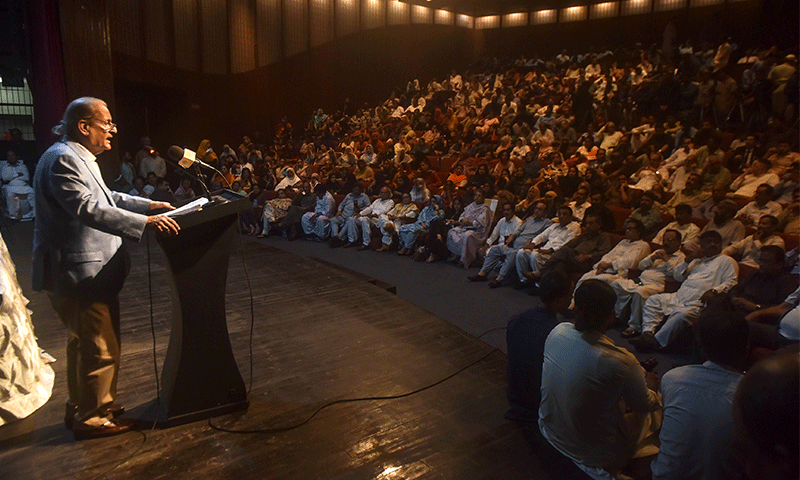
At a "big hearing", organized by the Directorate of Literacy and Non-Formal Basic Education, Sindh, as part of the Global EFA Week celebrations(April 24-30), teachers demanded for placing a ban on child labour in the province. The theme of EFA 2006 is "Every child needs a teacher".
The Sindh Minister for Education, Dr Hamida Khuhro, was chief guest at the ceremony, dedicated to a public reading of dossiers prepared by teachers.
The dossiers pertained to issues and challenges in three levels of the EFA Programme, ie early childhood education, primary education and adult literacy; role of teachers in achieving EFA targets, and what they expected of the community and the government in achieving them.
They said though in their capacity as teachers, they had been motivating parents to send their children to schools and not involve them in income generating activities, the result was not up to the mark, as about 2.7 million children, out of 6.2 million in the school-going age, were out of schools. They stressed the government to put a ban on child labour at the earliest.
A presentation of the dossiers received from 40 ECE, 84 primary education and 55 adult literacy teachers was made during the hearing by the Director of LNFBE, Sindh, Prof Abdul Latif Silro.
For the ECE level, it was said that non-availability of schools, lack of teaching aid, no separate rooms, absence of defined policy, rules and laws, no formal measures to implement ECE, lack of awareness in parents were the main issues that needed to be redressal.
In the case of primary education, it was cited that more and more primary schools should be opened, schools should be changed into community centres in order to ensure effective cooperation, and coordination of community and new and precise courses should be evolved.
If teachers showed interest in their assignments, the dropout rate of students could be controlled, it was observed.
In regard to adult literacy, it was said that appointment of local teachers for literacy centres should be ensured, while the community should also be motivated through awareness about literacy and its importance.
Giving a profile of Sindh’s contribution to the adult literacy and LNFBE, sectors, Prof Silro said a total of 1,509 non-formal education schools were working for 56,000 enrolled students, while 969 adult literacy centres were established during the period from 2001-02 to 2004-05, and about 30,000 illiterates were made literate.
In addition to dossiers, a couple of teachers’ representatives spoke at the hearing and said that teachers and centres were not provided with necessary facilities and teaching aid, while school management committees were also not exploited and allowed to work meaningfully.
One of the teacher said that adult literacy centres were not given due protection making them prone to activities of thieves and drug addicts.
Regular training of primary school teacher was also stressed by one of the speakers.
In her remarks, the Sindh Education Minister, Dr Hamida Khuhro, said that Pakistan prevailed among the category of countries pathetically failing to improve the state of affairs pertaining to education.
“There is nothing to hide the fact that we have failed to excel during the last 50 years in the field of education and literacy,” she added, saying that the government had now realized the importance of education, which was why considerable resources and funds had been diverted for the purpose.
She said the Sindh government was specially focussing on the training of teachers with special emphasis on interactive teaching.
“We need to take care of woman and children literacy simultaneously,” she said, adding that every man, woman and child should be aware of the benefits of education and should be ready to contribute towards the development of he country and Sindh.
She said that child labour was a problem, which was inevitable. As such, she suggested the need for taking education to places where school-going children were busy in earning livelihoods.
She said schools should be used as community centres besides using them as comprehensive education and training facilities for people who fail to get formal education in time.
The Secretary Education, Syed Ghulam Ali Pasha, said under a revised scheme, teachers of non-formal and adult literacy centres would get an increased salary soon.
He said that certification of NGOs working in the field of literacy and non-formal education would be carried out by the Sindh Education Foundation, while certification of institutions involved in teachers’ training was also under consideration of the education department.
Among others, Iqbal-Ur-Rahman from the National Commission for Human Development, Manzoor Solangi and teachers Sajida Parveen, Nilofar Ali and Shagufta Iqbal also spoke.
Prior to the meeting, the Directorate of LNFBE organized a literacy walk at Mazar-i-Quaid in the morning, which was led by the education secretary. The EDOs of schools from Karachi, Ghotki and other districts, and a large number of teachers and school students of Karachi also participated.