0
0

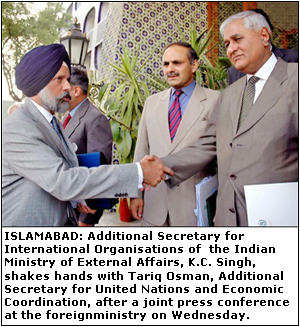 ISLAMABAD, April 26: Pakistan and India on Wednesday wrapped up the fourth round of expert group talks on nuclear CBMs amid optimism that the agreement to reduce risk of nuclear accidents would be finalised during the next meeting of foreign secretaries in July in New Delhi.
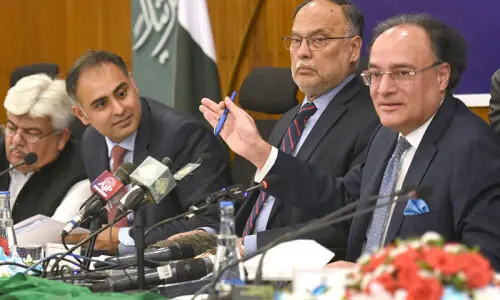
Leader of the Pakistan delegation Tariq Osman Hyder, additional secretary (UN) and head of the Indian team K. C. Singh, additional secretary (International Organizations) both sounded quite confident that they would soon be able to iron out differences on the draft text of the agreement.
“There are some areas of differences which remain but hopefully given the continuing goodwill and flexibility on both sides on this issue we look forward to finalisation of this agreement in the next round or during the foreign secretaries’ meeting,” Mr Hyder said at a joint press conference with his Indian counterpart soon after the talks.
Mr Singh was equally hopeful that whatever differences there were would be narrowed down in the shortest possible time. However, he was somewhat evasive on the question about differences that existed, conveying it was more a matter of having different opinions.
Apparently the differences are not sharp or specific as they were in the case of the missile test agreement when the two sides set out to negotiate it.
Mr Singh told a questioner that the draft agreement being negotiated was basically about minimizing risk from any radiological leak from an accident from either side.
Mr Hyder said in the overall context Pakistan and its leadership attached the greatest of importance to its relationship with India and expert level dialogues on nuclear and conventional CBMs were part of that process. Pointing to the fact that Pakistan and India were both nuclear power countries with weapons, he underlined: “It is important for our own people and the world community in general that we progress on measures of risk reduction and restraint in terms of our nuclear policies as far as possible and capabilities. And this is what we are working towards.”
Mr Hyder said: “It takes some time to negotiate an agreement, nothing is negotiated between any two countries in 48 hours.” He reminded the media that it took three rounds of talks to finalize the agreement on the pre-notification of missile tests. He maintained that although it was the very first round on the risk reduction draft agreement, the progress had been quite rapid.
Mr Singh said the message he brought from India was that the composite dialogue is proceeding well. While referring to CBMs he said these were all stepping stones in that direction.
NO-WAR PACT: However, K.C. Singh parried a direct question on whether India was ready to sign a no-war pact with Pakistan or not, saying that the Indian Prime Minister had gone even beyond that by talking of treaty of peace and friendship. “Lets look at it positively rather than in a negative sense,” he told a questioner as he mentioned the ceasefire that has held and other Kashmir-related CBMs.
When pressed further on the same question, his response in a rather agitated tone was: “My answer is we do not approach relationship with Pakistan from negative parameters. We want to approach it from positive parameters of engagement and friendship.”
N-DOCTRINE: Mr Singh emphatically reiterated India’s doctrine of no-first use of nuclear weapons and no use against any country which did not have nuclear weapons. “Let me assure the people of Pakistan that our doctrine is that India will not be the first one to use nuclear weapons, there is absolutely no danger,” he categorically stated.
His contention was that danger was not from the threat but from an accident and that was precisely what the two countries were trying to take care of by negotiating the risk reduction agreement.
ARMS RACE: Mr Singh disagreed with the view that India had initiated an arms race in the region and asserted: “India doesn’t believe in an arms race and India does not acquire arms for arms race but yes India has security concerns as we recognise Pakistan has security concerns.”
He said every country had the right to determine what its genuine security concerns were and declared: “Our policy is not Pakistan-centric.” Underlining that India was a large country and had its own concerns, he said: “Our concerns are wider than that of Pakistan.”
Mr Hyder said: “We have also conveyed to our colleagues on the Indian delegation that there have been recent developments, particularly this, which could affect the security calculus of South Asia and we would have preferred that this had been done in some other way taking into account both countries.”
However, he emphasised that Pakistan was confident of its deterrent capability. “If there are any reasons to change or review our deterrence levels we would do so,” Mr Hyder said.
CONVENTIONAL CBMs: Regarding the talks on conventional CBMs with India on Thursday, Mr Hyder said Pakistan was looking forward to the meeting, adding: “Our intention is to have a result-oriented dialogue which was in the interest of both the countries.” He pointed out that there were already a number of “good conventional CBMs” with India on the Line of Control. Referring to Pakistan’s proposal for demilitarisation in Kashmir he said: “We will make a proposal for further reduction of threats along the lines which we have already made, some of which have been accepted.”
COMPOSITE DIALOGUE: Mr Hyder said the composite dialogue was proceeding on all tracks and underscored that conflict resolution was the most important issue for Pakistan.
He said: “We believe that the settlement of disputes including on the issue of Kashmir would be one of the greatest CBMs and we are looking forward to progress together on this issue and on all the other tracks in the confidence-building process.”
JOINT STATEMENT: A statement issued at the conclusion of the nuclear talks said: “The two sides held detailed discussions on the draft text of an agreement, the objective of which is to reduce the risk from accidents relating to nuclear weapons, and agreed to work towards its finalisation.”
Both sides agreed to report progress made in the talks to their respective foreign secretaries who would decide the date and venue for the next round of talks on nuclear CBMs, it said.
It noted that the two sides held discussions in a cordial and constructive atmosphere, in the framework of the Lahore MoU of 1999.
Both sides also discussed modalities for further securing the foreign secretaries hotline which has already been operationalised.
It was agreed that future periodic expert level talks on nuclear CBMs would discuss, review and monitor the implementation of nuclear CBMs as called for by the Lahore MoU, the statement said.