A caretaker set-up
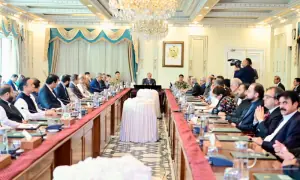
AN acting government to oversee the general election due next year is good news in a country where the sanctity of the ballot paper is no part of the political culture. The 1970 general election was truly fair, and the one in 1988, even though manipulated by the post-Zia set-up to pre-empt a PPP victory, did enable the party to achieve a plurality. Barring these two examples, all elections have been rigged by the party in power or the military. The election in 2002 was manipulated from the word go. A law forbade a person from becoming prime minister a third time, and the government used all its administrative machinery to ensure the Muslim League’s victory. Against this background, Chief Election Commissioner Qazi Mohammad Farooq’s disclosure about an acting set-up for the next general election deserves to be welcomed, though certain questions remain unanswered.
In Bangladesh, where the president is the titular head of the republic, the Supreme Court chief justice heads the caretaker government for organising national elections. After the process ends, the elected government takes over. The result is that a country like Bangladesh, which otherwise has its quota of strikes, violence and political turmoil, has had fair elections. In Pakistan, the problem of a caretaker government is compounded by the kind of civilian-military mix we have. The question is who will head the caretaker government? In all fairness it should be the Supreme Court chief justice. But President Musharraf will still be there with all the administrative powers at his command, and that is hardly likely to make the caretaker prime minister’s or the CEC’s tasks easy. The constitution (Article 224) does provide for a caretaker government, but caretakers in the past have often given a poor account of themselves by straying into other fields such as accountability of politicians on grounds of corruption rather than concentrating on making the electoral process fair and impartial. Indeed, the accountability bogey has often been misused for persecuting political opponents and postponing elections. Ziaul Haq called off the on-going election campaign in 1977 and postponed the polls on the pretext of conducting the accountability of corrupt politicians and used this to perpetuate his tyranny for 11 years as president and army chief.
Let us hope that the acting prime minister and the CEC will go about their job differently. Under Article 220 of the Constitution, it is the duty of all executive authorities in the federal and provincial governments to assist the CEC and EC officials in the discharge of their duties. The caretaker government must ensure that the bureaucracy strictly follows the relevant rules and principles, and any official found to be deviating from these is taken to task. Fears also exist in certain quarters about the role of the local bodies. The majority of nazims and their deputies belong to the Muslim League, and they may be tempted or forced to help PML candidates by intimidating and obstructing rival candidates and stuffing the boxes with fake ballot papers. They can be checked only by the law enforcement machinery provided it stays neutral and helps the EC carry out its crucial task. However, elections will never be considered truly fair if Benazir Bhutto and Nawaz Sharif are not allowed to return home and take part in the process. Between them they represent sizable sections of voters, and denying them their right to elect and seek election would amount to scuttling the very concept of a fair electoral exercise. A broad consensus between the political parties and the government on how the caretaker set should function will obviously help.
People’s victory in Nepal
NEPALESE King Gyanendra’s announcement on Monday night that he will reinstate parliament has been greeted with jubilation by the people who see his capitulation as a triumph for them. A massive protest planned for Tuesday turned into a victory rally as the seven-party alliance spearheading the demonstrations called off the march. Parliament — which was dissolved in 2002, three years before King Gyanendra assumed direct powers — will reconvene on Friday, and the parties’ consensus candidate, Girija Prasad Koirala, will head the new government as prime minister. While the return of normalcy has been widely welcomed, the rebel Maoists, who are in favour of a republic, have called the king’s announcement a “conspiracy”. They have declared that by welcoming the king’s announcement, the 12-point anti-king agreement reached between the rebels and the political parties last November calling for elections to a constituent assembly, had been breached. The Maoists have asked the people to continue their protests and have threatened to impose yet another blockade on Kathmandu and other cities. As against this, the alliance leaders have said that they would work towards a constituent assembly and the inclusion of the Maoists in the political mainstream.
Judging by their reaction, the Nepalese people clearly favour the political parties’ approach. Political violence and economic blockades have taken their toll and most are anxious to get on with their lives and to see a period of development, democracy and good governance in Nepal. While the Maoists dominate the rural areas, given the ruthless tactics they employ against dissenters, it is uncertain how much popular support they command in the country. The recent wave of protests was more an expression of disapproval of the king’s policies than support for the Maoists, who can only weaken their cause by resorting to violence. Working together on the basis of the 12-point agenda, the Maoists and the mainstream political parties can accomplish a great deal for the cause of the people and for democracy — with or without the king. It would be foolish of the Maoists to squander such an excellent chance of gaining political recognition for their goals.
Keeping the beaches clean
IT IS rather tragic that about 300 school children who were due to participate in a beach-cleaning operation in Karachi on Saturday to commemorate Earth Day, were unable to do so because a city government squad demolished a camp set up by the organisers the night before. This callous act deprived the children of attending the closing ceremony in which they would have been recognised for playing a useful role in caring for, and protecting, the environment. The seemingly small task of having children clean the beaches goes a long way to create awareness from an early age about caring for marine environment. It is a worthy campaign initiated by an international conservation organisation. While this year’s Earth Day celebrations were spoiled, it should not deter the organisation from continuing with the beach-cleaning campaign as the response to it was encouraging. Such campaigns instil a sense of responsibility among the young ones who, for example, will be more conscious and conscientious about protecting the marine turtles along the beaches. Those younger to them will take inspiration from their examples and look forward to playing such a role themselves when they come of age. It is an encouraging thing for the city administration provided it does not absolve itself of the responsibility of keeping the beaches clean and not leaving the task to school children alone.
Since the beautification and development process of the city’s beachfront began, there have been scores of more people thronging the seaside for an outing — and this means more pollution. Along with ensuring that the beaches are cleaned on a daily basis — which will create more employment opportunities — the public needs to be made aware of the role it can play by keeping the beaches clean.
The last gasp of a monarch?
IT has been at least 20 days since the people of Kathmandu took to the streets and — surprise, surprise — their revolt against a degenerate, autocratic and anachronistic monarchy remains unlabelled.
A couple of years ago we had the ‘orange revolution’ in Ukraine. Last year, large-scale protests in Beirut following the assassination of Rafik Hariri were dubbed the ‘cedar revolution’. The uprising in Nepal is nameless. Might that have something to do with the fact that it does not enjoy western blessing?
King Gyanendra, who in February last year pulled the plug on Nepal’s 15-year experiment with democracy, initially responded with insouciance to this month’s protests. There was, inevitably, a crackdown, accompanied by the customary police brutality. He evidently assumed that would suffice, once again, to safeguard his reign. If so, he clearly had little inkling of the popular mood. Then, last Friday, after talks with a special envoy from India — and, presumably, diplomatic pressure from other friendly sources — the king offered the mainstream seven-party political alliance the opportunity to name a prime minister.
A prime minister, mind you, who would serve at the sovereign’s pleasure. Nothing more. The alliance’s demand for the restoration of the parliament was ignored. Ditto the even more pressing call for elections to a constituent assembly that could frame a new constitution, thereby deciding the monarchy’s future.
The political parties appear to have realised that renewed participation in the king’s parlour games would render them irrelevant in the eyes of the public. Their acquiescence would have borne out the Maoist rebels’ characterisation of bourgeois parties as ‘anti-people’. That is why they resisted demands to take Gyanendra up on his offer.
Where were these demands coming from? Certainly not from the streets of Kathmandu. The ambassadors of the US, Britain, France, Sweden and Germany visited the home of Nepali Congress leader Girija Prasad Koirala. Her Majesty’s representative in Kathmandu, Keith George Bloomfield, was quoted as saying after the meeting, “We think it is the basis on which we can build and move forward.” The streets, meanwhile, echoed with slogans such as “Don’t ditch the people” and “We don’t need the crown”.
Last November the Maoists, who reputedly control much of the Nepali countryside, and the seven-party alliance reached an agreement, brokered by India, on demanding elections to a constituent assembly. If that could be achieved, the Maoists vowed to abandon their armed struggle, which is said to have cost 13,000 lives on both sides during the past decade. If the alliance had accepted Gyanendra’s nearly meaningless offer, the November agreement would have effectively become redundant, thereby all but guaranteeing an indefinite period of continued bloodshed.
This makes it seem all the more surprising that India joined the US and the European Union in recommending that the political parties humour the arrogant and out-of-touch potentate. But the element of surprise withers away fairly rapidly once one takes into account the blossoming strategic relationship between New Delhi and Washington.
That the US should see the Maoists as a threat to its interests is unremarkable; that this fear should push it into propping up an autocrat, notwithstanding all its rhetoric about democracy, is just another example of its customary hypocrisy. (American ‘security experts’ are said to have been frequent visitors to Kathmandu since the king’s power grab last year.) But it will be profoundly unfortunate if India, carried away by the attention being lavished on it by the US, intends to tailor its foreign policy and bilateral relations with neighbours to American requirements — as Pakistan, to its discredit, has invariably done.
One of the most fascinating aspects of the unrest in Nepal has been the rare but refreshing spectacle of leaders following the people. The loudest slogans raised on the streets of Kathmandu have been calls not for the restoration of democracy but for the end of the monarchy. They are based perhaps on a realisation that the divine right of kings is incompatible with meaningful popular representation. Although the Maoists have been resolutely opposed to the monarchy all along, their influence does not appear to be paramount in the wave of antagonism that has gripped the Nepali capital. In fact, Gyanendra himself is likely to have contributed more to it than Comrade Prachanda, the rarely seen guerilla leader.
Prachanda accuses Gyanendra of having engineered the palace massacre that propelled him to the throne five years ago. It is hard to say how many Nepalis share his suspicions about the grotesque events of June 2001, when an apparently intoxicated Crown Prince Dipendra killed his parents and siblings before shooting himself: Gyanendra was not present in the palace at the time, but his wife escaped with non-life-threatening wounds and his son and daughter were unscathed. The massacre may well have swept away the final vestiges of the superstition whereby Nepal’s kings were literally deified.
Gyanendra’s subsequent behaviour has exacerbated the impression of him as the representative of an institution that long ago outlived whatever utility it might once have had. His son and heir, Paras, is roundly loathed by Nepalis, particularly since he ran over and killed a popular singer — without, of course, attracting any penalties. As things stand, it seems likely that he will be remembered, if at all, as Nepal’s last crown prince.
It remains to be seen how the end-game will play out. The people of Kathmandu are every day defying the curfews announced by Gyanendra’s increasingly precarious regime. At the start of the week, the death toll stood at 15. It must be hoped that nothing reminiscent of Tiananmen Square will be enacted as the angry crowds edge ever closer to Narayanhiti Palace. That will depend, of course, on how quickly Gyanendra realises that the game is up. But he could be involuntarily pushed in that direction if police and military contingents refuse to open fire on their compatriots.
However, even if the transition to a post-monarchical Nepal can be achieved with relatively little bloodshed — which would provide cause enough for temporary euphoria — there are no guarantees that a functioning democracy will rapidly follow. Nepal’s political organisations are notoriously fractious, and while the instability of the democratic phase that followed the 1990 uprising can partly be attributed to royal interference, the squabbling parties must accept some of the blame. If their future attitudes reflect past behaviour, further chaos could ensue.
The people of Nepal deserve better. The economic misery in which much of the country is mired — which is precisely what makes it fertile ground for the Maoists (although coercion also plays a role) — needs to be alleviated through government initiatives and intervention, the feudal structures that Prachanda excoriates in his tracts need to be dismantled. Suitable industries need to be established, alongside tourism.
The task of framing a new constitution through an elected assembly should, of course, go ahead even if the monarchy autonomously completes its self-destruction. The world’s last Hindu kingdom can reinvent itself as a secular social democracy, traversing in one giant leap the vast distance between mediaevalism and modernity.
Where would that leave the Maoist rebels, who to outsiders have often seemed as much of a throwback to a long-gone era as the concept of a god-king? Some of the jargon they employ seems strangely out of place in the 21st century. Last year, for instance, in an interview with Time magazine, Prachanda described ‘Marxism-Leninism-Maoism’ as “a unified science of social revolution of the proletariat, developed through the earth-shaking struggle of the masses”. adding: “The Prachanda Path is the application of Marxism-Leninism-Maoism to the condition of Nepal, and its enrichment also.”
The Prachanda Path reputedly includes the occasional elimination of “class enemies” through brutal means. Such an approach, coupled with heavy indoctrination of recruited cadres, has led to comparisons with Khmer Rouge and Peru’s Shining Path. Some of the Maoists’ rhetoric makes it difficult to picture them as comfortable participants in bourgeois-democratic processes. But that would, in the circumstances, be a sensible move: the war of attrition they have waged for 10 years is probably unwinnable (and perhaps that’s just as well), but the Maoists, sans weapons, can potentially make a useful contribution to Nepali democracy, not least by striving to ensure that the interests of the peasantry are not overlooked.
All that lies in the possible future, however; for the time being, the status quo remains intact even as it continues to be rocked. It was reported on Monday that the US had ordered all non-essential diplomatic staff and their families to get out of Nepal.
One can only wonder whether they’ve bothered to ask Gyanendra if he’s interested in a lift. In fact, he probably doesn’t need one. A couple of helicopters are said to be on standby at Narayanhiti, waiting to whisk the king away. Gyanendra should waste no time in consulting his astrologers about an auspicious moment for making good his escape. If they hem and haw, he should sack them and clamber aboard one of the machines anyway.
There were jubilations in Kathmandu yesterday after Gyanendra announced a further concession — the restitution of parliament — and the seven-party alliance agreed to call off its strike. The Maoists, however, are less than thrilled. More generally, given all that Nepal has experienced over the past three weeks, a return to the status quo ante may not suffice as recompense.
A semi-surrender by the king is not enough. The chopper is still the best way out for him.
Email: mahirali1@gmail.com