0
0

Karachi carnage and after
THE tragic and disgraceful event that happened in Karachi on April 11 was not the first of its kind. The number of persons killed and injured this time was greater than that reported in previous such incidents, but the deed in all of them was the same in nature, springing from the same frame of mind or design. The questions being asked, as in earlier cases, are: who did it, who instigated him, and why?
Security agencies claim to have discovered bits and pieces of the suicide bomber’s body and sent them to a laboratory for DNA tests to compare his blood with that of his relatives for purposes of identification. But since nobody knows who the bomber was, or who his relatives are, the lab will have nothing to compare his remains with, unless the relatives themselves choose to come forward, which is not likely. We may never know who the perpetrator and his instigators were.
Guesses are being offered: one that they are enemies of the Muslim ummah, and their goal is to divide and disrupt it; second, that they are enemies of Pakistan whose domestic cohesion, peace, and order they wish to destroy; and third that they are unfriendly foreigners.
That the bomber and his instigators were enemies of Pakistan is true. It is, however, possible also that they believed Pakistan would be better off without the likes of those whom they intended to kill. The proposition that they wanted to disrupt the Ummah is not plausible, because the Ummah has been divided for several hundred years, and it poses no credible threat to external powers.
Arguing from the premise that a Muslim could not possibly hurt worshippers in a mosque or persons celebrating the Prophet’s (PBUH) birthday, some of the Islamic parties have concluded that the perpetrator of the Karachi carnage and his sponsors had to have been non-Muslim aliens. This is a palpably false premise. Starting with the assassination of the third pious caliph (Usman bin Affan) in 656, history has been replete with instances in which Muslim groups and their rulers fought and killed, one another. In our own time, Iraqi and Iranian Muslims slaughtered thousands on each side during more than eight years of war in the 1980s. Right now it is Muslims who are bombing and killing fellow-Muslims in Afghanistan and in the mosques of Baghdad and other places in Iraq.
The fact that some Muslims are capable of mounting terrorist acts against other Muslims does not, however, preclude the possibility of foreign involvement. Which foreign power might that be? Considering that each incident in which a mosque or a religious gathering is bombed brings embarrassment to General Musharraf’s government, and that the Bush administration regards this government as a vital ally in the war on terror, the United States is not likely to be the foreign power that is fomenting terrorist acts in Pakistan. Could it be India?
Indian officials continue to say that some “jihadi” training camps, that send infiltrators into their part of Kashmir, continue to operate on the Pakistani side, and that the government of Pakistan has chosen not to shut them down. Pakistani agencies, on their part, have alleged from time to time that Indian diplomatic establishments in Afghanistan are funding terrorists in Balochistan. It is hard to say whether official or private agencies in India are sponsoring attacks on religious leaders and mosques in Pakistan.
Even if Pakistani intelligence agencies cannot identify the culprit in each bombing incident, are we to understand that they are also unable to identify the foreign power, if any, that sponsors terrorism in Pakistan? If yes, one must ask what the reason for their existence might then be. On the other hand, if they do know that India is the foreign power involved, have they taken up this matter with their Indian counterparts and, if yes, what has the latter’s response been. Needless to say, in the first instance, each party would deny involvement in the other’s domestic affairs, but on deeper probing some ground for negotiation and give-and-take might emerge. The same goes for Afghanistan if it happens to be the interfering foreign power.
If the theory that Muslims are inherently incapable of killing fellow-Muslims in a place of worship is untenable, as I believe it is, a simple explanation of the event under discussion is at hand, to wit, that it was a case of sectarian violence, resulting from an extremist state of mind that has reached new heights of militancy during the last 25 years. The incidence of violence of all kinds, especially ethnic and sectarian, has increased precipitously in this period of time. It corresponds with the great rise in the number of professedly Islam-related organisations, which are in fact devoted mainly to incidental, peripheral, or ritualistic concerns.
There never was, for instance, the need to set up organisations to defend the “honour” of our Prophet (PBUH) and that of his companions. History has preserved their honour for all times to come, and nothing that anybody may say can detract from it. Considering that most of the Pakistani Muslims are Sunni, and that there cannot therefore be any threat to their identity or rights, it is baffling why organisations such as the Sunni Tehreek and Jamaat-i-Ahl-i-Sunnat have come into being. They have to justify their existence by placing themselves in opposition to other Muslim groups, whose beliefs and practices they denounce. They arouse their own followers to condemn and fight these other groups. They become preachers of hate and spreaders of conflict within the Muslim community.
The Sunni Tehreek, MMA, and other like-minded organisations hold the government of Sindh, and ultimately the federal government, responsible for the massacre on April 11. The government, they say, failed to make adequate security arrangements to protect the gathering. This allegation does not appear to be valid. Governments, it is true, are responsible for maintaining law and order and protecting the persons and property of their citizens. To this end they make the necessary laws, and set up police establishments, courts, and prisons for dealing with violators. But their obligation in this regard cannot be construed to mean that no violation of the law will ever take place.
There is no way the government of Sindh could have ensured that someone carrying a bomb under his clothing, but otherwise indistinguishable from the throng, will not join tens of thousands entering a meeting place, and then detonate it, killing himself and others. Nowhere in the world, not even in Israel, can the police always prevent suicide bombings.
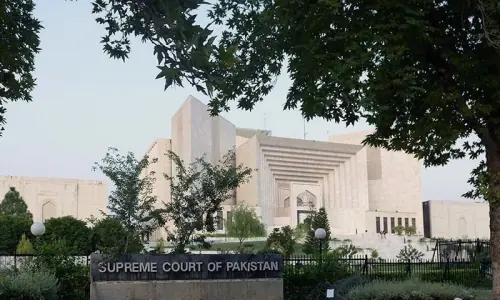
The government has appointed a committee to investigate the incident in question. Critics say the government is not to be trusted and, therefore, the findings of this committee will not be credible. They want a commission, composed of judges of the Supreme Court, to look into the matter. This is not a realistic approach. Judges have a specialised knowledge of the law and its application to specific situations. They may also be able to study the ideological and emotional environment that leads to sectarian violence, as the celebrated commission consisting of Justice Mohammad Munir and M.R. Kayani did while enquiring into the anti-Ahmadiya riots in Punjab (1952-53). But judges are not policemen, and they are not trained to apprehend the perpetrator of a specific crime, his patrons, or co-conspirators.
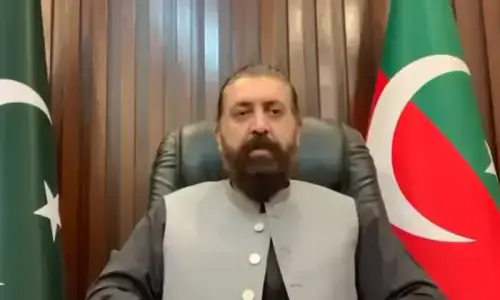
The governor of Sindh, Dr Ishratul Ibad, has announced a “compensation” of Rs 300,000 for the heirs of each one of the 50 or so persons killed at Nishtar Park and financial assistance for the best available medical care for the one hundred or so who were injured. Normally, compensation is paid to an aggrieved person by one who has caused him injury. As a result of offering compensation to the heirs of those killed, the governor may be seen as accepting his government’s responsibility for the event. This is a poor, indeed thoughtless, choice of words on his part, for as I have argued above, the government of Sindh cannot be held responsible.
I should now like to say a word about a related matter, even if it is related only tangentially. The “compensation” and the financial assistance the governor proposes to dispense would easily amount to more than twenty million rupees. How has he come to have this much money and the authority to disburse it? In a government of laws funds at the disposal of a government are provided by the concerned legislature, which also identifies the purposes for which they are to be expended, and all of this is contained in a document called the budget.
Has the Sindh government’s current budget allocated to the governor a sum of money that he may spend as the spirit moves him and, if so, how much and with what rationale? But if that is not the case, or if his discretionary funds do not run into millions, how has he found the money in this case? Could it be that he is directing the provincial finance department to come up with the money and dispense it to certain named individuals?
In that case two questions may be asked. One, does the Constitution allow him to issue such a directive? I don’t think so. Second, does the provincial finance department have a large amount of unencumbered, free-floating, funds in its custody that it may give away to its own, or the governor’s, designees? I should like very much to hear answers to these questions.
My heart goes out to the bereaved families and I have no doubt whatever that such of them as need help should get it. If the helping agency is to be the government, it should have the necessary lawful authorisation and a rationale that will apply to all situations in which the citizen’s life and limb have been jeopardised by someone’s criminal act. If that cannot be done, the Islamic parties, NGOs, philanthropists, and the community at large should find ways of helping out the families of the victims.
The writer is professor emeritus of political science at the University of Massachusetts at Amherst, US.
Email: anwarsyed@cox.net
Conflicts and investment
PRESIDENT Musharraf told foreign investors the other day that the recent explosion in Karachi that caused more than 50 deaths was, in a manner of speaking, a result of our own domestic (sectarian) feud which should cause them no worry about the safety of their lives or businesses. They were making large profits and should persuade more of their moneyed friends abroad to join them.
Gen Musharraf has got it all wrong. That he is in control and hopes to be in power for seven more years to come is not assurance enough. The investors view the situation differently. To them social behaviour in Pakistan is more important than its economic policies. Before staking their money and reputation they look more at the social norms than the political system. Societies in Vietnam, Russia and Eastern Europe have survived the collapse of their ideologies. The world does not have the same feeling about Pakistan for its ideology is undefined and disputed.
The rebel sardars of Balochistan may soon be tamed (though just at the time Gen Musharraf was making such a claim in the chamber of overseas investors, the Pirkoh gas field was blown up) but the social discontent will aggravate for no other bond holds the tribal nomads together. The unrest in Waziristan may last longer because the tribal society there is not ruled by sardars and is far from ready or willing to be absorbed in the national mainstream though it would stay alongside it in order to share its economic benefits.
The Karachi explosion will make little difference to Pakistan’s investment climate. Pakistan’s investment rating in the international community is determined by its constant social and cultural attitudes and religious prejudices. Violence or disorder do affect it but in passing. The same holds true for the bomb blast of April 11 unprecedented though it was in its devastation.
A look at Pakistan’s ranking in the eyes of investors after seven years of “enlightened moderation” should help. For foreign direct investment and an environment conducive to business, the Economist Intelligence Unit has placed Pakistan at number 74 among the 82 countries it surveyed just before the blast. India in this context inevitably comes to mind, despite Gen Musharraf’s new-found loathing to being India-centric. It ranks 24 places above. Malaysia, like Pakistan a state with Islam as its official religion, is 50 places above.
At about the same time, a well-known European consulting company surveyed almost every major city of the world for the quality of living based on criteria ranging from crime and congestion to costs and communications. In this survey, Karachi, Pakistan’s centre of foreign investment, is ranked 171 and, again for many like me who remain India-centric, New Delhi is placed at 150. Kuala Lumpur is rated 75. Sectarian carnage or an insurgency in Balochistan or a Taliban-ruled Waziristan cannot lower these rankings much further.
The reasons for Pakistan being at the bottom of the investment and business league are well known. They are not connected either with democracy or with dictatorship nor with Islam. Ziaul Haq’s Hudood laws did not scare away the investors nor did Nawaz Sharif’s Shariat bill. They were not lured by Benazir Bhutto’s modernity nor are they now by Musharraf’s moderation. What scares them are the unresolved and aggravating social, intellectual and moral conflicts that run deep through the body politic of Pakistan.
It has come to pass that the political forces that were inspired by Jinnah’s vision of an Islamic society with its socio-economic ideals of justice and equality have progressively and abjectly surrendered to the exponents of its retributive justice and meaningless rituals. Just imagine, Jinnah, president of the Muslim League then and Chaudhry Shujaat Husain, president of the same party today, only a generation apart as representatives of the same view of statecraft. No two individuals or parties could be more different.
The growing number of political parties, each with its own doctrines and taboos and distinguished by its own dress code and discipline, has curtailed people’s participation in electoral politics but increased attendance at public rallies marked by passion and angry slogans. Though their combined vote has never exceeded 10 per cent of the total every political party with the official Muslim League in the forefront is out to appease them. Having won over or intimidated most of the rest, the bomb blast has given the Islamic groups a pretext to target MQM, the last remaining secular force that stands committed, and also has the organisational muscle, to stem the tide of obscurantism.
In Musharraf’s politics of moderation all moderate elements — be they the peasants of Sindh or the chieftains of Balochistan — are on the run or in limbo. Only the orthodox groups, now with a tormented image, are free and desirous of supporting his regime. That may give him another term to rule but it still won’t make Pakistan a destination for investors.
For once the religious groups have found their way into the country’s power structure. They can remain in it only so long as mainstream and secular political forces are kept out of it. That is where the interests of the commanders and the clerics coincide. The moderation of one and the orthodoxy of the other will always be subject to this overriding consideration and the society held hostage to it as far as one can see.
Do we need an IMF?
WHAT is the International Monetary Fund for? To its critics on the left, the answer is easy: to foist the harsh discipline of markets on those desperate enough to need its help. If that were true in the past, then it is hardly the case now.
The IMF is in a funk, and its critics are not only the protesters in the streets outside but also the senior figures of international finance in Washington this week for the fund’s spring meeting. Mervyn King, governor of the Bank of England, bluntly addressed the issue when he said: “Certainly, the fund’s remit is unclear. Its lending activities have waned, and its role in the international monetary system is obscure.” This led Mr King to pose the question: “Do we need an IMF?”
The fund, along with the World Bank, was born in the spirit of internationalism in the immediate postwar era, with John Maynard Keynes as its midwife. The fund’s role was to administer the Bretton Woods system of fixed exchange rates and act as a lender to support the framework built around the US dollar. But Bretton Woods collapsed in 1971.
The fund became instead a banker of last resort in the new world of international capital flows. But that role, too, has been difficult to maintain. As private capital flows dwarf the financial reserves of governments, it is a government’s policies rather than its pockets that create vulnerabilities in the modern era. The most glaring example is that of the US, whose financial imbalances currently place the international economy at risk.
The US is also the largest shareholder in the IMF and carries an effective veto over its activities. But other than making pointed remarks, there is nothing the IMF can do if the targets of its advice ignore it.
Meanwhile, the exporting Asian economies, scared by a humiliating crisis in the late 1990s, seek to make themselves invulnerable by building up unassailable foreign currency reserves. As a result, some argue there is no possibility of creating a new, multilateral IMF that can operate effectively. Others, including Mr King and his Canadian counterpart, David Dodge, propose an IMF with surveillance, coordination and “referee” functions.
The IMF’s current managing director, Rodrigo de Rato, has suggested similar prescriptions. But none of these suggestions gives the fund a particularly clearcut role, making it little more than a souped-up version of what it already does.
The best place to begin any reforms is with the fund’s governing makeup. Like the UN security council or the G7, the IMF’s structure is a postwar relic. Voting power is determined by quotas that give Europeans and the US the biggest say. That must change. It is ridiculous that Belgium carries more weight than Brazil, South Korea or India.
That means the US, the eurozone bloc and countries such as Britain will have to concede power, in a redistribution of quotas and executive board membership. It is a hopeful sign that the US and Canada are open to reducing their sway in return for other reforms. Gordon Brown should make clear Britain’s support for such proposals.
But, most important, Europe and the US must end the shoddy carve-up that allows the pair to select the heads of the IMF and the World Bank. It is almost beyond belief that an influential multilateral body should have its leaders imposed in this tawdry manner. Any reforms that do not address this issue would be ludicrous.
If the IMF had greater legitimacy, especially in the developing world, it may yet turn into a robust international umpire and debating forum. But will anyone take notice? This week the IMF made stinging criticisms of US economic policy. The US’s response was to tell the fund to mind its own business. At the time the IMF was born, Keynes himself warned: “There is scarcely any enduringly successful experience yet of an international body that has fulfilled the hopes of its progenitors.” So far he has been proved right.
—The Guardian, London