0
0

YAVATMAL (India): Despite failed crops and mounting debts, the family of Indian cotton farmer Chandrakant Gurenule never believed his suicide threats until he set himself alight and fled their home in flames.
The ambitious 34-year-old bought the latest, expensive, high-yield genetically-modified cotton seeds for his 15-acre (six-hectare) farm in this parched corner of India’s vast rural hinterland only for his crops to fail for two successive years.
He sold the pair of bullocks he used to plough the fields, and told his wife — whose wedding jewellery had already been given to unofficial moneylenders — there was no hope left.
He sat inside his home, doused himself in kerosene and lit a match.
His death on April 1 was one of the latest in a crisis that saw more than 4,100 farmers commit suicide in the western state of Maharashtra alone in 2004, according to a state government-backed report based on police figures.
Desperate and debt-ridden with loan sharks demanding up to 120 per cent annual interest, the failed harvests and tumbling prices have driven businesses to the wall and farmers to suicide.
Officials confirm that the deaths are increasing at a faster rate than ever before in a country that already has the second highest suicide rate in the region, according to the World Health Organisation.
Indian government officials have said more than 8,900 farmers had died in four states since 2001, putting the Maharashtra figure at only 980 as opposed to 4,100 — a number dismissed as far too low by activists.
“In such hostile conditions when there is no ray of hope, the farmer commits suicide,” says Kishor Tiwari, an activist who has documented some 450 suicide deaths in just one part of the state in the last year.
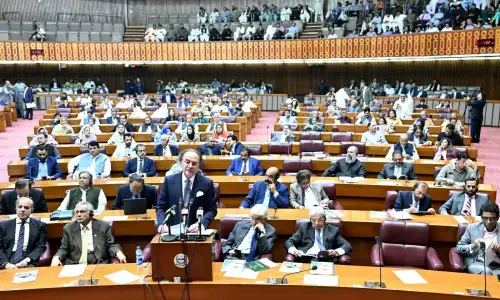
The opposition and even one key group of supporters are piling pressure on the Congress-led government, which was voted in on a pro-poor, pro-farmer ticket in 2004, to take action on the deaths.
Agriculture is essential to the well-being of Indian society as it employs some 60 per cent of the country’s workforce and accounts for a quarter of India’s GDP.
Amid a crumbling and bureaucratic system of providing credit, the government wants farmers to have easier and cheaper options for loans, but these plans have yet to be implemented.
Immediate survival was on the minds of Gurenule’s family at their home in the village of Sayatkhada.
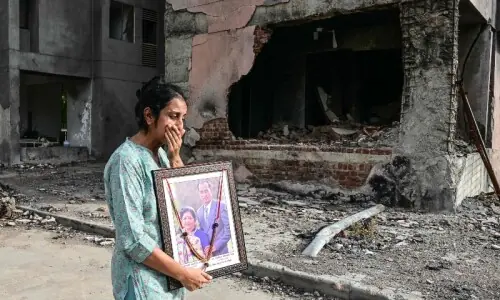
His young widow clutched his framed photograph and their two children while his distraught father Bapurao, 75, sat on the floor and wept.
“I hold my head and I think of him. I have lost him and don’t know what to do now,” he said. “There is nothing we can do.”
Three years ago, the Gurenules, persuaded by their local farm agent, took the first step to move into raising GM crops, and trials gave good results.
They increased the amount they bought the following year, even though the cost of one bag of seed was 1,600 rupees, compared with the 450 rupees they used to pay, but that year’s crop failed because of drought.
So they bought even more as part of a 70,000-rupee (1,500-dollar) cultivation bill. Again the crop failed when it was washed away by too much rain.
“After that, he told us the only way to get out of this was to die. But we never took it seriously,” said his brother Pralad.
They blame nothing other than fate and they must continue farming their land. But with at least 80,000 rupees of debt, they need another bank loan to pay for this year’s seed as planting draws near before the monsoon rains.—AFP