0
0

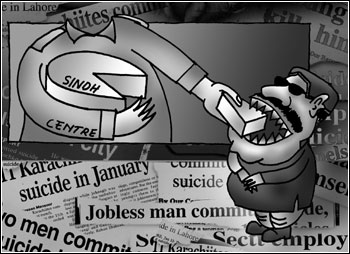 Despite massive spending on development projects during the last five years, Sindh failed to register a dent in high unemployment. Unemploment has actually gone up and the province stands next to Balochistan in this regard while Punjab and NWFP have witnessed a drop in unemployment over the same period.
Estimating employment levels is not easy, more so in Pakistan where records are poorly maintained in most sectors.
The latest government statistics reveal that the rate of unemployment in Pakistan had come down from 8.3 per cent in 2001-02 to 6.9 per cent by January this year. The government also claimed that during the period from July 2004 to September 2005, it has created a record 5.54 million new jobs. This has been possible after huge investment in infrastructure, agriculture, telecommunications, information technology and housing sectors.
According to the Labour Force Survey 2003-04, the overall jobless rate of the country fell by 0.6 percentage points. However, the provinces of Sindh and Balochistan saw an increase in unemployment. The survey revealed that Sindh saw an increase in the jobless rate that touched 5.87 per cent as compared to 5.17 per cent in FY02. In Balochistan the jobless rate increased to 8.38 per cent against 7.60 in FY02.
The unemployment rate in Punjab and NWFP during the period under review declined and stood at 8.52 per cent and 13.2 per cent, respectively.
The Sindh minister for labour, industries and commerce was not available for comment despite repeated attempts by Dawn to seek his views on the issue. But an official on condition of anonymity said that the Labour Force Survey (LFS) was based on sampling that was not a credible methodology. He felt that there some fundamental flaws in the assessment technique. For example, daily-wagers and seasonal workers were braketed with fully employed persons.
“The method of sample surveys may be an authentic method of assessment in the developed countries where literacy rates are high and where results of a survey of 100 randomly selected people may be good enough a measure to get a feedback, but this criterion cannot be applied in our country where people of different areas have different status, literacy rates, values and problems,” the official explained.
An important factor that could have contributed to higher unemployment in Sindh is the ban on government jobs for the last over 10 years. However, this cannot be the key factor as the public sector offers a fraction of new jobs as compared to the private sector.
Pakistan’s total labour force stood at 45 million in the year 2005. Out of this 30.13 million was in the rural areas and 14.87 million in the urban areas. Rural employment is estimated at 27.19 million and employment in urban areas is placed at 13.41 million in 2005. According to the survey, the country’s total unemployed labour force was estimated at 3.84 million in 2005.
The province-wise data showed a wide variation in female economic participation, with the highest rate in Punjab at 15.6 per cent and the lowest in Sindh at 4.6 per cent. Women’s economic participation in the NWFP was 6.9 per cent and in Balochistan it was 4.8 per cent.
According to the figures of the department of manpower and training, during the period from January 1, 2003 to December 31, 2005, a total number of 146,585 unemployed persons were registered at all employment exchanges in the province, including 153 ex-servicemen, 7,912 women and 138,520 men. Out of this, 28,201 were placed in gainful employment by the employment exchanges.
During the same period, 28,240 vacancies (64 government and 28,196 private) were notified by 5,309 employers (36 government and 5,273 private) to the employment exchanges in Sindh.
There is a total of 19 employment exchanges in Sindh. They operate on a voluntary basis. “There should be a permanent regulatory body that could evaluate and find venues for new openings both in private and public sectors. Multinational companies often go unchecked as they fill their vacancies from outside sources without intimating the employment exchanges,” the official added.
A district-based Multiple Indicators Cluster Survey carried out in Sindh from October 2003 to January 2004 showed that the unemployment ratio in men aged between 15 and 24 stood at 33 per cent in Karachi and 26 per cent in the rest of Sindh. The total jobless ratio of men and women of the same age group was calculated at 32 per cent in Karachi and 26 per cent in the rest of Sindh. The estimate shows that about 1.3 million young men and women are jobless in Karachi and 1.5 million in the rural areas of Sindh.