0
0

Despite a liberal industrial policy and lucrative incentives provided by successive governments, industrial development in Sindh, barring Karachi, has not kept pace with that in other provinces. Some of the factors enunciated by analysts and government officials include the lack of entrepreneurship, skilled labour, infrastructure, bad governance and a poor law and order situation.
A senior bureaucrat told Dawn that unstable coalition governments in the province were a major hurdle in the development process. “In such regimes, the high-ups and bureaucrats spend their time and energies in manoeuvring to protect their positions instead of concentrating on development plans and their execution,” said the official, who preferred to remain anonymous.
The bureaucrat said that the capabilities of civil servants in Sindh were not properly utilised and that favouritism — not merit — was the main consideration in the assigning of posts. This badly affected the quality of governance. The unwillingness on the part of businessmen to set up industries in the interior was another factor for poor industrialisation, he added.
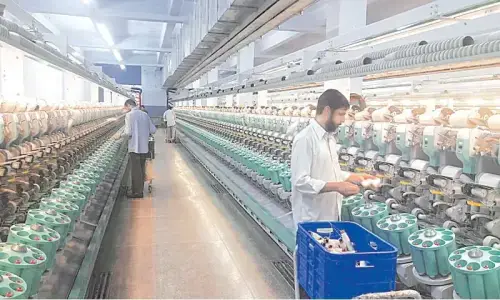
He said that the U-turn in provincial policies, with the change of governments at the centre, had also badly hit industrialisation in Sindh. It was seen during the 1990s when the Nawaz Sharif and Benazir Bhutto governments had been changed in quick succession. A glaring example of the U-turn in policies is the scheme for establishing special industrial zones (SIZs) in the country. Under the scheme Asif Zardari directed the Board of Investment (BoI) to set up an SIZ on 240 acres in Nawabshah. The Sindh Industrial Trading Estate (SITE) Ltd., an autonomous body for developing industrial estates, spent Rs62 million on the development of infrastructure in the zone. Consequently, a textile unit manufacturing viscose fibre was set up at a cost of two billion rupees.
However, with the sudden exit of the Benazir government, the incentives accorded to the SIZ were withdrawn and no second industrial unit saw the light of day in the Nawabshah special zone set up with millions of rupees. It continues to function with a solitary industrial unit.
The bureaucrat said, that the SIZ, which remained under the control of BoI through all these years, was recently handed over to SITE Ltd for inviting investors to set up units in the zone. SITE Ltd has fixed the price of land at Rs300,000 per acre compared to the previous rate of Rs625,000 per acre. Under the scheme three SIZs were planned for the province, at Larkana and Keti Bander, beside Nawabshah which were, however, abandoned with the change of the government.
Similarly, he further said that an industrial estate set up in Tando Adam was encroached by the land mafia who constructed unauthorised shops and houses over 21 acres. Gradually, the management of this estate was taken over by the city government which constructed roads and laid water and sewerage lines to meet the increasing needs of the residents of an area earmarked for industrial units. The Tando Adam industrial estate, set up in 1952 on 150 acres, has only 13 units in operation with five being sick out of a total of 39. The industries operating in the estate are mainly ginning factories, oil mills, flour mills and saw mills.
The present government has adopted a ‘very liberal’ policy for industrialisation in the province and no NOC is required for setting up an industrial unit except for those manufacturing arms and ammunition, currency and mint, high explosives, alcohol and radioactive substances.
The policy also prohibits setting up new sugar mills or expanding the existing ones in the province. Elaborating on steps taken for industrial development in the province, Deputy Secretary Industries Murli Manohar said that an extensive industrial infrastructure had been set up throughout the province.
He said that seven large size industrial estates, managed by SITE Ltd, and 18 small industrial estates, almost one in each district of the province run by the Sindh Small Scale Industries Corporation (SSIC), were in operation.
He said that it had been proposed that four more small industrial estates should be set up in the province at the cost of Rs4,401.7 million besides the upgradation of the existing nine small industrial estates. The proposed estates include a small and cottage industrial estate at Super Highway, Hawksbay and Bin Qasim in Karachi, and one in Hyderabad. “A package for the development of small and cottage industry in Thar has also been prepared at the cost of Rs133.486 million,” he added.
Mr Murli said that steps had been taken to resolve the problem of multiplicity of taxes and numerous unorganised inspections by various government agencies. Under the facility only three taxes — property tax, professional tax and cotton fee — were being collected by the excise and taxation department from the industrialists. Betterment tax surcharge and additional surcharge had been abolished.
He said that the number of industrial inspections had been reduced from 23 to only six. These six inspections had been clubbed together and were being carried out once a year with prior notice to the industrial associations.
The rates of land in industrial estates vary according to the size of the cities and towns. The rate per acre at SITE Karachi and Super Highway is Rs300,000, Nooriabad and Kotri Rs125,000, Hyderabad Rs300,000 to Rs500,000, Tando Adam Rs20,000, Nawabshah Rs300,000 and Sukkur Rs45,000.