0
0

 Financial discipline, transparency in transactions and prudent expenditure management are all areas that have remained alien to budget-makers in Sindh for the last few years. All this as the World Bank takes note of increasing block allocations in the annual development programmes (ADPs), provision of 42 per cent of the ADP to new schemes and inclusion of “unapproved schemes”.
The World Bank’s concerns on the future viability of provincial finances of Sindh have to be taken seriously. “The provincial budget continues to be prepared under antiquated procedures and processes that have a short term and input bias”, a World Bank report by a mission that visited Karachi last January says. The mission had a close look at the finance and education departments and was not much impressed by the state of affairs there.
For last many years, the Sindh budget shows an operational shortfall on the revenue side. It incorporates an ambitious development outlay, which stand at Rs24 billion in the current fiscal year. The ADP outlay carries a qualifying note which says that “provincial contribution and funding of the over-sized public sector development programme will be subject to availability of resources”.
Syed Sardar Ahmad, a retired bureaucrat who held charge of Sindh’s finance department for over two years explained in a post budget press conference in June 2005 that Sindh’s ADP is non-funded. It has become non-funded since the time the federal government stopped giving cash development loans and funds. What the Sindh government does is to squeeze savings from revenue expenditure to finance its ADP. In the year 2004-05, the revenue budget showed a deficit of Rs4.22 billion. But even with this revenue shortfall, the Sindh government financed a Rs20.80 billion ADP. This means that financial managers squeezed Rs25 billion from a Rs105 billion expenditure budget. It also shows that revenue budget was inflated by about 25 per cent since the actual expenditure was close to Rs75 billion.
For the current fiscal year, the budget shows an operational revenue deficit of 5.98 billion. Despite this resource gap, the Sindh government is spending Rs24 billion on its ADP. “We generate resources from within our budget”, Mr Ahmad had said at the post-budget press conference.
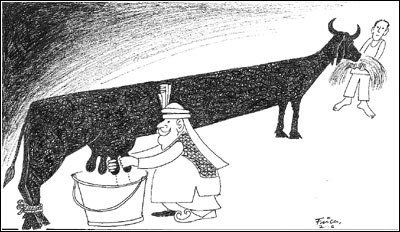
This financial engineering raises a lot of questions regarding the government’s credibility. The funding is are possible because the expenditure allocations are inflated. And this has been going on for years. Officials in the Sindh government concede that the provincial governments have a tendency to conceal their resources and often show highly inflated expenditure demands to federal government. For example, the Sindh government has been announcing that it will provide a large number of jobs. Block allocations are made against these jobs in the budget but since the vacancies are not filled, the allocated resources are utilised elsewhere in this case to bridge the ADP funding gap.
“Imagine, the Sindh government will be generating about Rs 30 billion from a Rs119 billion revenue expenditure budget this fiscal year”, an official said. About Rs6 billion will be generated to fill the budgetary gap and Rs24 billion to carry out the development work. It’s a federation-provincial relationship based on mutual deception and mistrust. The budget remains a document that misinforms the public at large and conceals rather than inform. On an annual basis, revenue expenditure is inflated by roughly 25 per cent.
After the October 2002 elections, the provincial government invested as much as over Rs50 billion in development. Despite this investment, Karachi, Pakistan’s biggest revenue generator and hub of industrial and commercial activity looks as if has been carpet-bombed. In the name of development, a big part of the city has been dug up causing traffic jams all day long.
It is not only the the infrastructure is crumbling, but services such as water, education, healthcare and above all law and order.
The situation in the rural areas is far worse. There are no roads, no electricity, no dispensaries and no schools. “Out of 40,000 government primary schools, more than 50 per cent lack basic facilities such as water, latrines and boundary walls”, the World Bank report says. It notes that public spending on education in Sindh has increased considerably, the number of teachers increased by 50 per cent, the number of schools increased by 220 per cent yet education indicators stagnated. These indicators show that the school enrolment ratio in Sindh is only 48 per cent.
It would be fair to say that development outlays and programmes in Sindh given a mere cosmetic purpose. Every government makes it a prestige point to come out with development programmes that make it look good. Unfortunately, none of the political parties have any long-term vision of social development. Military dictators are much too involved in seeking legitimacy while the politicians are busy trying to restore democracy. No wonder, neither has the time for issues such as water supply, healthcare, education, improving quality of life in the rural areas.
The World Bank now wants financial statements of the provincial and the district governments in Sindh to be published every six months. For the last few years, the Sindh government has stopped even a periodical media briefing on the economic situation. The World Bank also wants regular periodical meetings of the Public Accounts Committee of the Sindh Assembly. The proceedings of the PAC should be documented and displayed on a website, the bank has demanded. After the 2002 elections, the PAC is said to have met 33 times but its minutes are said to have been documented only thrice.
It is really an irony that the World Bank has to come to teach Sindh government elementary lessons in book-keeping. Sindh was a single province in undivided India after promulgation of the India Act of 1936 where good governance was a role model. Karachi was once the cleanest city east of the Suez Canal. Good education and health care attracted people from other parts of India. Even after 1947 when more than one million migrants came to this city from India, Sindh was relatively better governed.