0
0

Reforming the government
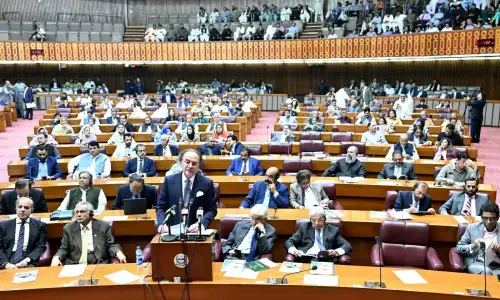
PRESIDENT Musharraf and Prime Minister Shaukat Aziz have announced formation of a national commission on government reforms to simplify the laws and rules of the country and make them truly helpful to the common man. Laws are made to help people but they seldom truly help them in reality.
Rules made under the laws, usually after a long time, often work contrary to the aims of the law. And the services and goods promised to people seldom reach them or reach them too late. Prolonged delays in implementation of laws are too well known. The bureaucracy twists the new laws and rules, made under them, to suit their whims or fill their pockets. President Musharraf wants to break with this odious tradition after nearly 60 years of the birth of Pakistan.
A recent World Development Report of the World Bank says that services meant for the poor hardly ever reach them and people are to be empowered to enable them receive what they had been promised, often following large external borrowing by governments. Empowerment of people or women and children remains a distant dream in Pakistan.
But now it is a different situation. General elections are due in Pakistan next year. And President Musharraf wants its results to be in his favour as much as possible on the basis of his performance in helping the masses. And he is not the first president to seek that goal in Pakistan.
As the president has repeatedly promised along with the prime minister to provide water, electricity and gas to all by the year 2008 and preferably by the end of 2007 when the elections are actually due. And now the new step at reforming the government is to be attempted to help people whom he sees as usually wronged which is an uphill, task in view of the negative history of the country in this area.
This is the right time for reforming the government machinery, as deregulation and privatisation are the norms of the day. This is the time when the government is expected to become slim, fit and effective and shed a great deal of its needless weight in terms of personnel. For example, the government commission has reported that 80,000 ghost schools were functioning in the country with far more ghost teachers as a part of the political tradition. Simultaneously the government is going to employ 8,000 women in the family planning department, which is being brought again under the centre. The government is trimming many of the over-staffed departments like the PTCL, Pakistan Steel, KESC and many more organisations. And more organisations like the PSO are also on the privatisation block. As a result we should have a thin government instead of one with four to five million staff, federal, provincial and local government.
Administrative reforms have been undertaken earlier as well, apart from the screening out process adopted by military rulers and they didn’t do great good to the administration. In one sweeping reform, assistant secretaries and under-secretaries were removed and replaced by the ubiquitous section officer. But soon we came to have too many costly additional secretaries and the fat cow became fatter.
Then came the political regime with too many ministers, ministers of state and parliamentary secretaries along with their lavish waste. Under the present system we have young men and women who got elected through family pulls and they instead of being appointed parliamentary secretaries, after a year or two in parliament were made ministers. They were also sent foreign trips frequently at a high cost to the country.
In the past the ministers were often not very educated, nor did they have any inclination for file work. They were led by the nose by the prime minister or their secretaries. But now we have young ministers, who are educated, but with notable exceptions, they do not want to spend much time on file work or get to grips with the problem they are supposed to deal with. Rich as they are, they love the foreign trips.
It is the first time we have a committee for government reforms headed by a banker. But he is a central banker and a former bureaucrat who has served in the east and the west of the country. Dr Ishrat Hussain has also studied the problems of Pakistan in detail and published some well-informed books. His sympathies are for the poor if not compelled to look the other way.
It is a loose organisation, which he is heading with the president and the prime minister as co-heads. And the four chief ministers are its members. Dr Ishrat says the National commission will have nine members among whom three will be officials and the six will come from the private sector whose names have not been announced. It looks like a pretty informal setup and the commission will make suggestions to the president and prime minister from time to time. How it all works remains to be seen.
The private sector members should not only provide their ideas but also play an effective role in developing the economy and rationalising the social system. After all this is the age of privatisation when all the key industries are being handed over to the private sector.
The notion that the government is a primary employer in the country should go and this role should be taken over by the private sector which should not wait all the time for foreign investment to come. If the investment climate is too good for foreigners, it cannot be bad for the Pakistani investors who know the country better and who are buying the shares of the privatised units at peak prices. Bank loans are available in plenty and at low interest rates. So the domestic investor should play a far more active role in industrialising the country.
Reducing the government burden in terms of the personnel employed has to come quick and the demand for larger pensions is increasing. With four to five million people in government employment, including ghost teachers and doctors, the pension bill will be too heavy. It is to become heavier following the clamour all round for higher pensions. A new pension scheme has been sent by the Employees Old age Benefit Institution to the prime minister who is expected to announce higher pension rates along with the budget.
The military pension burden is too heavy as they retire at an early age. A few years ago, a sizable part of the military pension of around 28 billion rupees was shifted to the civil side, which increased the burden of the pension. The pension bill is very large in the West including Europe, America and Japan. So various means are being devised to reduce that burden on the budget eve and increase the pension of the old people. And when it comes to paying heavy pension to ghost teachers and doctors it becomes too painful.
In a heavily-populated country the demand for goods and services will be great and when that country is a developing country it may not be able to meet all its demands. The minimum that people can expect is that there is fair play in the distribution and that there is very little waste.
Each one has to make his contribution to the wealth of the country through kitchen gardens instead of depending on India to export its vegetables. We have also to opt for drip cultivation at a national scale instead of hoping that after Rs 60 million is spent on lining the canal this year, we may have the water we need. A large bureaucracy means red-tape and excess of red tape means corruption. So by cutting down the large bureaucracy, we will not only get an efficient government, but also large savings in the economy which the country needs, more so when we are talking of making large leaps in exports.
An ideal government is one in which a citizen can get what he is ultimately entitled to through a letter to the relevant officer instead of having to wait on him which breeds corruption. In the CBR they firmly believe that contacts between taxation officers and taxpayers breed corruption. So the universal self-assessment scheme was brought in. The same should hold good for contacts between citizens and the officials. And the former should be able to get what they want through a letter to the officer concerned.
The $9-trillion heist
(This column was written by Art Buchwald from his hospice in Washington, D.C., where he is undergoing care. Buchwald stopped writing his regular column at the end of December, but continues to write occasional columns.)
I TOLD Knudson the other day that the national deficit is now nine trillion dollars. He said, “And what’s the bad news?”
I said, “It ‘s not as terrible as it sounds because it’s only $31,500 for each man, woman and child in the United States.”
Knudson said, “Well I don’t have $31,500.”
I said, “Well, if you can’t find it, you’re going to have to get your kid to pay it.”
“My kid would probably spend it on CDs and pot.”
I answered, “Well, that’s not going to help us fiscally. If we’re going to make our kids pay our debt, they have to get very serious. I know they have no respect for the Boomer Generation, but we can’t carry around a $9 trillion debt on our backs.
Knudson suggested, “I could hold up a bank, because that’s where the money is.”
I replied, “That money has already been spoken for.”
Knudson asked, “How are you going to come up with the money?”
I said, “I’m lucky because I have three children and five grandchildren. They promised if I couldn’t pay it, they would.”
Knudson asked, “How can you be sure?”
I said, “My children and grandchildren have never lied to me. Also, by the time they grow up, $9 trillion won’t be much money. It will hardly pay the salary of a good baseball player.”
Knudson suggested, “Maybe we can make it an accounting problem. Every corporation seems to be cheating on their taxes. So we could just get accountants to cook the books.”
“No, Knudson.” I said. “You don’t cheat on taxes. If we did, the rest of the world would lose respect for us. This country was built on the idea of no taxation without representation. That’s not true anymore because of the lobbyists.”
“What would happen if every man, woman and child refused to pay the $9 trillion?”
I said, “Perish the thought. I don’t want to see little kids running around the parks refusing to contribute to reducing the deficit. We have a slogan: ‘Let no taxpayer be left behind.”’
Knudson asked, “Does the deficit have anything to do with the government?”
“Heavens, no. The government is very frugal, and spends money only for things that are absolutely necessary, including war.”
Knudson said, ‘I don’t want to be pro-Bush or anti-Bush. But at the same time I don’t want to owe him money.”
“Why not?”
“Because I know he has a plan to pay off the $9 trillion before he leaves office.”
“I’m just warning you,” I said. “If you don’t come up with the $31,500, and if your kid doesn’t, and your grandchild doesn’t, the IRS will take your house away from you.”
Knudson said, “Can we change the subject? I hate to talk about taxes while we’re eating dinner.”
I said, “I probably wouldn’t bring it up if April 15 wasn’t just around the corner.”
Knudson said, “Well, I’ll tell you this. Paying taxes makes sick to my stomach.”
“There are only two things that mean anything, Knudson — death and taxes. You can do something about death, but you can’t do anything about taxes.” —Dawn/Tribune Media Services
The sunshine state
I AM by nature and upbringing a pessimist. As a boy in Glasgow, I was encouraged to expect the worst, on the principle that by doing so you’ll never be disappointed and sometimes you may even be pleasantly surprised.
This is not the American way. Optimism is in the DNA of the US. Louis Armstrong epitomized the upbeat national mood in that wonderful song “On the Sunny Side of the Street”. It says:
If I never had a cent/I’d be rich as Rockefeller/Gold dust at my feet/On the sunny side of the street
Nowhere is that sunny side sunnier than in Miami. I went there last week and was dazzled. The place is more than booming. Red Ferraris and black Hummers line the boulevards of Coral Gables. The good times have returned to the Biltmore Hotel, that glorious masterpiece of Roaring ‘20s architecture.
Tourism, which is Miami’s biggest business, has more than recovered from the shock of 9/11. Thanks to surging trade volume, both the port and the airport are thriving. Financial services are growing apace. Unemployment is low.
Pick up the “Miami Herald” and you find full-page advertisements with messages such as “Create Generational Wealth Through Real Estate” and “No money? It matters not. Bad credit? No problem. No education? So what. Over 65? There’s still time to change your financial future.” The sunny side of the street indeed.
Note too that Miami’s prosperity is a triumph for free migration as well as free trade and the free market. The population of Miami-Dade County is 57 per cent Latino, largely though by no means exclusively Cubans. Yet the contrast with shabby, down-at-heel Havana could scarcely be more stark.
Yet, if history is any guide, our present golden age of globalisation is unlikely to endure. It could be ended by a geopolitical crisis. Or it could be ended by a gradual domestic backlash. Should Americans — and especially Miamians — be less optimistic? Conventional wisdom has it that they should. Economists want them to save more. Environmentalists want them to consume less.
Well, be careful what you wish for.
For roughly a decade, the global economy has been propelled forward by the insatiable consumption of US households. Consumption accounts for about 70 per cent of the US gross domestic product, and US growth has recently accounted for more than half of global growth. The appetite of Americans for imported clothing and gadgets has been one of the engines of China’s economic miracle.
American consumption depends critically on American optimism. Why? Because it is only by saving literally zero per cent of their incomes and borrowing to the hilt that US households have been able to keep on consuming, as they say, to the max.
To take a look at the finances of the typical American family is to see optimism in action. According to the 2006 Retirement Confidence Survey, six out of 10 American workers claim they are saving for their retirement. In reality, more than half have less than $50,000 set aside (excluding the value of their homes), and more than a third have less than $10,000 in savings.
Similarly, most Americans say they expect to work until age 65. But in reality, the average retirement age is 62. This is what it means to walk on the sunny side of life’s street. You simply don’t contemplate the possibility that you might get made redundant, or fall sick, or get old. You hang on to that American dream that you’ll be one of the lucky few who scales the socioeconomic ladder to become “rich as Rockefeller.”
The decline of the US personal savings rate from about 8 per cent in the 1980s to below zero per cent today is in itself a remarkable phenomenon. Almost as impressive has been the sustained rise in American indebtedness.
Again, this borrowing bonanza has been based on optimism. As they pile up debt, Americans reassure themselves that the other side of the balance sheet is going to justify the risk involved. Most households have one big asset — their home. Its value has risen steeply over the last decade. The assumption is that this inflation in the real estate market will continue.
The world, as I’ve said, has reason to be thankful for American optimism. By the same token, however, the world has reason to dread an American mood swing. After all, interest rates have been rising steadily since the summer of 2004, driving up the cost of servicing credit card debt and adjustable-rate mortgages. And it’s generally assumed that the Federal Reserve will raise rates again next month. At the same time, Americans are coming to realize that energy prices are not going to go down anytime soon.
A quadrupling of interest rates and a trebling of oil prices is quite a combination.
“The only thing we have to fear,” declared Franklin Roosevelt during the Depression, “is fear itself.” That fear has been long absent from American life. But we should never forget what a devastating thing it can be on those rare occasions when the United States crosses over to the shady side of the street. — Dawn/Los Angeles Times
Democracy’s role is pivotal
PAKISTAN has the rare distinction of being created in accordance with the principles of democracy. Regrettably, however, since its birth in 1947, the country has been run by either the feudal/tribal class or by the military that has looked upon its rule as a legitimate extension of its professional role. This has made a mockery of democracy.
All along politicians have indulged in confrontational politics and have abused their power for personal gains and self-aggrandisement. They have also created a tightly-knit privileged ruling class that never committed itself to establishing a genuine democracy in the country and that has also failed to address the nation’s myriad political, social and economic problems.
As a result, a gloomy atmosphere prevails in the country and the majority of those who could have played a crucial role in establishing a firmly-rooted democracy in Pakistan have become disillusioned and adopted a complacent attitude towards politics. There is an obvious connection between widespread public apathy and the military’s meddling in the country’s political affairs.
Since its establishment in 1947, Pakistan has spent more than half its life under military rule. Ironically, Pakistan’s judiciary has often condoned military interventions by invoking the ‘law of necessity’, thus keeping the political system in limbo during military rule. If under domestic or international pressure, the military allowed limited political activity in the country, it was always kept under strict control.
The military rulers did not hesitate to abrogate the country’s Constitution or subvert it by making drastic amendments to it to suit their interests.
The need for political stability has always been one of the major issues faced by Pakistan since independence. Unfortunately, successive rulers in the country assumed that a powerful central authority would automatically resolve this question.
They were, however, blissfully ignorant of the fact that political stability in the country can be secured only by allowing a free and unadulterated democratic process. By taking an authoritarian path, Pakistan’s self-serving rulers have deliberately avoided the creation of a political system and have circumvented democracy in the country. Needless to say, the establishment of a genuine democracy in the country is the only way out of our simmering problems.
No wonder that present-day Pakistan finds itself unable to escape a vicious cycle of crises. The country has been polarised along ethnic and sectarian lines and the different regions are pitted against each other. Matters have been aggravated by the worst kind of lawlessness and criminal offences.
The founding fathers of Pakistan wanted to establish an egalitarian society in the country. However, a small elite that controls not only the economy but the entire apparatus of the state continues to flourish economically whereas a large bulk of the population is living below the poverty line. This has aroused bitter feeling and given birth to class antagonism in the country.
Regrettably, however, there are people in Pakistan, particularly those with a feudal and tribal background, who are very conservative in their outlook and believe that society should change as little as possible.
Some orthodox Muslims also perceive democracy as a western concept and consider it at odds with the values and principles of Islam. This perception is not, however, shared by Muslim scholars and intellectuals who believe that Islam and democracy are not unacceptable to one another.
It is also sometimes heard that democracy in Pakistan cannot function owing to the prevalence of illiteracy among large parts of the population. This is an erroneous view. All evidence shows that no existing democracy has been handicapped in achieving the goal of democracy on that count.
As a matter of fact, democracy itself is the sharpest of all spurs to the development of mass literacy in society.
Democracy should always be held out as the ultimate aim and ideal by politicians. However, in Pakistan, politicians have supported and even collaborated with successive military regimes in the country.
Now we see that some prominent political leaders are openly pleading for the military to play a permanent role — one that is sanctified by the Constitution — in the governance of the country which, needless to say, is wrong. It seems that political and personal interests have prevailed over constitutional rectitude. Fortunately, however, until now, only a small minority of politicians have shown their disregard for the principles of democracy.
Pakistan is now at a critical turning point of its history. It would be a great folly to ignore the fact that the future of the country hinges on democracy. It is a pity that successive rulers have ruled the country only to advance their personal interests and have hardly shown any interest in the welfare and well-being of the people at large. They have deliberately avoided establishing democratic institutions, believing more in hereditary peerages.
In this gloom, it is heartening to note that in Pakistan there is a resurgence of interest in democracy and the educated middle class that had remained largely unconcerned about the political process in the country because of its disillusionment now appears keen to take part in restoring the democratic process. This is a happy development and augurs well for the future. However, the road to democracy in Pakistan remains a long and arduous one and should be treaded cautiously and with great perseverance.
The writer is a former ambassador.
Schools for scandal
AFTER 80 years this has come as a bit of a shock. A dusty act of parliament, pulled from a shelf, an arrest and rich donors awaiting calls from the police.
In the 1920s the sale of honours by Lloyd George was explicit, the talk of the Drones club in PG Wodehouse’s The Inimitable Jeeves: “I suppose that peerage cost the old devil the deuce of a sum. Even baronetcies have gone up frightfully nowadays, I’m told”.
In 2006, it should be remembered, the worst conception of what might have been going on to fund schools and election campaigns still comes nowhere near Lloyd George’s record: knighthoods at 10,000 pounds, peerages at 50,000 pounds and 25,000 pounds for newly invented OBEs in four years. But the allegations are serious and the political implications for Tony Blair could be dire. The tramp of policemen’s feet through the corridors of power will surely resonate with voters in a way no amount of inquiries by the Electoral Commission and select committees could do.
The fact that there have so far been no charges as a result of Scotland Yard’s investigation, and may well never be, does not diminish the impact of the arrest on Thursday last of a respected headteacher and education adviser, Des Smith. The shock was felt inside No 10, which had no idea the move was coming and had, until now, regarded the police inquiry as something of a distraction, a formality following a complaint intended to cause trouble by a young SNP MP.
Now the police’s activities are being taken very seriously indeed, though Mr Smith has been released on bail and not charged. Downing Street’s concern is two-fold: at the way Scotland Yard has gone about its investigation, and at the unintended consequences for the city academy programme. This is supposed to be an education flagship, with 200 opening by 2010, private funds topping up much larger amounts of public money.
The press exposure of patrons of these schools, honoured or not, will surely discourage others from coming forward. As a Downing Street official put it yesterday, if the rich choose to spend their money on private swimming pools rather than community projects it is the poor who will suffer.
This is a legitimate worry, but it is also a distraction. If academies suffer in the backwash from the honours affair, it is at least in part because the government has been slapdash and over-eager about raising funds for them. The prime minister’s party fundraiser, Lord Levy, is also president of the Specialist Schools and Academies Trust, a link which should not have been made.
Number 10 is unhappy about the approach the police have taken, arresting Mr Smith rather than asking him to come in for questioning, and surprised that the investigation has spread so far and so fast.
— The Guardian, London