0
0

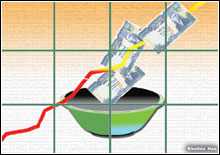 POWERS that be often claim to have broken the begging bowl. It means that there is no fresh external borrowing. Given regular debt servicing, this should be reflected in reduction in the stock of outstanding external debt. What is the factual position? Before going into numbers, it is necessary to clear a semantic confusion created by official pronouncements in this regard.
New external loans actually contracted or expected are termed as “assistance” or “aid’ which is grossly misleading. Foreign assistance or aid ended with the termination of cold war. Now there are only loans and grants.
The grants are being gradually reduced so much so that even the compassionate support for the October earthquake has very little grant and mostly it will be loans, though on soft terms. Terms of a loan, even if it is at zero rate of interest and stretched over a long period, do not bring any relief in the debt liability on account of principal. It will be only proper, if the term loan and grant is used instead of assistance and aid.
Another confusion arises when officials use a short-hand term for the external debt burden. This has two elements, namely “external debt” and “foreign exchange liabilities” adding up to “total external liabilities” for which the heading used is “External Debt and Liabilities.” The second element is much softer than external debt is the core problem. However, sometimes officials use the term external debt for total external liabilities, which can be misleading.
The factual position is that, between June 00 and December 05, external debt and liabilities, or total external liabilities have been reduced by $2.7 billion but this has been largely due to foreign exchange liabilities, which fell by $4.0 billion, mainly due to foreign currency accounts of Pakistanis, totally wiped out, giving relief of $1.7 billion and Special Dollar Bonds falling by $0.9 billion . In contrast, total external debt has increased by $1.3 billion.
Within this category, private non-guaranteed debt has been reduced to less than half, from $2.8 to $1.3 billion, or by $1.5 billion whereas public and publically guaranteed debt went up by $2.9 billion. The increase in the public debt would have been greater, for that matter total external debt, but for large loan write-off with which Pakistan has been rewarded after 9\11 for its key role in the American sponsored campaign against terrorism
In short, the regime continues to burden future generations, or mortgage them, without in any way increasing their ability to cope with it. They could hope to be able to bear this burden, if their capacity to do so was, in any way, enhanced by the present generation by long-term real investment in the economy. Unfortunately, gross national investment has been lack lustre and stagnating.
Gross fixed investment hovered around 15.5 per cent during the last three years. National investment is quite short of the minimum rate considered essential for sustainable growth. If a realistic allowance is made for depreciation of the existing stock of capital, the net rate of national investment may very well turn out to be negative. Against this setting, breaking the begging bowl, or attaining the cherished goal of self-reliance, demands strenuous effort in three crucial areas, namely domestic saving, balance of payments and fiscal policy. External resources have a large role even in the present dismal national investment rate. This is a reflection on effort for domestic saving.
In a growing economy, domestic saving is expected to improve with the capacity to save. However, in Pakistan the situation has been just the reverse in recent years. While the growth rate increased from 1.8 FY 01 and 3.1 per cent in FY 02 to 8.4 per cent in FY 05, the rate of domestic saving over this period declined from 18.1 FY 02 to 13.2 per cent. The rate for household saving, which was 14.8 in FY 02 and 16.5 per cent in FY 03, dropped to 10.8 per cent in FY 05. The government seems least concerned about the low rate of domestic saving and has been, in fact, actively pursuing anti-saving policies.
Of these, the most prominent are negative rate of return to financial savers and positive encouragement to consumption through introduction of consumer credit, at the instance of the central bank, in an already highly consumption-oriented society.
The rate of increase in private consumption expenditure was only 0.5 per cent in FY 03 but jumped to 8.2 percent in FY 04 and more than doubled to 16.8 per cent in the following year. During FY 05, the expansion in formal consumer credit accounted for 7.7 per cent of the increase in private consumption. It would be stating the obvious that the benign neglect of this important problem needs to be given up and anti-saving policies reversed.
As to the balance of payments, current account surplus of $4.2 billion in FY 03 was gradually turned into a deficit of $1.3 billion in FY 05. In the first half of the current fiscal year, this stood at $2.8 billion as against $0.7 billion in the corresponding period last year. This is fourfold increase. The deterioration has been mainly due to the trade deficit, which increased from $0.4 billion to $4.4 billion over the fiscal years, or by 11-fold and was $3.9 billion in the fist half of FY 06 as compared with $2.2 billion in the corresponding period last year, an increase of 77.2 per cent.
This has been the result of a much faster increase in imports than exports. Exports in the current year do not cover more than 66 percent of imports as against 76 per cent in the same period last year. The ratios in FY 03, 04, 05 were 96 percent, 91 and 77 percent respectively.
The real solution, of course, lies in pushing up exports and this is not going to be easy in an intensely competitive environment created by WTO. Pakistan should not hope for continuance of market access specially granted to it in the wake of 9\11 and must brace up to compete with the rest of the world.
The country is fast heading towards a “do or die” situation. It must “shape up or ship out.” The traditional ways would not do and a drastic psychological shake up of producers and exporters is called for. Foreign investment is looked up to but it must not be forgotten that it does not come without cost. Already payments abroad on account of profit income touched $1.8 billion in FY 05 showing an increase of 33.5 per cent over the year.
Dividend return on direct investment remitted abroad has gone up from $990 million in FY 03 to $1,228 million in FY 04 to 1,639 million in FY 05. This means an increase of 33.5 per cent in one year and 65.6 percent in two years. In the current year, in seven moths, profit and dividend payments abroad have been $299 million as against $269 million last year. These payments are, in no small measure, related to inflation and interest rates.
Fiscal policy comes into the picture because of heavy reliance of federal budget on external resources. During FY 05, external resources provided Rs198 billion as compared with revenue receipts of Rs875 billion (gross) and Rs630 billion (net).They financed as much as 22.8 per cent of revenue-current and development expenditure. For FY 06, they are expected at Rs212 billion as compared with the revenue receipts of Rs927 billion (gross) and Rs643 billion (net) and will finance 22.1 per cent of total revenue expenditure.
Currently, the low tax-GDP ratio is often bemoaned. What sort of effort to replace external resources by internal resources is required and how long will this take place in a corruption-ridden society is not hard to imagine. That will keep the achievement of self-reliance at a distance, even if, by any miracle, the trade and current count deficits are wiped out.
It is time economic managers looked beyond crisis management and seriously address the basic structural problems of investment\saving, balance of payments and heavy reliance of the federal budget on external resources. Without significant improvement in these crucial areas, breaking the begging bowl will be a pipe dream.