



 0
0

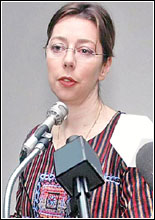 ISLAMABAD, April 7: Spaniards have turned the Christian-Muslim bitterness of the centuries past into festivals and enjoying it, a Spanish scholar said here on Friday. Dr Eva Borreguero explained in her illustrated lecture at the Council of Islamic Ideology (CII) that replaying the battles fought in the 15th century in the festivals helps participants release their emotions in good humour.
Coastal towns relive the arrival of Moors armada on the shores of Spain. The Christian guns open fire on them — only to lit the town with fireworks, she said.
Originally women were not allowed in because of the martial nature of the festivals but they fought and got a place in the parades in the 1960s. Now women dressed in Moorish and Christian period attires march in the parades — some even carrying swords.
Peace activist Dr Tahira Abdullah in the audience found the “glorification of women in arms” disturbing as, she said, women everywhere were “in the forefront of the peace movement”.
But the Spanish scholar disagreed with the comment, saying the fiestas produce harmony, not hostility.
Senator Mushahid Hussain, the chief guest, and CII chairman Khalid Masud, supported Dr Eva’s theme.
“It is the spirit of coexistence, tolerance and pluralism that brings out the best in a society,” said the senator, adding “for too long we have blamed outsiders for our ills. The mess we have, we have to clear ourselves”.
Senator Mushahid Hussain, who represents Pakistan on the OIC’s Eminent Persons Group, formed to promote enlightenment in the Ummah, said: “We need to bridge the gulf between Muslim elite and the Muslim street, between the ruler and the ruled”.
Europe, he reminded, was not just Christian but “multi- cultural, multi-religious and multi-ethnic” where 20 million Muslims also live.
In the battle of ideas, pluralism offers the opportunity to promote understanding between societies rather than discord, he said, appreciating the “alliance of civilizations” initiative of Spain and Turkey.
Dr Khalid Masud said the festivals Dr Eva talked about celebrate the “reconquest of Spain” but in a manner that promotes harmony not bitterness. “Only if we could emulate,” he added forlornly.
Dr Eva also talked about the arts and sciences that flourished in Andalusia — or Spain — under the Moors with Muslim and Jewish scholars working together, translating Latin works.
Spain became the first modern state and Europe’s Renaissance took roots in that scholarly rich and socially tolerant society, she said.
In fact when Christian king Alfonso, after conquering the last Moorish stronghold, Granada, in 1491, asked the Muslim and Jewish peoples either to become Christians or face expulsion, some 80,000 Jews preferred to migrate to Muslim Maghreb, she said.
Dr Eva, who teaches sociology and political science in a Madrid university, is currently a Fulbright Scholar at the Centre for Muslim-Christian Understanding of Washington’s Georgetown University. She is visiting Pakistan in connection with her research on Indian Muslim movements.
She is the third scholar from the Georgetown University to be on a lecture tour of Pakistan in recent weeks.

























