0
0

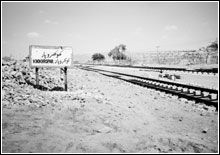 IN the still heat of the afternoon, a few scraggly-looking local boys joke with each other at the sole bench on the deserted railway platform. They swing their bare feet, fight over a biscuit and pick on the smallest among them.
A thick cluster of flies buzzes around them but they don’t notice. Behind them in a small room, Mohammed Sabir, the station master, smart in his dark blue uniform, listens intently to messages on his wireless set detailing the progress of the all-important train.
A few feet in front of the children, dozens of fat, shiny black beetles weave in and out, under the railway tracks. Three little girls, their feet also bare, skip over the tracks balancing baskets of food on their heads. They giggle.
Across the tracks, a crumbling brick teahouse begins to fill with men. They call loudly for tea and settle down for an afternoon of the blaring Indian movie on television.
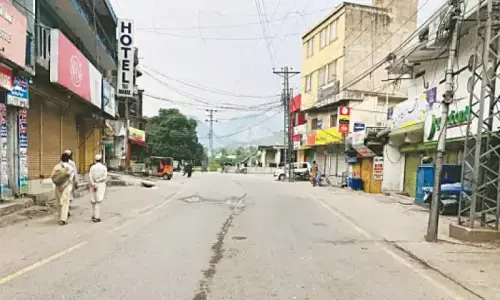
Beyond the teahouse, along a dirt road stand eight or ten odd tiny stores, that look more like makeshift cabins, selling biscuits, soap and a few odds and ends. The storeowners doze over their newspapers, convinced they won’t have customers to tend to yet again this afternoon.
This is Khokhrapar. Of the Khokhrapar-Munabao Thar Express, the glamorous India-Pakistan friendship train that restarted services in February for the first time in decades. It looks more like an abandoned railway station in a more-or-less abandoned town.
“We dreamt of huge palaces,” says one old resident, referring to the resumption of the train service. “But we didn’t even get to see a mud hut.” He asks not to be named for fear of harassment by the government. His companions nod vigorously in agreement. One trades in goats, another labours wherever he can find work. “When the train passes by, we wave at it and cry at our fate,” says the goat trader.
Here’s why: The “Thar Express” does little for the Thari people. At least so far. It enters Pakistan through Munabao, makes an immigraton stop at Zero Point and then hurtles through Khokhrapar to make its very first stop at Mirpurkhas, bypassing Thar altogether.
“It’s called the Thar Express but this is an international train that has nothing to do with Thar,” says another local.
When they first heard of this train service, the people of Khokhrapar had three aspirations. First, that they would see a bit of a boom in business as the train stopped in their town and passengers bought tea and snacks. Those coming to see off or receive passengers would also bring business to the town, they had hoped. At present, not even a local train stops here although the station master says a local service is scheduled to start in June.
Kombo Khan, a disabled store owner says he had been excited about seeing his earnings triple when the train made a stop. “We had thought the train would light up our town,” he says. Nearby, Ghulam Mustafa who sells snacks and bolts of fabric sits reading the Quran in his darkened store. “We had thought we would have so many visitors but we’re just sitting here with nothing to do,” he says. “We can’t even be angry because that will do us no good.”
Opposite his store is a small hotel where Abdullah, the owner, had big plans to add rooms which visitors could rent out and rest in during the train stop. “Now I have to content myself with the usual trickle of business I get from selling tea.”
Second, the people had hoped their town would get a little more developmental attention. The paucity of water plagues the entire town and without a tube well, they’re unlikely to ever taste sweet water. The primary girls’ school has no teacher, the boys middle school doesn’t have enough teachers and there is no high school in the town at all.
And lastly, the people had hoped the train would bring them the facility of going across the border and meeting family they hadn’t seen in years. But as one local put it: “It would cost us Rs400 or Rs500 to go on the train to Jodhpur but Rs4,000 to first go to Islamabad to get a visa. How does this make sense? How can we afford this?”
As dusk settles on the town, the boys at the station disperse. The station master still hovers near the wireless, awaiting instructions. He listens intently to the communications. The Thar Express has arrived at Zero Point and will soon pass through the tiny town of Khokhrapar. Locals begin to gather. They will wave the train goodbye.