0
0

‘Thousands’ of errors
THAT the US has made many mistakes in Iraq has been obvious to the whole world considering what has been going on in that country for the last three years. But this is the first time that a leading Bush administration official has conceded that America has made “thousands” of tactical errors in Iraq. Speaking at Blackburn on Friday, Ms Condoleezza Rice said that her country had made “tactical errors, thousands of them” in Iraq, but she insisted that the attack on Iraq was justified because the aim — the removal of President Saddam Hussein — was strategically right. A discussion on the relationship between strategic decisions and tactical errors is a subject unto itself, but “the larger sweep” of history to which Ms Rice refers seldom cares about strategy and tactics; what history cares about are the consequences, and from that point of view the decision was wrong. President Saddam Hussein committed a crime when he invaded Kuwait, and the US-led coalition punished him for this act of aggression. Earlier, he had received America’s unqualified support for attacking Iran — a war that lasted eight years. But history will note that Iraq was attacked when the Baathist regime had been de-fanged.
The Kuwait war had completely destroyed Saddam Hussein’s war machine, and he was in no position to threaten any country. For this reason, a new theory was developed — that Iraq possessed weapons of mass destruction. History to which Ms Rice refers would record that the American and British governments invented the hoax about Iraq’s WMDs to justify an attack on a country that Israel considered one of its major enemies. It has now been confirmed that neocons in the State Department and the Pentagon had been talking of an attack on Iraq much before 9/11, and that the stories about WMDs were invented merely to prepare the world opinion for the war on that oil-rich country.
The short-term consequences of the Iraq war are already there for one to see. An estimated 100,000 civilians, according to a British medical journal, have lost their lives, the US casualty toll has crossed the 2,300-figure, and everyone is now talking of a civil war in Iraq. If the present anarchy continues, Iraq may split into at least three states — the Kurdish north, the Shia south and the Sunni triangle in the centre. Israel may rejoice at the balkanization of Iraq and the coming into being of cantons and statelets, but that will hardly be in America’s and the region’s interest. In the long run, the process of fragmentation may extend to neighbouring states, and that will hardly produce a stable and democratic Middle East which is purportedly America’s aim in the region.
In her speech, Ms Rice said peace in the Middle East would not have been possible so long as Saddam Hussein was there. She forgot that the region never had a moment’s peace since the founding of Israel in 1948. Since then Israel has waged war on all of its neighbours, occupied their territories, drove the indigenous people out and annexed their land. Today Israel continues to occupy the Golan Heights and the West Bank, including Al Quds, which it conquered in 1967. So long as Israel, armed to the teeth with WMDs, continues to occupy these lands and does not accept the land-for-peace formula which could pave the way for the emergence of a sovereign Palestinian state, there will be no peace in the Middle East.
Health care anomalies
PRESS reports about the state of the people’s health and public sector health institutions in Pakistan do not make cheerful reading. They invariably indicate the high prevalence of various diseases — including the preventable ones — the low productivity of the people because of poor health and the dismal quality of health care available to the poor. All this points to a serious failure of the government to address the health needs of the people. The fact is that if a person has the financial capacity, he has the best possible medical care available to him from private practitioners and in private hospitals and medical centres staffed with highly qualified specialists and equipped with state of the art technologies. But a very miniscule section of the population has the means to pay for these facilities. Which means that the bulk of the population remains deprived of what is its birthright.
How can this anomaly be rectified? It would require the government to modify its policies and management techniques which are basically faulty and have resulted from an elitist approach to health care. To begin with the government’s allocation for the health budget is too miserly — about 0.4 per cent of the GDP — and its priorities are also wrong since they promote facilities for the rich. Thus, more goes to tertiary care than to primary health care. More doctors are trained than health visitors and nurses. Hospitals expand faster than basic health units and rural health centres. Hardly any attention is paid to preventive medicine, provision of clean water, sanitation and environmental hygiene. This neglect promotes the prevalence of diseases putting more pressure on the already tottering health-care delivery system. But injecting more funds into the health sector and plugging the loopholes in the policies alone will not be enough. Rampant corruption in all public sector organisations has deprived the common man of even the few benefits that he could have got if embezzlement did not have a free rein in public sector hospitals. A strict and efficient system of monitoring and methods of checks and counter-checks could also be devised to ensure that health care actually reaches the people, irrespective of their financial standing.
Fatal traffic jams
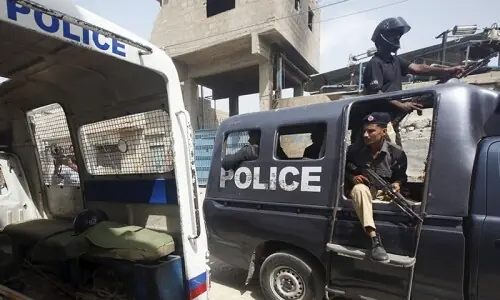
JUST how many deaths will it take for the Karachi administration to realise that the traffic snarls created by VIP movement on the city streets are more than a passing inconvenience? In recent months, the death of a number of patients has been linked to the closure of roads and the inability to get to hospital in time. Some of these have been caused by the road being cleared for the passage of long VIP motorcades that halt the flow of traffic and leave no space for even an ambulance to pass. The latest victim of the government’s callous disregard of the situation was a young university student who died of a ruptured appendix on Wednesday while on her way to hospital where doctors informed her family that she could have been saved had she been brought in earlier. This they could not do because of congested traffic conditions resulting from VIP movement.
What is surprising is that, although the subject has been debated and written about a number of times, apart from making noisy promises to provide alternative routes, there have been few indications from the authorities that they intend to regulate traffic in the interim period. It seems that they are not in the least moved by the plight of commuters waiting endlessly for VIP motorcades to pass or even by the anguish of the families who have seen their loved ones die on the way to hospital because of blocked passage. As for those high-ranking officials who are the cause of this traffic congestion, they have yet to show any remorse at the situation or use their power to ensure less hampered and more orderly traffic movement. Future tragedies of the sort recently witnessed cannot be ruled out unless an intelligent plan is worked out to lessen traffic jams, especially during VIP visits to the city.
Breaking the ‘hyphen’
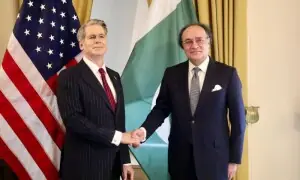
THE US policies in the past half a century plus, were supposed to be India-Pakistan specific. The all important hyphen between country names implied a sort of balance in the overall relationship. In the Nixon and Reagan years there was a “tilt” in Pakistan’s favour.
President Bush has done away with the hyphen and therefore the inter and intra-balance in the relationship. “India and Pakistan are different countries with different needs and different histories”, says Mr. Bush.
Now it is no longer a tilt in favour of India. President Bush has brought the house down. By swallowing the Indian conditionalities for the nuclear deal, hook, line and sinker, the US policy in South Asia is virtually subservient to India. Hats off to the Indians for having secured its biggest foreign policy coup since its existence as a republic. Pakistan, which was recently awarded the dubious distinction of being the closest non-Nato ally of the US, can take a hike.
What does this mean for Pakistan? The New York Times summed it up right. “It (the nuclear deal with India) has embarrassed Pakistan... President Bush should have stayed at home.” As if to make sure that the salt was fully lapped into our wounded pride, the tactless energy secretary of the US came all the way to assure us that nuclear cooperation for energy projects would not be on the table for discussion.
It is time we reminded the US that terrorism and national liberation too have different meanings and justifications. Are those who seek to expel the Americans from Afghanistan or Iraq terrorists or freedom fighters? Is the use of terror justified to expel a foreign occupier? If not, did the US not provide the means and instruments of terror to expel the Soviets from Afghanistan? Viewed from the angle of the average Afghan, there is not much difference between the Soviet or American occupation. The US fought a proxy war against the Soviets from the very same Fata regions, using Arab and sundry other fanatics, turning a blind eye to the narcotics trade.
The Afghans have given a bloody nose to every invader in its history. All the freedom fights in Afghanistan to expel foreigners — from the British to the Soviets and now the American occupiers — was terrorism blended with religious fanaticism. The pity of the situation is that Pakistan is fighting America’s war on terror in its own tribal areas. There is only one solution to this complexity: America must quit Afghanistan and Iraq. Let these countries resolve their problems in their own way. How America seals its borders for its own protection is America’s business.
There is today a congruence between Al Qaeda and the Taliban. Al Qaeda’s aims are truly terroristic — that is, to cause physical damage in the US and western Europe in pursuance of its political goals while the Taliban are fighting a foreign occupier. It is a coalition of expediency. The safety of the West as well as ours lies in breaking this coalition. And this can only be broken by the US forces quitting Afghanistan in 2006 and Nato forces if under British command (the British display much greater tact and finesse in confronting insurgencies) by the end of 2007; remember in Taliban times we had no troops on our western border, today we have about 100,000 there. We may need another 100,000 if Mr Bush’s demands are to be met. Remember, also, the Taliban were the only government in Afghanistan which could enforce a ban on poppy cultivation.
This is not to suggest that we desire a Taliban government in Kabul or advert to their policies prior to 9/11. We should hold fast to our current course of moderation. A Taliban government cannot exist in Afghanistan if there be no support from Pakistan. Remember Marx’s dicta: History repeats itself as farce. An Afghanistan force of the US occupation is not likely to be the same as it was before 9/11. Mulla Omar was a fanatic. He was bankrolled by bin Laden, but almost certainly not privy to his innermost secrets. Just as America is not the same after 9/11, nor is Afghanistan.
If the US were to quit Afghanistan, say in 2006, a Taliban government could possibly take over in a worst case scenario in the next two or three years. Devoid of Pakistan’s help in any fanatic agenda and bin Laden’s bankroll, it will soon lapse back into chaos and anarchy. The key to the situation is Pakistan.
Afghanistan is almost a picnic compared to Iraq. Ahmad Hashim, a professor at the Naval War College, Rhode Island, who has spent much time in analyzing the Iraq War, in a recent book, says that the US “sees the world in black and white rather than in shades of grey” and notes that “martyr operations are the only effective weapon the resistance has against the Americans”. He adds that in May 2005 “more suicide bombs went off in Iraq than during the entire Palestinian Intifada against the Israelis since 2000”. This macabre feat is being repeated almost every month. He concludes that the US is “congenitally incapable of waging effective counter-insurgency”.
The US-Pakistan relationship has not been a happy one. When in need of Pakistan’s services it is showered with aid and hardware; otherwise a cold shoulder. Because of its sudden twists and turns of policy the perception of most Pakistanis is that the US is an unreliable friend and unlike its stable and substantive relations with China. Consider the services rendered by Pakistan to the US: we were the conduit in changing US-China perceptions and relations. I remember Kissinger saying that during his time in office, Pakistan never asked for recognition of this favour, nor asked for any benefit. The Soviet Union, the mortal enemy of the US, was dismantled largely because it failed to hold Afghanistan after its invasion in 1979.
The Americans forget that Pakistan stood up to the Soviet Union at a grave risk to itself when about one-third of Afghanistan’s population entered Pakistan as refugees. A Soviet invasion or a policy of hot pursuit into Pakistan was a matter of touch and go. Soon after the Geneva accords, the US terminated aid and the supply of F-16s, including spare parts that had been paid for by Pakistan.
By supporting the US occupation of Afghanistan, we have alienated the tribal belt in our country. How can we prevent mischief across the border practically when the Fata population which is closely bound by clan ties is against the US occupation? Why does the US not mine and fence the border to prevent infiltration from across it?
Pakistan has been chastised over the Dr. A.Q. Khan affair. Let us for a moment look at it from Khan’s point of view, not that we necessarily agree with it. India’s claim since Pokhran-I in 1974 was that the NPT was discriminatory, because it arbitrarily confined nuclear club membership to the countries that had carried out nuclear explosions prior to 1964. That the high contracting parties — the five nuclear weapon states — were obligated under article VI of the treaty to move towards total nuclear weapon disarmament.
The non-nuclear states were Treaty bound to abstain from fabricating the know-how of the nuclear cycle on the assumption that the nuclear weapon would ultimately disarm. On the contrary, the nuclear weapon states not only failed in this obligation, but, went further by adding second and third generation nuclear weapons and delivery systems to their inventories. This was India’s point of view from 1974 to 2004. This exactly was also Dr. A.Q. Khan’s viewpoint. His presumptive agreement for clandestine nuclear know-how sale was that the NPT was a virtual fraud engineered by the nuclear “haves” to keep the “have-nots” out.
The reason advanced by the US for not granting Pakistan the same privileges as India over civilian nuclear facility mainly centres on the A.Q. Khan’s proliferation episode. But were US atomic secrets not leaked to the Soviet Union? To mind comes the execution of the Rosenberg’s, husband and wife, for such misdemeanour. The Rosenberg’s and many other top scientists leaked US atomic secrets for ideological reasons; so did Dr. A.Q. Khan for reasons which he considered ideological.
Leakages of atomic secrets have occurred not only in Pakistan but in the US, UK and Russia as well. It is pertinent to recall that just as A.Q. Khan has been placed in a sort of quarantine, so was Robert Oppenheimer, the architect of America’s atom bomb project and Andri Sukharov, the genius behind the Soviet hydrogen bomb, albeit for different reasons. These great engineer-scientists, responsible for the creation of the most terrible weapons known to man, assume the role of messiahs and harbingers of destinies of their own visions.
Given the element of inconstancy, amnesia, opportunism and heavy-handed dealings, which remind one of Soviet diplomacy, Pakistan’s response to the US should be firm and measured:
* That by breaking the ‘hyphen’ which has historically marked our relationship with the US and more so after declaring Pakistan as a ‘non-Nato’ ally, the US has alienated Pakistan, as it did in 1990 with disastrous consequences for the region and the West.
* Like India, we too are hydro-carbon deficit state and faced with an eight to 10 per cent annual increase in electricity demand. We need nuclear power units employing latest pollution-free technology. All our nuclear power plants are under IAEA surveillance.
* Afghanistan cannot be fully secured for the West without the cooperation of Pakistan. Henceforth, it will be the responsibility of the US or Afghan government to deal with terrorists/freedom fighters entering that country or ours. The US should build a demarcation fence and seal it electronically to avoid mutual recriminations over infiltration in the future.
* Any intrusion into Pakistan by the US or Afghanistan troops without its express permission shall be expelled.
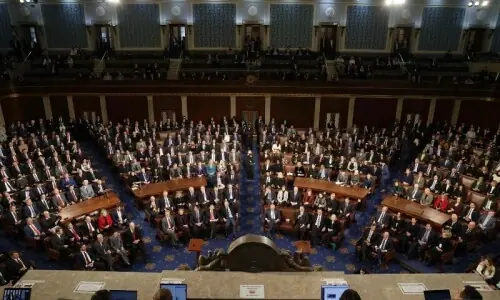
* We should inform US Congress members of our point of view. President Bush’s decision to disturb the NPT and the subcontinental balance will have long-term regional and international repercussions. Congress should reject the Agreement over supply of civilian nuclear reactors.
* It will be our intention to maintain correct relations with the US, so long as ‘correctness’ is reciprocated.
The writer is a member of the National Assembly. E-mail: murbr@isb.paknet.com.pk