0
0

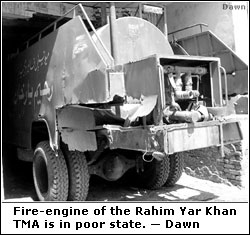 RAHIM YAR KHAN, March 27: Neither the government is interested in looking up its fire brigade units in the district nor ginning factory owners take any pain to establish the facility on their own despite suffering heavy losses in cotton fire incidents every year.
The Rahim Yar Khan district, known for producing the best quality cotton lint in the world, produces around 1.5 to two million cotton bales annually.
Every year cotton worth about Rs400 million is reduced to ashes in the country, but no concrete step has been taken by the quarters concerned to save the precious crop from being burnt and the much-needed foreign exchange.
Although the phutti from Rahim Yar Khan is sent to some other cities for ginning, yet the maximum ginning is done here in about 133 factories during the season. Passing through many stages from picking to bale forming, farmers keep the phutti for 20 to 40 days to get better rates in the market.
Brokers buy the phutti from farmers and sell it to grain market traders. They sell the commodity to ginning factories who prepare cotton bales within a week after ginning. The ginners take weeks in selling these cotton bales in the Karachi market to fetch desirable rates. In this way, the phutti requires some two to three months to reach Karachi and this intervening period runs the risk of catching fire in almost every stage.
In the last one-and-a-half-years, about 10 different cotton burning incidents were reported in ginning factories and the grain market of Rahim Yar Khan causing heavy losses.
On Nov 4, 2004, cotton worth millions of rupees was destroyed in the fire incident in Khwaja Muzaffar Mehmood cotton factory in Rahim Yar Khan.
On Dec, 29, 2004, around 100,000 maund cotton was burnt at Anwar Cotton ginning factory on Khanpur Road. Some 40,000 cotton bales worth Rs423 million were reduced to ashes at the TCP godown on the national highway in Akramabad on April 15 last year.
Similarly, around 4,500 cotton bales valuing Rs48 million were burnt in Aleem cotton industries, Chowk Suraly, on Jan 13, 2006.
In all these incidents, ginning factory owners had to suffer heavy losses as the government’s fire brigade units proved too inadequate and ill-equipped to cope with the demanding situation.
A ginning factory is established with an expenditure of about Rs9 million while the owner spends Rs100 to Rs150 million for ginning of phutti in the season, but he never incurs a penny to save cotton from fire. A senior cotton ginners association member and a progressive cotton ginner of Khanpur, Chaudhry Mehmood, said that a ginning factory needed only Rs300,000 to establish its own firefighting unit, but owners did not regard it a worthwhile investment.
On the other hand, he said, the firefighting system of the government had many handicaps. Of the six total fire brigade vehicles in the district, three are in possession of Rahim Yar Khan TMA and one each in Sadiqabad, Khanpur and Liaquatpur TMAs.
All the three vehicles in use of Rahim Yar Khan TMA had surpassed their span as one was as old as 32 years, the second was 28 and the last one had completed its 12 years, he said.
Fire brigade in charge Sheikh Muhammad Saleem said that at least three more vehicles and a mini vehicle were needed urgently besides replacing of the old ones to effectively carrying out our operation.
In addition, he said, the shortage of staff was another problem as our department needed three more drivers and nine firemen.
He said that Gulshan-i-Usman fire brigade centre was completed in the Factory Area and a vehicle was also available there, but the centre still could not become operative. The centre was also not provided with the telephone facility.