



 0
0

Fanaticism and its corporate beneficiaries
MILLIONS protested against the Bush visit in India, a huge component of them Muslims. Many more millions protested against abusive cartoons insulting Islam across the world, an even bigger component of these street-fighters being Muslim.
Back in India, meanwhile, a Muslim politician shot off a “fatwa” to murder the Danish author of the cartoons. The “avenger” would be paid 510 million rupees or $11.5 million and his weight in gold. This was the promise given by Muhammad Yaqoob Qureshi, Minister of State for Haj and Minorities Welfare in the Uttar Pradesh government.
Unless the income tax department suggests otherwise, there is a good possibility that Qureshi doesn’t have any money really and that he was merely indulging in easy bluster for quick publicity. But who is the real beneficiary of fanaticism that people like Qureshi bring into the heart of public discourse? There is good evidence to suggest that religious brinkmanship, verging on fanaticism is of direct benefit to India’s corporate world, at par if not more than the gain that goes to politicians.
India’s Muslim groups are constantly looking for political benefactors, someone ideally suited to fight the Hindutva menace, their biggest scourge.
The current flavour for Muslims in Uttar Pradesh is Mulayam Singh Yadav, the state’s chief minister. Qureshi, the would-be author of an international murder, is a minister in Mulayam Singh’s government.
When Mulayam Singh joined the chorus of protests against the Bush visit he had an eye on his Muslim constituency. There was duplicity too. He slipped in a Muslim MP at Bush’s banquet as a representative and unleashed Qureshi into the discourse on the other side. But Mulayam Singh is also closely tethered to the corporate world, as political parties usually are.
Let us take just one example of this proximity to see how farcical it all looks in the context of his appeal to Muslim groups who dislike Bush. The one tycoon who links the politics of Uttar Pradesh with Washington DC is Anil Ambani.
Ambani is a close friend of Mulayam Singh. He is also a key player in the state’s economic council headed by the chief minister. For the record, Anil Ambani was the only Indian, apart from his former movie actress wife Tina Ambani, to be invited to the inauguration of President George W. Bush in January 2001. In March 2000, he had played host in Mumbai to President Bill Clinton. At that time his father Dhirubhai Ambani was alive. Clinton had reportedly spent more private time with the Ambanis in Mumbai than he had with Prime Minister Vajpayee in Delhi.
Last year Mulayam used his links with the Ambanis to famously host Clinton during an overnight stopover in Lucknow on his way to China. Lucknow being a small town, the event gained an unduly large profile. Some of India’s leading editors were ferried by special planes to this jamboree. There is no issue, so to speak, if Anil Ambani has good relations with Messrs Bush, Clinton and Mulayam Singh. However, have we heard a single word of protest from Anil Ambani against Mulayam Singh’s new-found cause against “American imperialism”? What does he think of Qureshi’s outburst for that matter? Not a word, at least not in public.
Anil Ambanis cannot be anti-Bush, or anti-Clinton, or anti-America or anti-imperialism. No-one in India’s corporate world is known to harbour such strong feelings against their benefactors. It’s not a safe feeling to harbour. But it would be equally disastrous for them to meddle with Qureshi’s brand of Islam because it serves a corporate purpose.
Anil Ambani knows where his economic interests lie. Mulayam Singh knows where his economic interests lie. Do the Muslims too, who have been protesting vociferously against American militarism in Iraq have an economic world view? Do they have preferences and opinions on issues such as neo-con economic policies, free market reforms? What would be the economic structure of Iraq, when and if the Americans leave? There is nothing to suggest that our fellow Muslim street fighters are really concerned.
There is nothing to indicate also that Muslim leaders who exhort their followers to self-defeating protests against a perceived cultural imperialism of the West want to discuss issues that would force them to take clear-cut decisions on economic challenges confronting their people. For example, Muslim leaders in India are not known to express concern over what is causing so many Indian farmers to commit suicide.
Where do Muslims figure in the 300 million Indian citizens who make up the market that made President Bush drool? Are there more Muslims in the 700 million that have been left out of the market? Does the recent Chidambaram budget hold out any hopes for their betterment?
Finally, the reasons that Muslims are under attack in Gujarat and Mumbai may have as much to do with agent provocateurs like Muhammad Yaqoub Qureshi as the fact that religious strife provides a better breeding ground to India’s fascist tendencies that have surfaced in the form of Hindutva. It may not be a coincidence that the recent split in the fascist Shiv Sena of Mumbai has come about at a time when Mumbai’s vast tracts of expensive land that once hosted the now defunct cotton mills have been released for commercial transaction by the country’s Supreme Court.
The move symbolizes a victory dance at the death of the once robust working class movement that grew up around the cotton mills. The Shiv Sena, as much as it targeted Muslims and South Indians, was mainly instrumental in breaking up the trade unions. This is also what happened in Gujarat. The working class movement has been decimated there by a new discourse on fictitious nationalism, in which if you are not with Narendra Modi you must be a terrorist. It would be useful for Muslim leaders to probe into the corporate links of Modi’s BJP and Mumbai’s Shiv Sena, including its new splinter group. They need to know how the Qureshis in their ranks help the growth of Hindu fascism.
Arundhati Roy loves to celebrate anarchism. She believes the only way to fight a powerful state is to be prepared to be punched in the face, to be abused and maligned. It was in this spirit that names were named by her supporters in a no holds barred kind of discussion during the book release of the Hindi version of “An ordinary person’s guide to empire”. Poet Javed Akhtar, actress wife Shabana Azmi, human rights activist Nirmala Deshpande, secular activist Swami Agnivesh and former actress Nafisa Ali were all debunked. Javed was accused of endorsing Atal Behari Vajpayee’s politics and poetry. Shabana received an award from the World Economic Forum in Davos, a sacrilege after being the toast of the rival camp at Mumbai’s World Social Forum. Swami Agnivesh was in a huddle with George Bush during a meeting with India’s religious leaders. Ms. Deshpande escorted the American president around Mahatma Gandhi’s shrine, and Nafisa Ali, who worked tirelessly in Gujarat is supposed to have let down the side by escorting Laura Bush around Delhi. The gloves are off.
More buses, not more cars
 CARS of varying shapes, sizes, power and colour are flooding Karachi roads. The figures are staggering. About 45,000 cars move off the assembly lines of plants established near the city. On average, 414 vehicles are registered everyday in Karachi, with the total number crossing the 1.4 million mark. Many more are seen with registration plates of other cities and provinces.
The cars may be an answer to the dreams of the owners, the acquisitions made easy by the various leasing companies and banks, tripping over one another to make attractive offers. The introduction of low price CNG has also encouraged new buyers.
City roads are unable to take this growing load. Their capacity cannot be increased to cope with the number of cars coming in. Parking places brim with all sorts of vehicles.
The decision of the city government to bring in 8,000 large CNG buses in phases is welcome. But the policy-makers should remember that a similar scheme failed previously.
The former city government had introduced the Urban Transport Scheme (UTS) aimed at solving the transport problem and providing safe and comfortable transport for commuters. The Green Bus Company was among several that ran buses on various routes. The company had imported 28 buses from China and all of them were fitted with CNG engines. These buses could not be sustained and the company had to wind up its operations. Officials blamed the failure of the company on its internal problems. All of the buses were seized by a bank when the company was unable to pay back its loan.
Trans Livia was another company that operated 25 large buses on two important routes, but had to abruptly suspend service. Again, it is said, loans remained unpaid and the buses were sequestered. As the regulatory authority, the transport department of the city government did not do much to keep the companies afloat.
The number of large buses under the UTS was 300 but the fleet is shrinking rapidly. The government had promised to give a subsidy to the transport operators, but no payment has been made to them yet. The companies had signed agreements with the transport department and fixed fares for different stages. However, the fares were not revised to match the sharp increase in petroleum prices which hit their profit margin.
Transport officials say transporters had prepared documents showing over-invoicing of buses so that they could obtain large loans. As a result, they failed to keep up their instalment payments. The government had announced 70-30 per cent equity ratio for loan but the equity was later changed to 90-10, which transporters say overburdened them. They said their companies deposited 10 per cent amount and got 90 per cent loan, but they were not able to return it and had to lose their buses.
The new transport companies will bring in buses only if they are offered incentives. Besides, the city government has to learn from the past and take steps to ensure that Karachi gets an efficient bus system, which is the answer to the growing traffic problems.
Struggle for rights
INTERNATIONAL Women’s Day (March 8) saw a lot of activity in the city, as elsewhere in the country. There were seminars, symposiums, marches, demonstrations as well as special features in newspapers and programmes on TV channels highlighting women’s problems.
Things are gradually changing for the better. Women are in the Senate, the National Assembly, the provincial assemblies and a good percentage of them in the local bodies.
There are many more girls in universities than boys. Banks, businesses, educational institutions and services give preference to women in employment.
In the social sector, too, progress is being made, although slowly. Mukhtaran Mai, along with several other victims of similar rape, led a big demonstration in Multan on women’s day. They urged that women should be courageous enough to expose their tormentors.
But fewer girls are enrolled in schools than boys. There are laws that discriminate against women that remain on the statute books. Many women work in stifling conditions — sweeping roads, peeling lobsters, toiling away in factories and as poorly paid domestic help. Much needs to be done.
While women who are victims of social customs and oppression were the main topic at city seminars, little was heard about the travails and courage of mothers who bring up children, get them ready for school, look after their feeding, attend to their husbands’ comfort, and manage households. The challenges they face are hardly ever discussed.
Letter writing
The postman has not disappeared, but it is not really the old scene any more. The postman was a key figure in most people’s lives — bringing letters, telegrams, money-orders, knowing everyone in his area.
Letters have dwindled in number after the spread of telephone and the Internet. Letter-writing is a dying art.
The postman and the letter no longer form popular themes for playwrights and poets.
Ghalib sang:
Qasid key aatey aatey, khat ik aur likh rakhoon.
Mein janta hun jo woh likhain gey jawab mein
(Let me write another letter before the bearer arrives, I know the answer he will bring to the first letter.)
In most school children were asked to write essays on the postman. And every pupil would fondly describe his neighbourhood’s amiable postman. No longer.
‘Chipswali Amma’
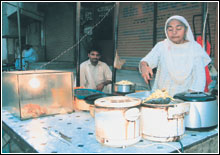 One woman whose life has been a long struggle is Shahjahan Begum. Born in Delhi some 75 years ago, she and her parents landed in Rawalpindi at partition. Later they moved to Karachi. Here she was married to a man 25 years older than her. They had six children whom the man could not feed.
Shahjahan came to the rescue and tried to employ her rudimentary skills in stitching. But at some stage, her husband went his separate way and left her to look after the children. Shahjahan Begum went out to work in factories to feed the six boys, two of whom died young. She tried her hand at cookery and established a small shop, where she now sells potato chips, samosas and rolls. Her youngest son, who has six children, lives with her in an 80-square-yard house in Bhitai Colony. The other three sons live on their own. She is content with what she is earning and the respect she commands as the ‘Chipswali Amma”.
— Karachian
email: karachi_notebook@hotmail.com
'You can't say yes to Israel, no to Iran'
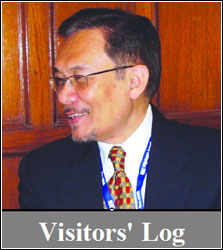 WHILE advocating nuclear non-proliferation, a former deputy prime minister of Malaysia, Dato Seri Anwar Ibrahim, is critical of the world community’s double standards vis-a-vis Iran and others and calls for a more effective monitoring mechanism to ensure that nuclear capability is not used for military purposes.
“You can’t say no to Iran and yes to Israel, you can’t say no to Pakistan and yes to India. Non-proliferation means a consistent policy,” said Mr Ibrahim while talking to Dawn on the sidelines of the 10th Management Convention here last week.
“If you allow peaceful use, then it is fair, and India, Pakistan, Iran or Iraq should also be allowed, but you have to have a more effective monitoring agency to ensure it is not meant for harmful military or defence establishments.” He said the “issue has angered the Muslim countries because they see that inconsistency”, and noted that the issue had brought the Iranian people together.
Asked to comment on the impact of the Iraq war on Muslim countries’ relations with the West, particularly the US, Mr Ibrahim was of the view that the decision to wage war was a flawed decision. “Not only it was unilateral but indefensible, and there is growing sentiment throughout the world against what is now called aggression. The Iraq war had now become a major issue in the Muslim world and reflected the arrogance of power on the part of the United States. But Mr Anwar cautioned that many Muslims, including authoritarian leaders were using this as an excuse to cover up their corruption and repressive measures in their own countries and societies. “So that is why I don’t share this hysteria against America, but reserve the right to criticize.” At the same time he called for addressing the problems within the Muslim world.
When asked what kind of exit strategy for the Americans from Iraq and Afghanistan was possible, Mr Ibrahim, now a consultant on strategy, was of the view that it was getting to be so complex that an immediate exit would be condemned as irresponsible. “But I think that the Turkish initiative about an axis among the neighbours in Muslims countries together with the western world as a multilateral arrangement is probably more credible.”
But for that one had to engage with all section of Iraqis. And what was also important, whether the US liked it or not, was that it must engage with Iraq’s neighbours, Syria, Iran, Jordan, Kuwait and Turkey.
Commenting on the conflict between East and West, Mr Ibrahim said the present divide was one factor but stressed that there were “some friends who are more willing to continue a discourse based on reason and not just on anger”. It is true that some states in Europe suffered from Islamophobia. But this did not represent the entire West “It is not Kipling’s east is east and west is west and never the Twain shall meet. I think there are quite a number of friends in the West too who appreciate the need for dialogue and engagement and take a more sympathetic view of the Muslim world. Similarly within the Muslim world there is also internal dynamics between those who want to reform and support the cause of freedom and those who want to perpetuate their authoritarian order and also the call by some fanatics for violence and militant actions.”
Mr Ibrahim quoted the Indian scholar Abul Hasan Ali Nadvi, to say that “finally you are judged by your commitment to justice and freedom and not by whether you are East or West... So I think this is what we need to push. There are extremes on both sides but I don’t see it essentially as an East-West dichotomy”.
He was of the view that the “OIC is not effective. “It is unfortunate that now Malaysia is chairing it and they have not done anything.” But we have to rethink and reinvent in the light of the new dictates. I think the Turkish prime minister is thinking of proposing a new format.”
Mr Ibrahim, who was sacked from the government on Sept 2, 1988, later stripped of his party membership and incarcerated on Sept 20, regained his freedom in 2004 after acquittal by the Malaysian federal court. He is confident of returning back to Malaysian politics. I am very much in touch with the Malaysian political scene - with the president of the Justice Party, and am working towards a broad coalition of opposition of the Justice Party, the Democratic Action Party, the Islamic Party and also some progressive civil groups - despite limitations and the unfree media in Malaysia. — Shamim-ur-Rahman



























