0
0

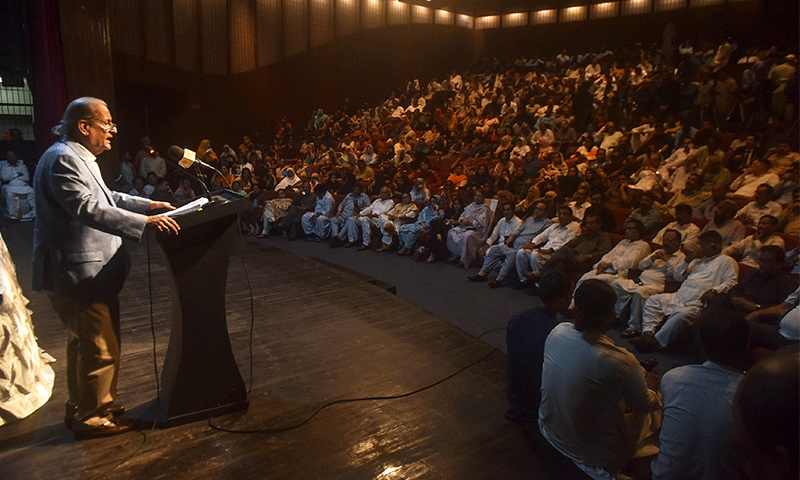
KARACHI, Feb 3: The Higher Education Commission will establish five law varsities, one each at four provincial capitals and Islamabad, which will offer an integrated five-year programme after intermediate level education, said chairman of the commission Dr Attaur Rahman.
Speaking at a press conference at the HEJ Research Institute of Chemistry on Friday, Dr Atta said that at present the country did not have any law varsity and as such the federal government had in principle agreed to establish and run five law varsities of international standard. The land for law universities will be provided free by the respective provincial governments and the CDA.
The HEC chairman remarked that the existing law education institutions in the country generally lacked permanent faculty members, but the HEC had planned to have full time faculty at all the proposed law varsities.
Students at these varsities will be imparted education in subjects of social sciences and economics as well and will be equipped with communication skills also, he added, saying that a committee comprising former chief justice Nasir Aslam Zahid, Justice (retd) Salim Akhtar, the Attorney General of Pakistan and others had already been formed to guide and formulate workings towards the establishment of the proposed universities.
He informed that projects papers for the five law universities would be probably presented in the next meeting of the Central Development Working Party (CDWP). It is likely to cost about Rs5 billion on the establishment of the five varsities, Dr Atta added.
Talking about the overall improvement in the public sector varsities in the country, he said that the HEC’s measures were aimed at bringing qualitative changes in the teaching, training and research activities. It is unfortunate that during the last fifty years we could not have a single university of international standard in any branch of the higher education, he noted.
Dr Atta said that the engineering varsities had also been failing to attain any standard as far as production of PhDs was concerned. He hoped that the establishment of the proposed six federally controlled engineering varsities at Karachi, Lahore, Peshawar, Sialkot and Faisalabad, costing Rs800 to 900million each, would help meet the international standards.
He said that the tenure track system had been introduced in the varsities to ensure quality of education and foster research. So far 32 varsities have adopted the tenure track system, under which the salary of a professor can be four times more than that of a federal minister.
Dr Atta said that students sent abroad under the HEC Overseas Scholarship scheme for PhDs in selected fields would start coming back next year and onwards. The scholars will be placed at the public sector varsities and degree awarding institutions under the tenure track system of appointment upon their return, he added.
He also referred to PhD level foreign training of faculty members of universities, ensuing digital library programmes at the varsities, video conferencing systems, grant of an amount up to Rs3 million to every university for mega development projects and other measures and hoped that all these would effect the qualitative and quantitative changes in the varsities.
Dr Atta said that a high quality video conference facility would start later this year enabling the institutions of higher learning to have the dissemination of live lectures from top varsities of the West to the local students and faculty members.
Replying to questions he said that in future the HEC would not recognize or endorse those PhD degree holders who would have not cleared the international graduate record examinations and as such chances of getting jobs in the government sector for such candidates would diminish ultimately.
He said that only three per cent youngsters in the age group of 17 to 23 years had access to higher education in Pakistan, where as this percentage in India was seven per cent and in Korea 68 per cent.
Dr Atta said that actions against illegal and substandard varsities had also been initiated.
Names of the institutions operating without acquiring government charter in any shape are being provided to law enforcing agencies for their closure. On the other hand higher education institutions, both in the government and private sectors, are required to meet the HEC set criteria for quality education latest by Feb 2007, otherwise they would be deprived of university status and allowed to function only as colleges affiliated to varsities only, said the HEC chairman.