



 0
0

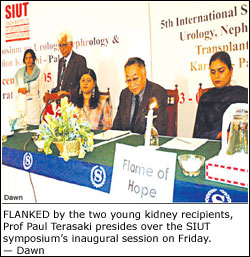 KARACHI, Dec 2: Two leading specialists of organ transplants have called the medical professionals of the world to unite and work together for the betterment of the ailing humanity and to meet the challenges of tomorrow.
The experts, Prof Paul I Terasaki from USA, and Prof Adibul Hasan Rizvi from Pakistan were speaking at the inaugural ceremony of the 5th international symposium of the SIUT on Urology, Nephrology and Transplantation at a local hotel on Friday. Technical sessions of the symposium would be held at the Dewan Farooq Medical Complex of the SIUT on Saturday and Sunday.
The inaugural session was inaugurated by Prof Paul Terasaki, jointly with two young kidney recipients, Dr Afshan and Ms Uzma Sultan.
The ceremony provided some touching moments to the local and foreign delegates of the symposium as the two young woman kidney recipients also shared their experiences before and after transplantations.
Prof Terasaki led the two recipients to the stage amidst clapping and mentioned that they were the real product of hard work and sincerity at the SIUT.
In his presidential remarks, Prof Terasaki, who is a professor (emeritus) of surgery at the University of California and also serving on the editorial boards of prestigious journals on transplantation, clinical nephrology and human immunology, lauded the efforts of the SIUT and said that he had not seen any success story like the transplantation institute headed by Prof Adib.
He emphasized for a philosophy of assembling the government, community and doctors together, which could give an example of a world working together, without maintaining geographical boundaries and colour or cast differences.
Prof Adib gave a resume of the working of the SIUT in the fields of urology, nephrology, transplantation and hepato-gastroenterology and provision of services to hundreds of thousands of poor people from all over the country every year.
He said that the SIUT mainly based on charity and philanthropy, but never neglected anybody seeking treatment on the ground that he or she was not in a position to afford the cost.
We are among the countries which mainly had two options pay or die, while at the SIUT our motto is “don’t let anyone die because he or she cannot pay”, he said categorically.
Prof Adib said that the SIUT was a public sector tertiary institute serving patients from all walks of life and mainly the poor and the needy. It started in a modest way with an 8-bed unit in 1970 and is now an institute with over 350-bed facility with 26 out-patient departments and having affiliations with institutions in UK, Germany, Netherlands and Sweden, he added.
Prof Adib hoped that with the passage of the cadaver donation bill in the national assembly, as promised by the authorities from time to time, the SIUT would become more beneficial to the humanity as a whole as it would help providing thousands of end stage kidney failure patients a new lease of life.
He said that with the availability of cadaver organs, the SIUT would be able to perform three transplants every day.
Prof Adib appreciated the efforts of his team of doctors saying that the SIUT also had a team of dedicated and well-trained professionals with all the expertise to perform organ transplantation.
He said that the recently launched SIUT Institute of Transplant Sciences and Biotechnology would provide advanced education and training to all the future scientists related with organ transplantation and basic sciences.
Prof Adib said that the coming era was full of hopes and challenges and only those communities would survive who believed in supporting each other and were ready to share the information, experiences and resources with the less privileged ones.
Earlier, Dr Afshan Beg, 27, said that she developed end stage renal failure in 1995 and was on dialysis for 8 months before the transplant of kidney donated by one of her brothers. After graduating from the Sindh Medical College in 2002, now I am leading an active professional life.
Narrating her experience, Uzma Sultan, the other recipient, said that she was totally dejected when she learnt about her kidney failure and thought her world had come to an end at the age of 20 years.
“SIUT gave me a second lease of life by transplanting a kidney donated by my mother,” she said and mentioning that she was normal now and pursuing her education in the university.
Dr Fatema Jawad and Dr Zafar also spoke on the occasion.




























