What the crisis demands
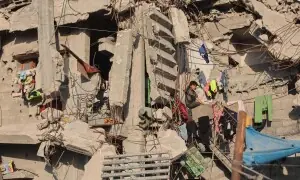
WEDNESDAY’S announcement by the federal relief commissioner raising the death toll for the Oct. 8 earthquake from 57,597 to 73,276 will perhaps drive home the point that the country faces a rescue, relief and rehabilitation task of enormous magnitude and that it could last a decade or more. While the death toll is lower than that of last year’s tsunami, international experts and the UN have pointed out the scale of devastation in the case of the quake being more severe. The tsunami affected a relatively narrow coastal strip in the countries that it hit compared to the far larger area affected by the quake, which makes the task of relief and rehabilitation much more daunting. As high as it already is, the death toll may well still rise higher because quite a few mountain villages have not been reached yet. Over 69,000 people have been injured and 3.3 million rendered homeless. A sizable proportion of those injured will be physically handicapped for the rest of their lives given the high number of amputations. In addition, many have lost their entire families which makes the process of rehabilitation all the more difficult in view of the survivors’ need for emotional and financial support to pick up the thread of life again.
While the role of the volunteers, doctors, relief workers, army personnel, helicopter pilots and students who have volunteered their time and effort as well as of private and corporate donors has been commendable, one wonders whether those who have not seen the devastation, affected areas or met survivors are able to grasp the enormity of the crisis. For instance, tent villages have been put up by the government but reports say that many of the tents are too flimsy to provide adequate protection against the oncoming bitter winter. Also, the numbers of tents that have been provided is far less than what was initially sought by the government for the survivors. Sanitation and providing safe drinking water and adequate food should be other areas of concern. Several deaths have already happened because of tetanus. On Thursday, a senior UN official said that seven child survivors of the quake had died of water-borne diseases. Scabies (a skin infection caused by mites) and measles have also been reported from various areas.
A serious shortage of funding is becoming increasingly evident. In response to a UN flash appeal urging member states to donate a total of $500 million, only $122 million has been pledged. Unless more money is made available — and soon — it will be difficult for the World Food Programme to provide emergency food for winter to 2.3 million affectees and this factor alone could sharply raise the death toll among the victims. The advent of the chilly winter already there in the areas at higher altitudes — coupled with lack of proper shelter and medical aid — also means increased vulnerability of survivors to very many diseases. This means that the ordeal for many survivors is only beginning. The government and its partners in the relief effort will have realized a crucial determinant in dealing with the various aspects of the crisis is more money from both internal and international sources and that is why President Musharraf has made an ardent appeal for sustained international support. One hopes the response to this appeal will be both prompt and generous.
A better KESC?
WITH the cabinet’s approval of the sale, the management control of the Karachi Electric Supply Corporation goes over to a newly-restructured consortium led by a Pakistani firm in partnership with a Saudi group. The government will now gain Rs 20.2 billion from the KESC’s privatization, besides another Rs 16 billion from the “proceeds”. More significantly, the billions of rupees which the government pumps into the KESC every year to keep it going could now be ploughed into the social sector. However, the issue needs to be looked at from the point of view of the people of Karachi, who have been victims of the KESC’s inefficiency and its frequent shutdowns and failures for decades, no matter whether it is summer or winter. Over the years, instead of improving, the quality of the KESC’s service has gone down. In addition to “load-shedding” announced in advance, there are snap blackouts. The causes for these outages range from wires that snap to cable faults and the “tripping” of power-generating units. The sufferers are the consumers, who live without electricity for periods that may range from six or seven hours to a full night or more - sometimes 24 hours. While there may be power deficit, the consumers’ suffering also stems from inefficiency, poor maintenance and bad repair jobs.
The people of Karachi will now watch the performance of the new management with great hopes. It has pledged to bring light to the lives of the people of Karachi and fuel economic growth. All one can hope is that the new owners will be true to their words. The task before them is how in conjunction with other power producers they can narrow and ultimately wipe out the gap between demand and supply, re-equip and overhaul vital installations, improve the quality of the network by having better wires and other material, eliminate theft and line losses and replace the present blackout-prone system with a more efficient mode of operations that is in keeping with the requirements of a modern metropolis with a population of over 10 million. What the people need is uninterrupted power supply at a reasonable cost instead of what they are getting at present — poor service at an unusually high cost.
Inefficient ATMs
ACCORDING to a report, scores of people in Karachi faced innumerable difficulties using automated teller machines (ATMs) in the last few days, unable to access their hard-earned money to spend on the occasion of Eid. Most of the customers quoted in the report, complained of running from pillar to post in an effort to withdraw cash at several of their banks’ ATMs but were unable to do so. Unfortunately, this is not a problem restricted to holidays. A cursory glance at the letters column of major newspapers shows how peeved customers are with ATMs. Complaints range from the non-availability of funds in ATMs to ATMs being simply out of order, from failing to get a receipt to debiting one’s account without having dispensed the cash. What was supposed to make life convenient — access to cash 24 hours a day, less waiting time at the bank counter and less operating costs for the bank itself — has instead caused numerous problems. All of these point to the indifferent attitude of banks. With more and more people availing themselves of ATMs — especially after March last year when a decision was made to allow account holders to use ATMs of other banks too — one would have expected banks to make the process of cash withdrawal far easier, not worse.
What compounds the frustration on this score is that grievances are not properly addressed by banks concerned. The introduction of a banking ombudsman, whose appointment was made into a law in 1997, has failed to make the desired impact as consumers are unaware that they can take their grievances to the ombudsman who can take action against the erring bank. Banks whose ATMs perennially cause problems should be taken to task for inconveniences caused to customers.
Dhaka’s coming of age
DHAKA seven years ago looked like an adolescent unsure of itself: it was a disorderly, chaos-ridden, confused and unconfident child that its parents seemed to have all but abandoned it. Less than a decade later, it looks like a young, responsible adult with a sense of destiny of its own and eyes set on the future. The capital of the nascent democracy that is Bangladesh is coming of age — fast.
Gone are the hundreds of thousands of slums along the major arteries and shantytowns built around water-logged pools of standing floodwater that refused to drain, and caused malaria and diarrhoea — those death knells for the teeming poor’s children. The city has been cleaned up so meticulously that these disturbing images of the past seem like phantoms of ancient folklore.
A drive several miles out of the city in different directions confirms that the disappearance of these eyesores is real and not just a cosmetic relocation. The sight of cycle-rickshaws, that ultimate image of basket-case poverty, is also on the wane, giving way to economy and luxury, privately-owned cars.
The non-motorized three-wheeler is increasingly being seen as a receding phenomenon, and thus given the pride of place in the lobbies of five-star hotels. Cycle rickshaws there are, no doubt, but they do not have the omnipresence that one was accustomed to seeing, and the city’s busy thoroughfares are certainly free of these.
The new prosperity seen in the Bangladeshi capital is unparalleled in Dhaka’s history. A burgeoning middle class, comprising young, educated men and women, confidently walk the crowded streets as they go about their daily routine. These are the clerks, business associates, secretaries, young MBAs and professionals who make up a literate urban workforce. Side by side are the semi-literate workers belonging to the industrial workforce, the service industry, petty trades, small businessmen and women; gender equality seems to be a growing part of the emerging equation.
A beeline of what appears to be a newly empowered class of semi-literate young immigrant women from the rural hinterland comes out of innumerable factories and workshops at the end of the workday. On the way home, these young women are seen picking up grocery or just stopping by for window shopping at the new glossy malls that now line the old and new commercial streets in parts of the capital.
This sea change, as many will argue, has come about as a result of Bangladesh’s ‘look east’ policy in recent years. To the immediate west of the country lies the inter-trade-wise inactive Saarc region, home to the world’s largest number of poor found in any one region. The India-Pakistan rivalry has stalled regional progress, leaving those Saarc member states that are not party to the political and nuclear one-upmanship in South Asia to seek economic benefits elsewhere.
Foreign Minister M. Morshed Khan eloquently explained his government’s economic priorities to this writer, saying time for passing declaratory resolutions was over, and now “if we can’t back up those declarations with action, we’ll be left behind.” This, he said, his country could not afford to do.
Expressing his frustration, Mr Khan said, “We are not waterlogged, for we can tackle that problem. We are India-logged, and to an extent India is also Bangladesh-logged; we have to find practical ways of solving our problems and move ahead.” He then went on to explain that the South Asian Development Fund, set up five years ago, had yet to be agreed upon as to which of the Saarc countries would manage it. Terming it a ‘sad’ fund for those who desperately needed it, Mr Khan hoped that the forthcoming Saarc summit in Dhaka would break the ice on this issue.
Alternatively, Bangladesh in recent years has worked hard to improve and augment its economic relations with Myanmar, Thailand, Malaysia, China and many other South-East Asian countries. Frequent exchange of visits with these countries has helped Dhaka define for itself a vision for the future that entails emulating some of the success stories east of South Asia. That the policy is working is evident from the way Bangkok-look-alike shopping malls have come up in Dhaka.
The way the city has been cleaned up is also reminiscent of the new prosperity seen in emerging South East Asian economies, where the hitherto small towns — Chiang Mai and Hat Yai in Thailand and many others in China — were the backwaters of those countries not too long ago.
The Dhaka chamber of commerce president Mr Sayeeful Islam said many untapped opportunities existed for cooperation between Bangladesh and Pakistan, especially in the garments sector. “We have special quotas in western countries but we can only meet a fraction of the total demand. Joint ventures with Pakistan can be mutually beneficial.” Earlier, the foreign minister had also pleaded for removing trade and duty barriers to facilitate such ventures.
Visiting Dhaka today, no one can doubt that the Bangladesh Nationalist Party-led coalition, despite its many shortcomings, has done something right in its ongoing four-year stint in power. The turning tide has seen the most critical of the opposition Awami League MPs return to parliament for fear of being rendered irrelevant. This is a big break from a political past when the BNP and the AL took turns as opposition parties to pull the rug from under the feet of ruling party. There is a shared feeling among the treasury and opposition MPs that there is a lot more that needs to be done.
That there indeed is a long road ahead that must be traversed remains all too evident among officials and ruling politicians today. They have no time to boast of their successes; often it is the regret on failures that haunts them, even though the opposition has stopped demanding an early election. The democratic strength of the system in place can be gauged by the fact that unlike our politicians, Bangladeshi ruling party and opposition MPs do not badmouth their adversaries when talking to foreigners even though polarization between them remains quite intense. Instead, they talk about issues that confront the country.
This is the kind of evolved public responsibility on the part of the politicians that an emerging democracy must have in order to keep marching ahead, setting goals for the future and deadlines to achieve those goals. The press, both the vernacular Bangla and the English-language, is ferociously independent and critical of the government’s faults and failures as they see them. There is a sense of alarm in the media about rising prices of daily-use commodities, and what is seen as growing religious fundamentalism, although there is nothing that meets the eye in the street to confirm the concerns on account of the latter.
Dhaka’s bazaars and shopping malls did not observe a shutter-down during the Iftar-Taraweeh hours, as is the norm in Karachi. The city did not even shut down for the last of Ramazan’s Friday prayers. It was business as usual in the surrounding areas of the Baitul Mukarram, a leading mosque located in the heart of the commercial business zone of Motijheel. Though Friday remains a public holiday, hectic commercial activity that one saw was due to the rush for Eid shopping.
The city’s restaurants and the few bars that are there stayed open during the holy month, even though the vast majority of Bangladeshi Muslims religiously observe the fast and say their prayers. But they do not flag their religious sentiments about, preferring to keep the matters of faith a personal affair. Similarly, religion is not part of the social or intellectual discourse, much less a selling point for an obscurantist agenda subscribed to by a handful of regressive elements, who are virtually the outcasts of society.
Why, then, is the press crying wolf about growing fundamentalism? Information Minister Mr Shamsul Islam explained that the press was free to draw its own conclusions regardless of the reality on the ground which was there for all to see. The temperament of the people of Bangladesh was such that they could not be drawn into religious fanaticism, he said. This certainly seemed to be the case. “The press in the past has suffered a lot at the hands of dictators; it has earned the freedom it enjoys today, and it will take some time before it stops seeing red where none exists. It’s all part of an evolving democracy,” he concluded.
The writer is an assistant editor of Dawn who visited Bangladesh recently.
| © DAWN Group of Newspapers, 2005 |