



 0
0

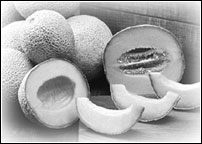 Musk melon (Cucumis melo) is a creeping cucurbit and a popular crop with lots of medicinal values. It is considered as tonic to heart and brain, and is laxative and diuretic. It is a good source of Vitamins A, B, and C and all its parts are used including the rind, seed and outer skin.
In Sindh, musk melon is cultivated on large scale as compared to other provinces. It is grown in Kacha and irrigated areas and is known as one of the cash crops of the province. There are many varieties but farmers grow only ‘golden’ and ‘dharidar’.
Musk melon requires more heat and the plant can not survive below 20º C. Hot and dry air and sunshine during the fruiting period are important factors for high sugary taste. For germination 27-29º C is required. Clay soil is best where crop is not irrigated. In Sindh it is mostly cultivated in Thatta and the main markets are Karachi and Punjab. This crop gives reasonable returns to growers and marketing agencies.
A good land preparation is necessary for proper and rapid growth. Normally one deep ploughing is carried out for opening soil surface and is left for few days to get air and sunlight. Growers then use gobble two to three times followed by two to three cultivators. The majority level their lands while the rest do not.
Time is an important factor which gives best results. There are two crops winter and summer. Winter crop is cultivated on 70 per cent of land and is planted in December-January which matures in 105 days and gives produce for more than three months. Summer crop is planted in July-August and matures in 60 days. About 40 per cent grow only winter crop.
Sowing musk melon through drill is a common practice. The two types are tractor-driven and the bullock driven drill. About 99 per cent use former while only one per cent the later. There is a common problem of fungus attack on seed which should be treated with any fungicide. Majority do not apply fungicide before sowing.
Farmyard manure is necessary to keep the plants healthy as it fulfils nutritional requirements. It contains about two per cent N, 1.7 per cent K2O and 0.4 per cent P2O5, while fresh poultry droppings contain twice as much N, and are much richer in P2O5 and K2O. Soil fertility level should be maintained through regular application of the FYM. This year about 56 per cent of growers did not apply the FYM. Growers normally apply 2.5 trucks of the FYM per hectare costing around Rs2,500 per hectare.
Growers do not follow recommendations made by the Agriculture Department and use fertilizer on their own. Around 96 per cent apply below the recommended dose. The most common insect attacks are fruit fly, white fly and leaf cutter. The most common disease is Downey Mildew.
There are a number of musk melon varieties under cultivation but only two golden and dharidar are commonly grown. Data indicate that 55 per cent growers plant the first variety while 17 per cent the second with 28 per cent planting both. The yield varies from farm to farm due to variations in soil, land preparation, and insects-pests and diseases attacks. The summer harvest ranges between 533 and 800 crates (15kg crates) per hectare, while winter crop ranges between 1,066 and 1,333 crates per hectare. The main reasons for low yield are improper fertilizer application, poor land management, old varieties, unsuitable climatic conditions and low use of the FYM.
Musk melon prices vary during the season due to alternative fruit bearing, and disproportionate supply and demand. In early harvest prices are higher than the mid and late sessions.
The analysis of musk melon is based on the primary data collected from Thatta where majority of the growers are “Abad Gar”, which have come from Punjab and grow the crop on rented land. Landowners due to the lack of knowledge and finance are unable to earn from this crop.
There are a number of hurdles faced by the producer from sowing to marketing such as production losses and marketing constraints. In production, the major problem is the wastage of fruit due to pre-mature bursting and decaying.
The growers discussed the problem with experts, horticulturists, soil chemists and officials of the Agriculture Department but without any solution. Adverse climatic conditions too play havoc which is rare. Heavy rainfall or cool breeze destroys the crop. There are few marketing problems except for price variation which proves that there exists a tremendous scope of musk melon cultivation in lower Sindh.
It has been indicated that major inputs such as the FYM, fertilizers, and pesticides spray affects production. Growers should sow both summer and winter crops to earn more profit.
The current environment is characterized by the lack of information, non-availability of research and extension support, high transportation cost and lack of interest by the owners. Musk melon yields high returns than other crops. As growers from Punjab are particularly attached with its cultivation in Sindh, therefore it is suggested that the local landowners must begin musk melon cultivation.
Among Sindh growers, lack of finance is a major problem. Credit should be arranged on low interest rates. Given the resources and extension difficulties, it would be best to target such efforts at the farm level. There is a need to maintain the soil fertility through organic and inorganic sources. Growers should seek guidance from the local available resources such as research stations, extension agents and progressive growers of the locality.




























