0
0

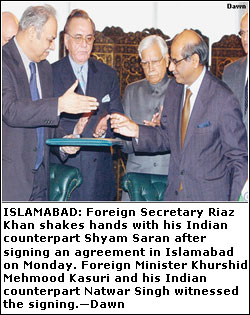 ISLAMABAD, Oct 3: Pakistan and India on Monday signed an agreement on pre-notification of flight-testing of ballistic missiles and a memorandum of understanding for the establishment of a communication link between the Pakistan Maritime Security Agency and the Indian Coast Guards.
The accord and memorandum were signed after the 90-minute delegation-level talks between Foreign Minister Khurshid Kasuri and his Indian counterpart Natwar Singh at the Foreign Office here in the afternoon.
The signing of the agreement on ballistic missile tests coincided with the testing of two air defence missiles in India.
However, the missiles tested are not covered under the agreement. The agreement that emanates from the MoU of Feb 21, 1999, is aimed at preventing misunderstandings and misinterpretations and promoting peace and security between the two countries.
The agreement, which became effective immediately, will remain in force for five-year, after which it will automatically extend for another five-year.
The agreement is open to amendments and any party can withdraw from it after serving a six-month notice.
This is the second nuclear-related agreement between Pakistan and India. The first agreement was on the ‘Prohibition of Attack Against Nuclear Installations and Facilities’ that was signed by the two foreign secretaries on Dec 31, 1988, and ratified on Jan 27, 1991.
Defence experts see the pre-notification agreement as a significant confidence-building measure, pointing out that the two nuclear capable neighbours need to have an effective and reliable channel of communication to ensure that there is no accidental or unauthorized launch.
“It is a very useful measure and will avert apprehensions particularly when relations between the two countries get tensed,” said Dr Shireen Mazari, a defence analyst and director-general of the Institute of Strategic Studies Islamabad.
The MoU on establishing a communication link does not indicate a timeframe.
TALKS: Earlier in the day, the two foreign ministers held a review session of all aspects of the second round of the composite dialogue that covers eight subjects, including Kashmir, and peace and security.
Endorsing the recommendations of the two foreign secretaries in their last month’s meeting, the foreign ministers reiterated their commitment to the ongoing peace process.
“The tone of the talks was positive and both sides reiterated their desire to take forward the dialogue process,” a Pakistani delegate told Dawn after the meeting.
The two sides agreed that the third round would start in January 2006 and conclude by July 2006.
The foreign secretaries, high commissioners and senior officials of both the foreign ministries were present on the occasion.
After the formal talks, the two foreign ministers left for a Nathiagali hill resort where the NWFP governor hosted a lunch for them. The two ministers continued informal talks for over an hour.
A joint statement would be issued on Tuesday and it might spell out a roadmap for resolving the Siachen and Sir Creek issues, informed sources told Dawn.
SARAN: Later in the afternoon, Indian foreign secretary, who is accompanying Mr Natwar Singh, briefed journalists about the meeting at a separate news conference.
He maintained that both the foreign minister had expressed satisfaction over the second round of the composite dialogue and shared the view that the results of the second round were better than the first. They were optimistic that the outcome of the third would be even better.
He said the two countries would formally revive the Joint Commission on Tuesday after 16 years.
Mr Saran mentioned that the two foreign ministers had also talked about Jammu and Kashmir, peace and security and cross-border terrorism during the informal talks in Nathiagali.
In the context of the resolution of the Kashmir issue, he ruled out the possibility of any territorial changes. His emphasis was more on alleviating the miseries of the Kashmiri people by establishing meeting points along the Line of Control, promoting cross-border trade and starting additional bus routes etc.
They, Mr Saran said, also discussed economic issues and the Indian side suggested regularizing the land route trade. A ‘Made in India Fair’ would be held in Pakistan next month, he told newsmen.
Mr Natwar Singh had informed Mr Kasuri that India would very shortly be releasing another 30 Pakistani prisoners, he said.
He announced that Mr Natwar Singh would be meeting his “old friends” in the evening, including Sahibzada Yaqoob Khan, Agha Shahi, Niaz Naik, Shehryar Khan, Humayun Khan, and Riaz Khokhar.
RIAZ KHAN: Foreign Secretary Riaz Mohammad Khan, at a separate news conference in the evening, said the talks were held in a positive atmosphere and the two sides agreed on maintaining the integrity of the composite dialogue.
The two countries, he said, expressed their determination to carry the process forward and improve its momentum. While stating that there had been progress in a number of areas, he specifically mentioned Siachen and Sir Creek issues.
“There was an exchange of views and ideas on Siachen and Sir Creek between the two foreign ministers and there is a possibility of some progress in these areas,” he said in reply to a question.
The foreign secretary disagreed with the view that the Kashmir issue was on the back burner and underlined that it was a priority issue for Pakistan and had been raised at every level and figured prominently in both rounds of the composite dialogue.
In reply to a question, he said: “There is no cross-border terrorism taking place.” He said violence in the occupied Kashmir was linked to the human rights situation there.
He told a questioner that Pakistan had raised the issue of troop reduction and human rights situation in the held Kashmir with the Indian side, but did not explain it.
About the peace progress, he said: “We want to address all issues, including Jammu and Kashmir, at a much faster pace.” He said discussions were now focusing on dispute areas and might pave the way for solutions. “We have to proceed on the basis of hope,” he emphasised, adding that both sides also needed to show sincerity, courage, and flexibility.
The foreign secretary made it clear that an LoC-based solution would neither be acceptable to Pakistan nor to Kashmiris.