Inter-faith dialogue
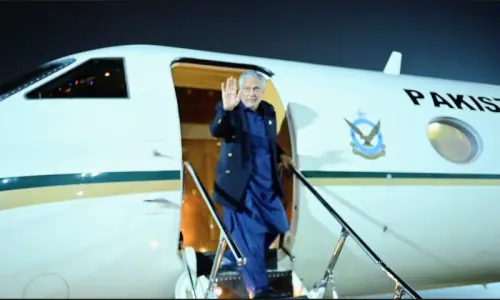
IT is a pity that relations between Muslims and Jews should be viewed through the prism of the Arab-Israeli conflict. Israel came into being in the middle of the last century, touching off a political conflict that has lasted till this day and will continue until the formation of a Palestinian state. However, relations between Muslims and Jews are more than a millennium and a half old. That period was characterized by two things: one, ruthless persecution of the Jewish people in Europe, and, two — in contrast — the peace and security the Jews enjoyed in the Arab-Islamic world. This is not a defensive argument but a fact of history. One only has to read books by Jewish scholars — one such is My People by Ebba Eban — to realize the extent of trust, harmony and social interaction between Muslim and Jewish people. Jews occupied important positions — especially those concerning state finances — in the Arab caliphate and were often viziers. The most glorious period of Arab-Jewish cooperation was in Muslim Spain, to which President Pervez Musharraf referred in his address to the American Jewish Congress in New York on Sunday. Following Reconquista, Ferdinand and Isabella slaughtered not only Muslims but also Jews. But the Jews found refuge in the Ottoman empire.
All this, however, belongs to history. Today, the generosity and broad-mindedness that characterized Muslim statecraft has ceased to exist. By and large, the majority of Muslim people still abhor intolerance and violence, but a microscopic minority has done incalculable harm to Islam and to the Muslim peoples’ relations with the non-Muslim world. The crime on Sept 11, 2001, and the murder of the innocent in Madrid, Bali, Istanbul and London have given a chance to an equally schizophrenic minority in the West to stigmatize all Muslims and their faith. Some sections of the western print and electronic media have made it a practice of maligning Islam and Muslims by focussing on some negative aspects of Muslim societies as they exist today. This is counterproductive, because such perversity only adds to Muslim grievances against the West.
Pakistan has drawn some flak from the western media, because its image has been tarnished by its involvement at one time with the Taliban and the activities of religious militants. As a leading Muslim country, Pakistan must, therefore, make a determined effort to reach out to those who have fallen victim to the unabashed anti-Muslim propaganda. All Muslims are portrayed as potential terrorists and fanatics bent on killing non-Muslims. This profiling of the Muslims and the anti-Islamic schizophrenia in the West needs to be tackled through a dialogue. It is in the fitness of things that Pakistan should make a difference between Israel and the Jewish community in the world. All Jews did not support the creation of Israel, nor do all Jews, even those who believe in Israel’s right to exist, approve of its policy of state terrorism against the Palestinians. The president’s address to the Jewish Congress was thus a bold step and deserves to be commended because it seeks to open a dialogue between Muslims on the one hand and Christians and Jews on the other. It needs to be emphasized, though, that a non-resolution of conflicts like Palestine and Kashmir are a major source of discontent and militancy in the Muslim world.
Afghan polls
THE immediate reaction to Afghanistan’s parliamentary elections on Sunday must be one of relief that the polling was held peacefully and took place without any large-scale disruption. The Taliban had warned Afghans against voting and threatened to attack polling stations. The threats did not materialize and the people apparently defied the Taliban in turning out to cast their ballots. Voter participation was said to be less than the 70 per cent registered during the presidential election last year, but in the circumstances constituted both a fitting rebuttal of the Taliban and an indication of the ordinary Afghan’s enthusiasm for participation in the country’s political process. It should strengthen President Hamid Karzai’s hands and help him in extending his existing limited mandate, although for this he may have to rely on some of the warlords who got elected and who will demand control over their fiefdoms. Smarting under the rebuff dealt to them by the elections, the Taliban may step up their militant activities. The need, therefore, to continue efforts to isolate them will remain pressing. A particularly encouraging feature of Sunday’s exercise was the respectable turnout of women.
The last parliamentary elections were held in 1969 under King Zahir Shah and prime minister Nur Ahmed Etemadi. Although a bill had earlier been passed legalizing the establishment of political parties, the king had not signed it, and all candidates had stood as independents representing various regional interests. This time too the elections were held on a non-party basis. The evolution of a society from a monarchy based on a system of tribal loyalties to a functioning democracy is a difficult process. Afghanistan is passing through a particularly painful transition. It has gone through foreign intervention, revolutions, civil wars, rule by religious terror and attacks and occupation by the US. It will take more than ordinary effort by its leaders to stabilize the country and make democracy work. It is the responsibility of Pakistan and Afghanistan’s other neighbours to do everything possible to assist Kabul and President Karzai in moving forward. The election results will take some time to be finalized, and the actual political chequerboard thrown up by them will be interesting to watch.
Demolishing cultural heritage
WILL somebody in government step forward and explain why Karachi’s Beaufort Building — an imposing sandstone relic dating from the Raj era — is being demolished despite its protected status? There is mystery surrounding the whole affair as the authorities have not been able to prevent its piecemeal demolition, despite sealing the building. Unfortunately, the move is of a piece with the whole process of crass commercialization that has come to dominate the cityscape, and the Beaufort Building is the latest target of unscrupulous constructors responsible for obliterating the architectural glory of the past and creating eyesores instead. The demolition of Palia House in the 1990s and the more recent move to raze the Shikarpuri Cloth Market on M.A. Jinnah Road are but two examples of the indifference besetting our civic organizations.
What is perhaps equally perplexing is the lack of action on the part of the citizenry. There is no denying that private organizations and individuals have played a part in rescuing some monuments of historical value from the destructive hands of builders. But, judging by the speed at which the city’s architectural gems are vanishing, their efforts seem to have been in vain where jogging the conscience of the public is concerned. In a city where the population is growing at an alarming rate, highrises and plazas accommodating families and businesses will always be welcome. But has this to be at the cost of our cultural heritage? The public — and KBCA and archaeology officials — need to answer this before it is too late.
From Baghdad to New Orleans
IN 1962 social reformer Michael Harrington published The Other America, a startling expose of the plight of tens of millions of citizens ill-fed, ill-clothed and ill-housed despite a vibrant economy churning out a tremendous stream of flashy goods. His heretical best-seller shook up an ‘affluent society’ that managed to overlook the ugly poverty in its midst, a social blight complicated, as are all things in America, by racism.
So in the 1960s the US government started in modest ways to help the poor and, accordingly, scored modest successes. But the financial drain of Vietnam, as Martin Luther King foresaw, soon obliterated any chance that US elites might spare enough change from their bulging pockets to end needless poverty. Such a goal still seems a utopian dream in much of South Asia, of course, but America had the material means to pull it off easily — and shamefully declined to do so.
In the US the reigning ideology, which the rich tirelessly promote, is that everything that befalls you is your own fault, which conveniently overlooks the systemic ‘insider’ deals that put tax dollars into coffers of the well-connected, the use of the military as corporate servants, denial of decent public services to the many, and the asserted ‘right’ of employers to treat employees any way they please. Government, according to the sacred conservative mantra, must be gotten ‘off our backs’; the less government, the better. It’s cynical drivel, of course.
What wealthy people really want from government: as novelist Kurt Vonnegut acidly observed, is ‘the right to shoot craps with loaded dice.’ The Right adores state programmes that it controls and benefits from, and passionately hates programmes that help or even empower ordinary people. It is plainly in the interest of business to keep a lot of people poor — as a labour ‘reserve’ to push wages down and as a frightful example of what happens if you don’t behave according to their standards.
So, for four decades the American Right gutted every law protecting the non-rich from powerful predators.
Eager market ideologues slashed paltry welfare aid, undermined unions, diverted cash to arms industries and to buddies’ boondoggles, neglected public infrastructure, drove up higher education costs (decreasing upward class mobility), imitated Third World standards in policing, weakened safety regulations, filled vast prisons with minorities, waged holy wars on crimes, colluded with fundamentalist Christian demagogues, distorted the purposes and costs of foreign interventions, enabled firms to poison the landscape with pollutants, and all the while fed litanies of sweet-smelling lies to the public through the media the Right overwhelmingly owns.
As ‘successes’ piled up, the Right naturally grew bolder so that the neocons today believe they can con anyone. Bush’s administration resembles nothing so much as a haughty colonial elite ruling a pack of heartily despised ‘natives,’ only within their own country. No need to worry about a future reckoning with the results of their selfish and destructive policies, or so they imagined.
Hurricane Katrina rudely ripped away a gossamer thin veil over the ‘other America’ which expanded because of the sustained corporate counterattack on 1960s social reforms. Although George W. Bush doubtless is the worst US leader in living memory, he is only the radical end result of a long line of mean administrations, including Southern Democrats Jimmy Carter and Bill Clinton, who loudly denigrated government while really steering it in accord with the whims of big campaign donors.
The underlying message to average Americans is: pay your taxes but, if you get in trouble, you’re on your own. At first, Americans weren’t really listening. They are listening now and they don’t like what they hear. So, yes, this disaster, which will take ages to repair, is a turning point in Bush’s political fortunes. The realities of Bush’s regime are emerging.
Forget the misleading stock market for a moment. The real income of the average American (adjusted for inflation) has not risen since 1973. With welfare programmes slashed, upper bracket taxes cut, and unions crippled, the rich can capture just about all the gains. The real income of the typical household has fallen five years in a row, despite the fact that 2002 -2004 were years of GNP growth. The number and share of persons in poverty also increased to 12.7 per cent, the fourth consecutive annual increase.
Bush and his wily handlers will strive to squirm out of any responsibility but the Associated Press reports that the Army Corps of Engineers got 40 million of the 105 million dollars it requested for hurricane and flood programmes in New Orleans last year. In June last year the emergency management chief for the area told a newspaper: “Money has been moved in the president’s budget to handle homeland security and the war in Iraq, and I suppose that’s the price we pay. Nobody locally is happy that the levees can’t be finished.” The slack government response to Katrina was even more, if predictable. “They’re thinking small,” New Orleans Mayor Ray Nagin complained about the sluggish response. “(Federal agencies are) feeding the public a line of bull and they’re spinning, and people are dying down here.” The Bush regime’s media machine spews the usual glib lies, which are wearing out their welcome, as his plunging approval ratings regarding Iraq already show.
The gun-toting swagger of the initial ‘relief effort’ appalled European audiences who watched in disbelief as American authorities imposed their own antagonizing sense of ‘order’ when they ought to have just lent a hand in a mass humanitarian rescue mission. Fresh from Iraq American troops quickly seemed to fall into brutal habits, roughing up reporters and shooting ‘looters’ who always were dark-skinned. Recall that this is the Deep South where slavery often only took sly legal forms after the North won the Civil War.
Would affluent whites have been treated so casually and badly? Yet even middle class housewives looking at New Orleans and Biloxi can imagine that much the same casual disregard for human welfare would have been their fate had they suffered such a catastrophe — and that’s why Bush is in trouble. Even the most dim-witted Bush supporter can begin to make connections between an unjustified Iraq occupation and the lack of resources available for domestic emergencies. Indeed, a lot of local rescue equipment was hauled to Iraq along with 40 per cent of the local National Guards.
The toll mounts. Is anyone surprised that US oil prices under a cabal of oil company executives tripled in five years? Everyone feels that pinch. The oil companies enjoy a no-lose situation. No matter what happens they flourish. A shortage in capacity is just fine because all they do is raise prices. Cutting taxes means that Bush’s wealthy supporters don’t pay for the war and the soaring debt. They not only keep their money but make secure loans at good rates to the government, which have to be paid back from general revenue, which comes increasingly only from non-rich Americans. It’s another scam.
The poor victims are to blame, according to official stories, not high-handed leaders — not even when Republican zealots are still trying to abolish an estate tax on the superrich so as ‘to make the economy grow’ for no one but themselves. Military spending now approaches World War II proportions in order to defeat not the combined forces of world fascism but a few fanatics — and all it has spawned is huge defence industry profits and a new generation of guerillas in the bloody training grounds of Iraq. America will face more dangers when emotionally damaged returning soldiers begin to behave here as they did abroad.
For comic relief, we behold in the meantime Bush appointing a commission to find out who is responsible for the scandalous lack of preparation — rather like the promise accused murderer O.J. Simpson made on his shocking acquittal to go out to find the real culprit.
In praise of... The Red Cross
IT is 142 years since Henry Dunant was so shocked by the carnage of the battle of Solferino that he founded the Red Cross to regulate the conduct of warfare and care for casualties. The famous emblem he chose was an inversion of the flag of his native Switzerland, signifying neutrality. It has been displayed ever since to protect medical personnel, buildings and equipment in the world’s trouble spots. Red Cross staff have reunited families divided by war and mediated to swap dead guerrillas for live prisoners. They have freed Nepalese soldiers held by Maoist insurgents, relieved victims of ethnic cleansing in Bosnia and famine in Darfur, and succoured the faceless “enemy combatants” of Guantanamo Bay. The organization’s reputation rests on being the silent service of humanitarian action. In an age of instant and noisy communication, it says very little but does extremely valuable work in 80 countries.
It is a great strength that its emblem is so easily identifiable. So is the Red Crescent used by Muslim countries since Ottoman times. But since the Geneva conventions do not extend the same recognition to Israel’s Red Shield of David, or to the Iranian Lion and Sun, it makes sense to create an additional emblem — a red crystal or diamond “free of any perception of religious, political or other connotation” — which can enclose other symbols.
Inclusiveness matters. Still, it would be a pity to weaken a unique global brand that has survived amid so much misery, inhumanity and destruction.
— The Guardian
| © DAWN Group of Newspapers, 2005 |