0
0

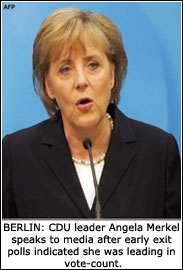 BERLIN, Sept 18: Voters plunged Germany into political limbo on Sunday, splitting their ballots between Angela Merkel’s conservatives and Chancellor Gerhard Schroeder’s Social Democrats so closely that both claimed victory.
Projections by leading polling institutes gave Merkel’s conservatives the biggest share of the vote at around 35.2 per cent, far less than pre-election surveys had predicted and not enough to form a coalition with their preferred partners, the liberal Free Democrats (FDP), who stood around 10 per cent.
Chancellor Gerhard Schroeder’s SPD were just behind Merkel’s party at around 34.1 per cent, their partners the Greens were at 8.2 per cent and the new Left Party stood at 8.6 per cent. In a later projection both leaders had bagged 222 seats each.
The most likely outcome of an election that ended up far tighter than expected appeared to be a so-called “grand coalition” between Merkel’s Christian Democrats (CDU), their sister party, the Christian Social Union (CSU), and the SPD.
Normally, the senior partner and chancellor in such a constellation would come from the strongest party — in this case Merkel’s CDU/CSU by a slim margin, according to latest projections.
“We are the strongest party and have responsibility for forming the next government,” said the 51-year old Merkel.
But Schroeder, 61, who was counted out before the election by the pollsters despite a tireless, dynamic drive to win himself a third term, refused to concede the top job to Merkel in a speech to cheering supporters Sunday night.
“I feel I have a mandate to ensure that in the next four years there will be a stable government in our country under my leadership,” Schroeder bellowed. “There will be no
coalition under her leadership with my Social Democrats.”
—Reuters