After the storm
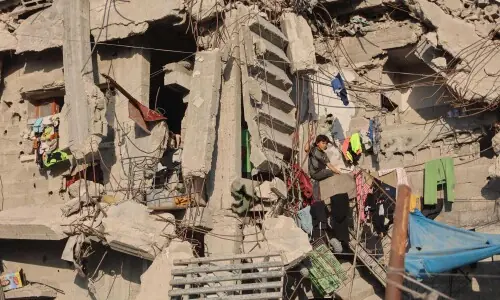
WHAT we are witnessing far away on the Gulf Coast of the US is nothing short of a human tragedy which has left hundreds, if not thousands, dead. Scenes of the massive destruction caused by hurricane Katrina appear to have resulted in a near collapse of American society in the ravaged areas. The images of chaos and disorder are those one would expect from some poor developing countries caught in a similar situation. Lawlessness remains rampant as the poor — the majority of whom are black Americans who live below the poverty line — struggle to survive. Those who were evacuated to Texas are languishing as supplies of food and medicine are fast depleting and rescue efforts painfully slow. Those who were unable to leave primarily for economic reasons are living in squalor, forced to loot for food. New Orleans has suffered the brunt of nature’s fury, the colossal damage done to it hard to digest. US authorities say it is difficult to tell how long it will take before the city can return to some semblance of normality or when its homeless residents can be rehabilitated. Amidst the pains of the devastation, there is much frustration and anger directed at the federal government for doing too little, too late. Their argument that they did not expect such a disaster convinces no one as reports show.
The fallout of the hurricane is proving to be a testing time for President George Bush who is under severe criticism for his failure to ensure that aid reaches the area in time to relieve human distress. There is a dire shortage of National Guards (and its equipment) to send to calamity-hit areas because they are all in Iraq fighting a war, which more Americans than ever before are beginning to question, their disillusionment heightened by the state’s failure in dealing with the consequences of the disaster at home. A surge in fuel prices has affected the economy whereas other important sectors are also feeling the impact. The storm is already being termed the most expensive one for the US; President Bush has requested Congress to release $10.5 billion in emergency funds. To make matters worse is the realization that the government disregarded warnings, issued by the Federal Emergency Management Agency as early as 2001, that a hurricane striking New Orleans was a most likely disaster hitting the US. The administration instead cut New Orleans flood control funding by 44 per cent to finance the Iraq war. This speaks volumes for the administration’s continued neglect of environmental issues, at home and abroad. No wonder, Mr Bush is facing his career’s biggest political storm, under attack not just from the Democrats but from his own senators. There are outraged cries for accountability.
The crisis has also brought to the fore America’s race issue. Many are questioning whether the scene would have been the same had most of the victims been white Americans, rather than the black. That Congress moved in the middle of the night to save the life of an essentially brain-dead Terri Schiavo but has been slow in moving to save hundreds of thousands of lives on the Gulf Coast highlights its skewed priorities. The Bush administration has often been accused, in the Iraq context, of being insensitive to the suffering caused by its war; the same insensitivity seems to underline its approach to the Katrina disaster victims.
Hard road to justice
A POLICE inquiry constituted by the IG of Punjab is currently underway into the allegations that Sonia Naz of Faisalabad has made against two police officers. In her statement before the inquiry, she alleged that an SHO had raped her and that he was ordered to do this by his SP. According to her statement, SP Khalid also physically beat her up, stripped her off her clothes and hit her on the face with a shoe. After the rape, she says she was kept in custody for over a week and then let off, but not without a warning from the police officers not to pursue the matter any further. She has also said that she was being punished by the police officers for continuing to pursue the disappearance of her husband — a low-level government employee accused by the local police of corruption. Ms Naz created a furore some months ago when she was spotted sitting in the main hall of the National Assembly. She said she had gone there to plead her husband’s case before high functionaries. The inquiry is underway and one will have to wait for its findings.
However, there are a few points of concern to note in this context. One, no FIR has so far been registered against either of the police officers, despite the seriousness of the allegations. Two, after the formation of a police inquiry, the Punjab chief minister had also ordered a judicial inquiry to prevent the police from tampering with evidence against two of their own officers — a practice which in the past has often led to such allegations being swept under the carpet. So what became of that proposed judicial inquiry? Three, regardless of whether Ms Naz’s husband is accused of corruption, the alleged conduct of the two police officers is reprehensible and what she had to go through in seeking his release is a matter of shame. It becomes extremely unsettling when those entrusted with upholding the law break it with impunity. If the allegations are proven correct, the officers should be given exemplary punishment.
Afghan refugees’ travails
PAKISTAN may have acceded to Kabul’s request for delaying the closure of Afghan refugee camps in the tribal areas because of the hassles involved in repatriating 100,000 Afghans by the unrealistic deadline of August 31, but the process itself must not be allowed to falter. While the refugees are spread all over the country, there are valid concerns that the camps in the tribal border areas may be harbouring militants. Moreover, the competition for space and resources has grown, and many local communities have come to resent the presence of the Afghans who first arrived in droves after the 1979 Soviet invasion of their country. The current UN-backed repatriation process is voluntary, giving the refugees the choice to go back or to relocate to other camps in Pakistan. About 2.5 million Afghans have been repatriated under this scheme that started in 2002. But about three million remain — most of them do not want to return.
This is not surprising considering that many have grown up in Pakistan, where there are more employment opportunities and better living conditions than in their home country. War-ravaged Afghanistan, that will hold its crucial parliamentary elections this month, offers them little in the way of jobs, education, or even shelter. Lawlessness is rampant, and land and homes belonging to the refugees have been taken over by local warlords and their supporters. These are valid reasons for the displaced Afghans in Pakistan not to want to go back, especially for those who have large families to look after. While Afghanistan and Pakistan must keep the humanitarian aspect of the problem in mind, Kabul has to have greater resolve and make adequate preparations for the return of the refugees. In this, it should be assisted by those countries that pledged huge sums for the rehabilitation of Afghanistan but have yet to deliver on their promises.
Peace prospects after Gaza
THE Israeli withdrawal of 8,000 Jewish settlers from the Gaza strip has been given high publicity in the western media, which has built up a veritable drama over the resistance put up by Jewish hardliners, the last of whom had to be dragged out one by one.
At the concluding stage, the resistance encountered in getting Jewish settlers to vacate settlements recently set up on the West Bank was also included in the news coverage, highlighting the same resistance by settlers. However, it was clear that only 30 families were being evicted from each of the four settlements, whose numbers had been swollen by diehards from other parts of Israel.
Mahmoud Abbas, President of the Palestinian Authority, has welcomed the implementation of the commitment made by Prime Minister Ariel Sharon. While appealing to the Palestinians to avoid any violence, he has made it clear that the establishment of durable peace in Palestine will be achieved after Israel withdraws from other territories occupied in 1967, namely the West Bank and East Jerusalem. Many Palestinian groups, notably Hamas and Islamic Jihad, believe that militancy in pursuit of their aims is the only way to ensure that the “roadmap” of 2002 which was agreed on by the US, the UN, the EU and Russia is implemented.
Ariel Sharon’s own history in the saga of Palestine does not inspire confidence that he will go as far as is necessary to finally resolve the issue which is believed by many to be the main cause of the resort to terrorism by militants in the Arab and Muslim countries. All existing indications point to a slowing down of the process of implementation of the roadmap, as Sharon copes with Jewish hardliners who are adhering to his own erstwhile policy of ignoring justice and Palestinian rights.
The sad part is that the US has encouraged and militarily backed Israel’s aggressive and frequently ruthless policies. Indeed, Sharon, in moments of candour, has claimed that US policies on the region are made by Israel, because AIPAC, the powerful pro-Jewish lobby in Washington virtually dictates the policies of the US Congress.
The 9/11 attacks on the US enabled Sharon to treat the Palestinian freedom fighters as “terrorists”, and to ride roughshod over the occupied territories. Despite sympathy for the US over the terrorist attack, the conscience of the world was not ready for a scale of atrocities at par with what the Jews bemoaned as the “holocaust”. By 2002, President Bush had to come forward with a “roadmap”, based on a two-state solution for Palestine.
Israel under Sharon continued to show contempt for the roadmap, and despite the positive response from the Palestinian side continued to target innocent Palestinians, ostensibly to eliminate “terrorists”. Israel also began building a fence along the West Bank border, locating it in such a way as to take over another 10 to 15 per cent of Palestinian lands. Though the UN and the World Court ruled against the fence, Israel kept on building it. The process of building new settlements on the West Bank, and enlarging existing ones also continued. No wonder, violence in Palestine broke out again, with Israel besieging elected Palestinian President Arafat in his own compound at Ramallah.
As disaffection in Arab and Islamic countries for Washington’s pre-emptive methods in the Middle East, has grown, European leaders Tony Blair in particular, have been urging the US to recover its credibility by making greater efforts farwards resolving the Palestinian problem. The passing away of Yasser Arafat has brought to the helm a leader, Mahmoud Abbas, who has always opposed the militant approach to dealing with Israel, and who has called for peaceful dialogue instead.
President Bush has demonstrated his approval for the change by getting Secretary of State Condoleeza Rice more actively engaged in the Arab-Israel imbroglio. He has repeatedly called for a “viable” Palestinian state, which suggests he stands for substantial Israeli withdrawals from the West Bank.
The Gaza strip accounts for only two per cent of Palestinian territory occupied by Israel in 1967. Over 1.5 million Palestinians are crammed into it, the majority housed in refugee camps. A viable Palestinian state would have to involve Israeli withdrawals from the West Bank of the type offered by Prime Minister Ehud Barak in the 2000 Camp David talks promoted by then President Clinton. At that time, the onus for the failure of the peace process had been placed on Arafat for lack of progress on two key issues, namely Jerusalem, and the right of Palestinian refugees to return.
In assessing the prospects for peace in Palestine, these issues, and most importantly the negotiations for the final settlement that are to provide the “grand finale” of the roadmap and involve large-scale Israeli withdrawals from occupied territories are at the heart of the matter. Can we expect the kind of US pressure on Israel that will compel it to abandon dozens of illegal settlements on the West Bank, and to pull down the protective fence it has built? Will Israel be ready to meet the Arab demand for the control of East Jerusalem, that is fully backed by the OIC?
The withdrawal from the tiny Gaza Strip has already cost Sharon the support of factions of his own Likud Party, and other conservatives, and he has had to team up with Labour to maintain his majority. The hawkish former prime minister, Binyamin Netanyahu, resigned from the cabinet prior to the Gaza withdrawal, and Israeli domestic politics is likely to make further progress required by the roadmap highly controversial. As such, one has to be not only cautious, but even sceptical, about whether peace will prevail in Palestine.
The attitude of the US needs to be watched. Russia has called for a conference on Palestine to rally support for further progress through international pressure. Britain and the EU may step up their involvement. The UN will certainly hear references to the problem during the forthcoming General Assembly this month.
It is time the Islamic countries stepped up their support for a just settlement, if there is to be peace in this tortured region. Gaza may prove to be a meaningless gesture, unless the real issues of Palestinian rights, and of access by the Muslim world to Al-Quds, are addressed. If further progress on the “roadmap” is not maintained, Mahmoud Abbas will find himself in an untenable situation. A return to militancy by the Palestinians will generate the usual excessive show of force by Israel that will mean more killings, more misery, and a general worsening of the militancy in other parts of the Muslim world.
The outlook is that if the Constitution agreed between the Shias and the Kurds is imposed on Iraq, the resultant reaction will be to intensify operations in central Iraq, with extremists getting a renewed lease of life in other countries. President Bush has to demonstrate his seriousness in using America’s undoubted clout to promote peaceful solutions of problems that lie at the roots of Islamic militancy.
President Musharraf has been urging a western role in the fight against terrorism by facilitating solutions of long-standing disputes in the Islamic world. Palestine is becoming an acid test, and the Gaza withdrawal is not enough to satisfy the Palestinians, or the Arab and Islamic world. Indeed the global community must engage itself forcefully through the UN.
Germany’s crucial vote
FOR the second time in four years, Germany’s August has been enlivened by a hotly contested election campaign, and once again Chancellor Gerhard Schroeder has sought to help himself with anti-American demagoguery.
“Let’s take the military option off the table. We have seen it doesn’t work,” he bellowed at one rally, referring to President Bush’s refusal to rule out force in the case of Iran.
Never mind that Mr Schroeder declared just a few weeks ago, during a visit to the White House, that he “couldn’t agree more” with Mr Bush’s message that the development of an Iranian nuclear weapon is “unacceptable,” or that his rhetoric undermined an urgent attempt by the European Union to pressure Iran into accepting limits on its nuclear programme. The chancellor hoped to repeat his feat of 2002, when his attacks on Mr Bush’s move toward war with Iraq helped him win a new mandate, at the expense of a poisoned relationship with Washington.
Luckily for German-American relations, and for Germany, Mr Schroeder’s gambit appears unlikely to work this time. With a little more than two weeks left before the Sept. 18 election, polls show him a dozen points behind the candidate of the Christian Democratic Union, Angela Merkel. Barring a dramatic reversal, the 51-year-old former physics professor stands to become the first female chancellor in German history, and also the first citizen of the former communist East Germany to lead the reunited state.
That’s one of several reasons the German election stands to be one of the most important in the country’s post-World War II history. In addition to the possible end of Mr. Schroeder’s seven-year tenure, Germans also face a dramatic choice about the direction of their social welfare state.
—The Washington Post
| © DAWN Group of Newspapers, 2005 |