Politicians and the police
IF any politicians were ever to ask me how he should practise his craft (which none has done to date), I would say: “be good, but if you cannot be good, be careful.” This advice would have worked well for Agha Ali Haider, a parliamentary secretary in the Punjab government. He chose to act impetuously a few weeks ago and got into trouble. Apparently, the police had picked up a few religious militants in a place called Syedwala. With some 200 agitated “troopers” in tow, Agha Sahib marched to the local police station and demanded their release. The station house officer (SHO) declined to oblige him.
Ignoring the federal government’s “crackdown” on religious militants, Agha Sahib resolved to confront police power with street power, and led his mob to close down, forcibly, the town’s businesses. As one might have expected, his companions damaged public and private property in the process, and the SHO registered a criminal case against him and a dozen or so of his followers.
Agha Sahib’s intercession with the local police might not have been quite as counterproductive if he had visited the SHO alone, exchanged pleasantries and shared a drink with him, and then asked him if the latter could find a way of releasing the detained men. But he chose to act like one of the high and the mighty, which he was not. He was, thus, neither good nor careful.
One way of influencing police officers has been to bribe them. The feudal lords in Sindh and southern Punjab follow this tradition on a lavish scale and the police, in turn, overlook their lawlessness. Politicians in power have less expensive ways of getting things done. They can offer to post officers at places where social life and shopping for their wives, and schools for their children, are good, money flows, and the possibilities of graft abound. Alternatively, they can threaten to transfer an officer from his currently lucrative position to stations where living is hard and unrewarding.
They can also arrange for an officer to get accelerated promotion. In return they will require him to break the law to their advantage.
Once in a while an officer will decline to bend the law to meet his political superior’s wishes and get away with it. Mr M.M. Hasan, a former inspector general of police, recalls an interesting incident in his memoirs (“Thirty-six years of police service,” Urdu, 2001). Once in 1975 Prime Minister Zulfikar Ali Bhutto told him he was sick and tired of Maulana Shah Ahmad Noorani’s tirades against him and his family, and that Mr Hasan should straighten him (Noorani) out. He said he did not want the Maulana to be killed, but it wouldn’t be a bad idea to break a few of his bones.
Mr Hasan suggested that he might find other ways of getting Noorani Sahib to see reason to which Mr Bhutto agreed reluctantly. The Maulana did not see reason and, as I gather from other sources, one day some tough guys did beat him up.
Devolution of governmental authority and power to local governments would normally involve giving them responsibility for law enforcement and some measure of control over the police. One may wonder how politicians at the local level would handle this commission. I have been studying issues of police organization (selection, posting, transfer, and promotion) and the extent of political control of the police in the United States and Great Britain. Let me briefly state my findings,
In both countries the maintenance of law and order is, in the first instance, a local function. The central government does maintain a police force, FBI in America and Scotland Yard in Britain, but it participates in the investigation of crime only when the local police call for its assistance (or when, in the American case, violation of federal law is involved).
In America, each town, city, or the county has its own police force which investigates crimes, apprehends suspects, gathers evidence against them, and submits it to the “district attorney” who prosecutes them. In larger cities, the police establishment is headed by a functionary appointed by the mayor in consultation with the city council or another designated representative body. He is essentially a political appointee, and he may or may not have been a professional police officer. One or two of his deputies may also be political appointees. All other officers are career men and women who reach their positions according to prescribed procedure.
Persons desiring to have a career in law enforcement enter the force at the lowest level, and patrol the streets for at least a couple of years before they are assigned duty elsewhere in the organization (detective, vice squad, drugs, organized crime, murder, robbery, juvenile crime, etc.). A patrolman gets promoted to the rank of sergeant, and he to that of lieutenant, on the basis of his performance ratings and by passing the relevant departmental exams.
Promotion to higher ranks (lieutenant and captain) usually requires the commissioner’s approval, but normally the mayor and his council have little or nothing to do with it. An officer may be transferred from one specialty to another, or from one police station to another, within the same city but he cannot be sent away to another city or town.
In a smaller town, decisions in all of these matters need the formal approval of its government’s executive organ (variously known as board of selectmen, overseers. supervisors, commissioners), which is given after consultation with its chief administrator (town manager) and the police chief. It may be fair to say that on the whole the police department in each locality is largely autonomous in the area of its internal personnel management.
The mayor may call upon the police chief to hurry in solving a crime that has attracted media interest and attention, but otherwise there is no political pressure to steer the investigation of a specific crime one way or another.
Police organization and its personnel management procedures in Great Britain are similar to those described above with reference to America. Responsibility for law enforcement is placed with the country’s 52 county governments, each one of which has its own police force headed by a “chief constable.” The local police authority fills the top positions, chief superintendent and higher, with the approval of the home secretary in the central government. The chief constable, or his designee, makes all other appointments.
In Great Britain also, those who choose law enforcement as a career enter the police service as constables (even if they are university graduates), patrol the streets for a time, and rise on the basis of their performance. As in America, accelerated promotion by passing departmental exams is possible. General criteria and guidelines for recruitment and promotion have been developed by the home office, which all police departments follow.
The chief constable supervises the conduct of operations at the police stations in his jurisdiction. Any attempt on the part of ministers, members of parliament, and county councillors to influence operations, including investigations, would most likely be rebuffed.
Returning to Pakistan, it may be recalled that one of the purposes of the Police Order of 2002 was to insulate the police from improper political influence. This did not go well with the chief ministers, ministers, and MPAs in the provinces. The amendments to this order made in November 2004 were designed to restore their influence. Some of the more important of these amendments are noted below.
(1) The chief minister may transfer the provincial police officer (PPO) before the completion of his three-year tenure with the approval of the federal government but without consulting the Provincial Public Safety Commission. (chief ministers have abused this power in the past to serve their personal or partisan ends.)
(2) The federal government may recall a PPO prematurely without consulting the National Public Safety Commission (NPSC).
(3) The PPSC may recommend the premature transfer of a PPO only on grounds of unsatisfactory performance. (4) The PPO may not appoint a district police officer (DPO) without the chief minister’s approval.
(5) A district or city PO may be transferred prematurely with the approval of the provincial government (meaning presumably the chief minister), but without the concurrence of the nazim or the District Public Safety and Police Complaints Commission, to meet the “exigencies” of the service.
(6) The nazin will record his evaluation of the DPO’s performance which may be considered in the matter of his advancement.
(7) Three of the nine members of this district commission will be chosen from amongst the MNAs and MPAs from that district.
(8) A number of MPAs, named by the Speaker of the provincial assembly, will be placed on the Provincial Public Safety and Police Complaints Commission.
Considering that postings and transfers of public officials can have rewarding or punitive implications, restoration of the chief minister’s authority in these matters and the placement of legislators on the provincial and district public safety commissions, will inevitably have the effect of restoring political control over the police establishment, which the original Police Order of 2002 had sought to diminish.
Why should ministers and legislators want to have a say in the postings and transfers of police officers? They do because they want to use the police in aid of their unlawful ends.
The politicians are the makers of law and they are sworn to preserve it, while the police have the duty to enforce it and apprehend those who violate it. That the constitutionally designated makers and preservers of the law should want to recruit its enforcers in an unholy alliance for breaking the law makes for a topsy-turvy land.
The cliche which has it that “the more things change, the more they remain the same” surely does apply to the ways of our politics and governance.
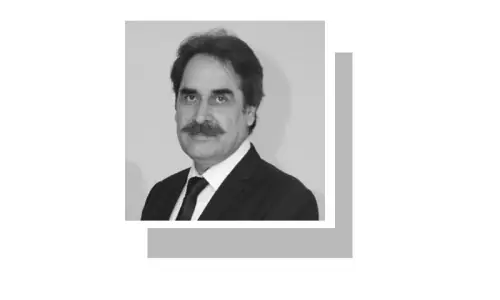
The writer is professor emeritus of political science at the University of Massachusetts at Amherst, USA. E-mail: anwarsyed@cox.net
When army rules the political roost
THE elections recently held may put the district governments on a footing more viable than in their first term but the polling, assuredly, marks the beginning of the end of the country’s precarious parliamentary system, even in its present hybrid form.
The foremost requirement for a parliamentary democracy to succeed is to have few parties — three and four — closely-knit and ably led with roots in the people. In the course of time, their ideologies and objectives may overlap as indeed they have among the Tories, the Liberals and Labour in Britain but the cadres are held together by force of tradition and history. The voters do switch support from one party to another but only on the margins and that is what all the campaigning there is about.
Pakistan has scores of parties recognized not by what they stand for but who leads them. Alliances forged to topple a government or to form one are also governed by the same rule. At no time in the past has this rule been followed with greater freedom than now in the aftermath of elections to the local councils.
Old political rivals, with nothing in common and some nursing personal vendetta, are embracing each other only to share power. The religious parties are joining forces with secular elements of their own choosing, and yet insist that their alliance (the MMA) remains intact. The most bizarre example of this behaviour is that of a doctrinaire Jamaat-i-Islami aligning itself with the secular ANP in Peshawar to defeat its own MMA ally JUI, which in turn is joining hands with a faction of the PPP that forms part of the government the religious leaders consider a usurper.
Thus to capture the post of nazim, the JI is hedging its bets on the votes of the ANP while the JUI, seemingly, is relying on the patronage of the minister. The Peoples Party and the Muslim League, mauled in the polls with their leaders in exile, are also entering into similar, if less outrageous, arrangements with other parties.
This trend of parties splitting and forming new alliances will quite likely continue on a broader scale and intensify as the provincial and national elections approach. Party loyalty and discipline have thus become a casualty down to the village level in an ironically non-party election.
There is no possibility nor hope of the existing scores of factions to merge into three or four parties on the basis of programmes. In fact more of them are likely to come into being. hence the country may have Musharraf’s “real” or Ayub’s “basic” or now, more fashionable (but chimerical) “Islamic” brand of democracy but not its parliamentary variety.
Fewer parties with defined charters and countrywide presence are important but more critical to the success of parliamentary democracy are the heritage, traditions and attitudes of society intending to practise it. In that, the odds are weighed more against Pakistan than other Third World countries.
Pakistan has been trying since its birth to adopt a parliamentary government and that too of quintessential Westminster model. No other newly independent or developing country has succeeded in doing that. The only notable exception is that of India and because Indian society is not burdened by ideology and its territory is so large and population so huge and diverse that it cannot be governed, or even held together, in any other way. That is why some have described it as a functional anarchy.
If no other developing country has succeeded in implementing the parliamentary system in its pure (i.e. Westminster) form Pakistan is even less likely to succeed because it has declared itself an Islamic republic and yet is unable to determine what legitimate role religion has in its governance. An example: the government of NWFP has drafted a law to make its citizens conform to Islamic values. The Supreme Court has ruled the law is un-Islamic.
The only Muslim country which comes close to having a parliamentary government is Malaysia. But though it has a Muslim majority, its society is distinctly secular because of a large Chinese and Indian population. The governments of some Muslim countries are indeed democratic but not parliamentary as most have authoritarian regimes.
A more concrete, and inescapable reality is that because of various crises and the hostility of neighbours Pakistan is compelled to keep a large standing army for its survival. The army, in turn, demands a definite say in its internal politics and international relations. And when an ambitious or enraged army commander decides to take over the government the political system is too weak to resist. In fact, on all four occasions — coups or takeovers by Ayub, Yahya, Zia and Musharraf — the army found ready collaborators from within the ranks of politicians to wield power longer than the elected government.
The political structures and cadres today are weaker than they were in 1977 or in 1999. Even if General Musharraf is compelled to quit it is unlikely that a political government would succeed him. What follows would be yet another experiment in democracy under the auspices of another general which would certainly not be more parliamentary in character than the Musharraf regime’s, but may last another decade.
At this juncture, a sensible course for politicians to follow would be to dig their roots among the people and combine to form fewer parties. Only popular and strong political parties can keep the army out of politics or, at least, reduce its dominance. Collaboration or defiance by individuals or splinter groups would strengthen it. Even Zulfikar Ali Bhutto and Nawaz Sharif had to make way for the army because the parties at their be were weak and divided.
A Third World scene?
HURRICANE Katrina has cruelly demonstrated the awesome power of nature and the havoc it can wreak on the proudest efforts of humankind. It has also exposed the United States government, and George Bush at the head of it, to charges of badly mishandling what looks like being one of the country’s worst ever natural disasters.
Unlike what happened after the September 11 terrorist attacks, partisan warfare has already broken out over the waterlogged catastrophe that is New Orleans and the battered coast of Mississippi, Louisiana and Alabama. This is a crisis in full spate — as shown by shocking images of bodies floating in putrid water and desperate refugees scrabbling to catch supplies dropped by helicopter. America is the richest and most powerful country on earth. But its citizens, begging for food, water and help, are suffering agonies more familiar from Sudan and Niger. The worst of the Third World has come to the Big Easy.
Such is the scale of this disaster that Mr Bush would probably have been criticized however he had responded. He was already under fire for taking the longest summer vacation in presidential history and he stayed put at his ranch in Texas as Katrina made her deadly landfall.
On Wednesday, two days after the hurricane struck, he flew over the area in Air Force One, only arriving yesterday (but not in New Orleans itself) to see the scene for himself, though he did declare that relief efforts so far had been inadequate. He sounded grave, but spoke of hope ahead, even in these “darkest days”.
In previous public appearances, his tone and demeanour seemed inappropriate, further evidence of the tin ear he displayed when referring to Osama bin Laden and the 9/11 hijackers as “folks”. It is hard to disagree with the New York Times, famously restrained in its use of language, whose editorial found that Mr Bush’s response had been “casual to the point of carelessness”. The Times’ former editor, Howell Raines, wrote in our pages that his behaviour was “outrageous”.
More substantive points include charges that the president cut funding for the levees that were supposed to protect New Orleans from floods. Others have singled out the damaging and greedy redevelopment of coastal wetlands. Not all the criticism stands up to close scrutiny.
Even with full funding in recent years, none of the flood-control projects would have been completed in time to prevent the swamping of the city. Staving off cuts to the budget of army engineers would not have helped since the destruction was vaster than any contingency.
Still, there is a widespread perception that the sheer scale of the problems reflects a shuffling of resources - to pay for tax cuts and the Iraq adventure - that has left the US far too vulnerable. It is all a brutal reminder that government policies, sometimes followed only in the small print of rows over obscure budget allocations, can have real - and deadly - consequences for real people.
The words “homeland security” now have a terribly hollow ring in the anarchic south: 35% of Louisiana’s National Guard is serving in Iraq, where four out of every 10 soldiers are guardsmen. And recruiting is down because people fear being sent to Iraq.
—The Guardian, London
| © DAWN Group of Newspapers, 2005 |