0
0

WASHINGTON, Aug 28: Like Vietnam, the war in Iraq is not winnable because there are no clear military targets to achieve, says an article published in The Washington Post on Sunday.
The author, Lewis M. Simons, an ex-Marine who covered the Vietnam war for the Associated Press and the Post, says that he had an ‘eerily reminiscent experience’ when he visited Iraq recently to write a piece for National Geographic.
After a month in Iraq, he returned home, ‘certain that this war, like Vietnam, will never be won … Since, in my judgment, we were wrong to go in, I’m afraid there’s no good way to get out’.
In an attempt to understand the concept of winning the war in Iraq, the author asks: “What would ‘winning’ in Iraq mean, anyway? A democratic society that’s free to elect an anti-American, pro-Iranian, fundamentalist Islamic government? A land of gushing oil wells feeding international oil company profits at US taxpayers’ expense? Shias, Kurds and Sunnis joining hands to end terrorism around the world?”
Like Vietnam, says Mr Simons, the Americans do not understand Iraq. “The truth — that Iraq was not a terrorist haven before we invaded, but we’re making it into one today — has been thickly painted over with unending coats of misinformation.”
Comparing the two wars, the author notes that ‘where 392 Americans were killed in action in Vietnam from 1962 through 1964, the first three years of the war, (and 58,000 by the time of the US withdrawal in 1975), after two years in Iraq we have nearly 1,900 American killed in action. Where two million Vietnamese were killed by the war’s end, we have no idea how many Iraqis have died since we unleashed ‘shock and awe’. Is it 10,000, 20,000, 30,000? More?”
Mr Simons says that this ‘blithe American disregard’ for their lives infuriates Iraqis.
He warns that what American failed to understand in Vietnam – ‘that people who want foreign occupiers out of their country are willing and prepared to withstand any kind of privation and risk for however long it takes – are failing, once again, to grasp in Iraq’.
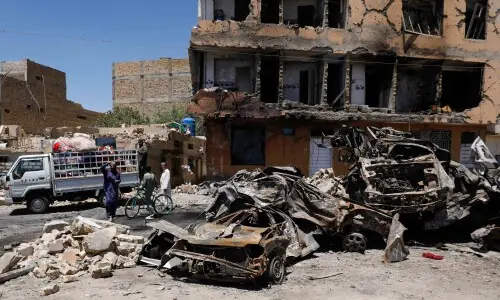
MILITARY SOLUTION: Discussing his experience in Iraq, the author says that in a country where planes have to make emergency landing to avoid being hit by the enemy’s rockets and where American soldiers and citizens have to be protected by Humvees and helicopters when going out in the streets, ‘there can be no military solution’.
The author also notes that some American soldiers in Iraq are most bitter about their perception that the Bush administration’s effort to wage the war on the cheap applies only to them, while private contractors grow rich.
“On the green plastic wall of a portable toilet at Baghdad military airport, I read the following graffiti, scrawled by a civilian contract employee: ‘14 months. $200,000. I’m out of here. [Expletive] you Iraq.” Beneath it was a response from the ranks: ‘12 months. $20,000. What the [expletive] is going on here?”
Arguing that there’s no ‘good way’ to quit Iraq, the author says that if America stays, the ‘insurgency’ continues. If it leaves, the insurgency will most likely expand into an all-out civil war, the fragmenting of Iraq and the intervention of Iran, Turkey and Syria, followed by the collapse of promised democracy in the Middle East: a kind of reverse domino theory.
He says that before the mid-term elections next year, President Bush may withdraw several thousand US troops, but the bulk of the US forces will stay, giving the guerillas an excuse to fight.
The author believes that the Bush administration will leave this mess for the next administration, which may find equally difficult to deal with it.
He quotes a senior US diplomat in Iraq as saying that if the US is serious about establishing democracy in Iraq, it would take two generations of soldiers fighting there.
“That’s 40 years. You may want to pass that along to your grandchildren,” warns the author.