Lollipops are no solutions
THE rising oil prices and the post-9/11 environment, coupled with the success of the industrial revolution now unfolding in major parts of Asia, have been pushing increasingly large investment flows towards Asian markets. Within last month alone six billion dollars were invested in stocks of just six Asian countries even when excluding major markets like Japan, Hong Kong and Singapore. All indications are that this rising trend is likely to continue in the future.
Although our markets have also been benefiting from the surge in liquidity of Asian markets, Pakistan is still on the periphery of these flows. Since the money is footloose in this seamless world of global finance, it would only strike deep roots here when our capital market develops the reputation as an efficient vehicle for transferring savings into investment.
So, how prepared are our institutions to turn Pakistan into a destination receiving substantial flows from the flood of investment funds going into Asian markets? The ‘environment’ in the world of investment is largely determined by the health and credibility of institutions dealing with it. What matters in the minds of investors committing large funds into any market, besides its potential for growth, is to find answers to the questions like: What guides the working of the institutions dealing with investment — the laws or the changing exigencies of individuals? And how predictable is the behaviour of the institutions in dealing with their areas of responsibilities?
For sometime now, our capital markets have been a cause for concern for many, especially since the crash last March. Funds for our capital markets are currently being generated by the many factors indicated above including the high growth rates of the domestic economy. Various reports appearing in the wake of the March crash, including the Taskforce, have indicated that a large part of the problems of March could be attributed to too much liquidity chasing too few products, specially the nexus created around Badla financing.
But even if the liquidity was not such a problem, the stimulus for additional liquidity has been injected into the market through the recommendations of the Tareen committee to lift the market spirits.
But what about our markets being open, fair and efficient instruments for transferring funds into investment in the country? One of the fundamental purposes of capital markets is to act as an efficient vehicle for flow of funds — transferring savings into investment — domestic as well as foreign. More specifically, to channel funds into the securities of more efficient industries and out of the less efficient and losing ones.
An efficient capital market is supposed to protect the investors from paying more than the fair value of stocks when buying, and also in receiving fair value when selling the stocks. The fairness of the market requires that the expectations of gains by the investors are guided by the principle of ‘Profit based on performance’ — whether actual or potential — of the companies. And the openness of the market in information, operations and accessibility is meant to give confidence to investors.
In a ‘buyers beware’ market, there cannot be too much emphasis on the continuing need for full and prompt flow of information to all as also on the public/investor education programmes run by the regulators to demystify stock market operations and enable investors to make ‘informed’ investment decisions.
How does the reality relate to these requirements? The Taskforce and other reports give ample indications about the weaknesses afflicting the market. A stock market where trading is largely restricted to people on its premises, cannot claim to be open and accessible to all investors. And a market where 90 per cent of trading value is confined to less than five per cent of its listed companies, cannot be an efficient channel for flow of funds into investment opportunities. Or do we understand that out of the nearly 700 companies listed on the exchange, there are no more than 30 entities that are rated first class enough to attract big investor interest?
Coming back to the crash of capital markets, the Taskforce has listed several abusive practices that have been taking place in the market, including insider trading, wash trading, demand and price manipulations, ghost buyers and sellers, selective relaxation of rules and many situations of conflict of interest, etc.
However the litmus test would come when these abuses are tested against the security laws of the country to see if these practices are anything more than some smart fellows exploiting loopholes of our archaic laws? It would then become clear that many of the operational abuses, talked about in various reports, have been nurtured over time by the vague generalities and loopholes embedded in our outdated security laws. These and other abusive practices have also been appearing and taking their toll of investor confidence in the earlier ‘investment’ schemes of the cooperative societies, finance companies, forex associations and others. Against the backdrop of the recent market crash, the weaknesses of the regulators have also come under the microscope. Some of their inadequacies seem to be arising out of the conflict of interest situations inherent in the structure and management of institutions.
Again, without belittling this issue, it needs to be realized that the regulators derive their strength and authority from the investment/ security laws. And it is a moot point to see how far their weaknesses are rooted in the weak, ineffective and outdated security laws of the country.
What this tells us is that any attempt to rectify the abusive operational practices and creating a fair, open and efficient security market outside the framework of security laws will be a fruitless pursuit. That is why it is so important to go back to the basics of the laws on investment again and again to continually weed out bad practices. While many developed markets keep regularly updating their security laws for this purpose — some even totally revamping them every 20-25 years — we have largely remained stuck with our outdated, inadequate and inefficient security laws since their inception 35 years ago.
Whenever the inadequacies of our security laws have nurtured abusive practices, our approach in the past has generally been to wait for a bunch of sufferers to cry foul after they have lost their shirts, and then give them some lollipops in the shape of some relief measures to calm them down without getting into the underlying causes embedded in basic laws that give rise to these abuses in the first place.
Although the regulatory issues were included among the terms of reference of the Taskforce, it has generally focused on the policy and operational issues of the market in the report it has produced, perhaps because of the limitations it has mentioned.
However, if the compass of the basic law on investment were to guide our search for solutions, it would help us understand better why repeated weakening of investor confidence has been occurring with impunity under various labels. It would also become clear that we cannot have efficient capital market operations without having efficient investment laws.
Simply put, if the markets have not been functioning well, a major part of the answer lies in the weaknesses, lapses and loopholes in the laws that govern the functioning of the markets. And when we try and update our archaic security laws, the guiding principle of such an exercise should be to define the success of the capital markets in terms larger than the success of those physically present and occupying positions of influence and authority in the bourses and related institutions. The success of the capital market must include the success and protection of the interests of third-party players, small investors, strangers and individuals and institutions that commit their resources to market operations while living and working far away from the premises of the bourses.
The standing committees of the National Assembly looking into the crash of capital market in March should help where it is most needed — in revamping and enacting an updated version of the security laws. Only then would investor protection be properly enshrined in our investment laws and the capital markets become a real engine of economic growth for the country. From the public policy perspective, as the success of the capital markets acquires wider meaning to include various stakeholders, their claim on national resources and policy support would also be justified.
A fair balance in the relationship among various market players — regulators, management, stock brokers and dealers in other kinds of investments and the investors themselves — must be guided by the compass of an updated and efficient system of security laws, and not by any lollipops of quick-fix solutions. Or else when the next bubble bursts (real estate?), the small investors might see deja vu all over again.
E-mail:smshah@alum.mit.edu
Reining in the madressahs
LAST week the government issued an ordinance requiring all the madressahs in the country to get themselves registered with the authorities. In line with General Musharraf’s approach of treating the clerics with kid gloves, the ordinance takes the form of an amendment to the Societies’ Registration Act, 1860.
The newly added section 21 also makes it compulsory for the seminaries to submit an annual report of their activities and their audited accounts while they are prohibited from teaching or publishing material that promotes religious and sectarian hatred and militancy.
Does the government mean business this time? In 2002 it had promulgated the Deeni Madaris (Voluntary Registration and Regulation) Ordinance which was more elaborate than the amendment proposed now. It had even provided for the establishment of a federal and four provincial madressah education boards to supervise these institutions. This law came to naught because the religious parties opposed it tooth and nail. Moreover, since registration was voluntary, the madressahs exercised their right not to register.
The other day, President Musharraf told Ahmed Rashid, the internationally known author of The Taliban, he is “deadly serious” about a crackdown on the banned extremist groups operating under another name, the closure of all publications promoting hatred, creating new syllabi for the madressahs and their registration within six months.
He explained that earlier he had failed to carry out these measures as his hands were tied down by the confrontation with India, the general elections in 2002 and political insecurity at home and abroad. Now he says he feels stronger to act.
Under the new Ordinance the registration process is expected to be completed by November. It seems a bit unlikely given the fact that it is not even known precisely how many madressahs there are in the country. The number quoted varies from 9,000 to 15,000. Besides the amendment doesn’t make many procedures very clear. Who will register them and who will regulate their working? Do the madressah education boards to be created by the previous ordinance continue to be valid? In the absence of specific provisions a lot of confusion can be anticipated. It has not even been made clear what the outcome would be if a madressah violates any of the clauses of the ordinance. Would it be shut down? All this makes it difficult to place one’s confidence in the government’s will and capability to take effective action, especially when it has for all these years patronized the religious parties because of the political dividends it could derive from them.
Since many of the madressahs are known to be fertile breeding grounds of militancy and jihad — only last week a madressah in North Waziristan was found to be imparting military training to its students — not much will be achieved if the registration process is no more than a procedural one. Two important aspects of the madressahs need to be tackled judiciously. First is their control and second is what they teach.
Until now many of the madressahs have been controlled by political parties, which have set them up, and facilitated the flow of funds for them. These institutions with a political orientation provide the ‘foot soldiers’ for the extremist groups which subscribe to the belief that jihad against non-Muslims is mandatory. Funds are no problems. According to an International Crisis Group report, the madressahs collect over Rs 70 billion a year from within the country. But more than that is generated by external financing — from foreign states, private donors and Pakistani expatriates. With their accounts never audited, it is difficult to ascertain who is exercising control over these madressahs.
According to Dr Tariq Rahman, there are five central boards of madressahs controlling the institutions academically under them. They are the Deobandi’s Wafaq ul Madaris, the Barelvi’s Tanzim ul Madaris, the Shia’s Wafaq ul Madaris, the Jamaat-i-Islami’s Rabta-tul-Madaris al-Islamia and the Ahl-i-Hadith’s Wafq-ul-Madaris-al Salafia. These institutions are quite autonomous of the government and chalk out their own curricula and pedagogic methodology.
An attempt was made by the government in 2001 to regulate the madressahs’ curricula by introducing the Pakistan Madressah Education Board Ordinance. In this context, Dr Rahman quotes a document of the government on education sector reforms, “Three model institutions were established ... Their curriculum includes subjects of English, mathematics, computer science, economics, political science, law and Pakistan studies.” But the ulema rejected this proposition.
In an excellent study of the madressahs, Dr Rahman describes the Dars-i-Nizami and how the memorizing of the canonical texts and their backward-looking nature symbolize the “stagnation and ossification” of knowledge. With Radd (refutation) being an intrinsic part of madressah education, students internalize a hatred and lack of respect for the beliefs of other sects, sub-sects, and religions.
Since they are not short of funds they can literally buy over their students who are provided boarding and lodging. Living on the premises, the students provide ample time and opportunity to be thoroughly indoctrinated.
It has been questioned if simply introducing new and modern subjects to this obscurantist syllabus would change the mindset of the students. This is a valid question because, according to Dr Rahman, many of the major madressahs have already introduced subjects like English, mathematics and general science. But what he emphasizes is that the ulema or teachers approved by them teach these subjects. “Thus the potential for secularization of these subjects, which is small in any case, is reduced to nothingness,” Dr Rahman writes in Denizens of an Alien World.
This leaves us wondering if the government will really succeed in controlling the madressahs by promulgating the new ordinance. The madressahs did not pose much of a problem for decades — the first organized madressah at Deoband was established in 1867 — and though politically their role was very negative, they remained on the sidelines. It was Ziaul Haq who brought the madressahs into the mainstream. They were provided support and financial assistance (some coming from the United States) to conduct jihad in Afghanistan against the Soviet “infidels”.
Their numbers went up by leaps and bounds. According to Muhammad Qasim Zaman, a professor at Brown University and author of the Ulama in Contemporary Islam, there were 279 madressahs in Punjab run by the Shias, the Deobandis and the Barelvis in 1971. In 1994 their number had jumped up to 2,288. Once the trend started the momentum built up even though Ziaul Haq was no more on the scene and the Soviets had withdrawn from Afghanistan. Today the number of madressahs in Pakistan are estimated to be about 10,000.
Of greater concern is the ubiquitous effect the madressahs have had on the religious culture in Pakistan. They have made their inroads into politics and, worse still, are exerting a powerful influence on education in Pakistan. While the government worries about the curricula of the madressah, it should show more concern for what is being taught in the supposedly secular schools all over the country.
Analysing language-wise the ideological contents (Pakistani nationalism, Islam and the military) of course books from Class I to Class 10, Dr Rahman found the Urdu books had 40 per cent of such contents that glorified wars and conquests by the Muslims and carried derogative references of non-Muslims, the West and so on. In fact, nearly 40 per cent of the Urdu medium school students advocated war with India in 2003. Only 47 per cent of them want the Hindus in the country to be given equal rights to jobs. Even less — 46 per cent — supported equality for the Qadianis.
With this mindset proliferating our society, simply reforming the madressahs will not be enough. A start has to be made on multiple fronts. The job of reforming the school curricula, which was started earlier but abandoned when the religious parties resisted it and raised a furore, should be undertaken again and more firmly this time.
No end to corruption
 AS far as I can recall, it is the first time that a responsible government functionary has said something sensible and realistic about corruption. Some time ago, the Auditor-General of Pakistan stated in a gathering that, in his opinion, bribery and corruption cannot be absolutely done away with; their incidence can only be reduced through suitable administrative measures.
One is grateful to the officer for this statement, although no great wisdom was required to arrive at this conclusion. Incidentally this goes to show that this benighted country has never really had wise political leaders, because every one of them, whatever his affiliation and whenever his party was in power from August 1947 to date, have claimed that “we are going to root out corruption from the body politic of Pakistan.” Of course they never did anything even to lessen the evil. Military leaders were no exception. I wonder what they meant by body politic.
Although it is quite an old statement of the Auditor General, he had mentioned in passing, as an example of departmental corruption, that financial irregularities involving 15 billion rupees had been discovered in the Central Board of Revenue and were being jointly probed by his men and staff of the National Accountability Bureau (NAB). I too may mention something in passing: I have always wondered how clean and honest are the gentlemen deputed to investigate cases of corruption, considering the general state of probity and uprightness in “the body politic.” It is significant that the police is hardly ever associated with such investigation.
Coincidentally the figure of 15 billion also occurs in another news report, this time from Multan. It says that the NAB has asked the Auditor-General and the provincial accountant-general to furnish details of cases of embezzlement in various government departments unearthed by them through audit during the last decade but in which no action was taken against the culprits because of political pressure. So much for corruption during political regimes and the protection they provide to their favourites.
Poor Pakistanis! They are really in a fix, literally between the devil and the deep sea. They are wholeheartedly for democracy and therefore averse to military rule. At best they can tolerate the latter as a short surgical operation. And yet they know that going back to elected government, headed by the winning political party, means a return to all kinds of evils being perpetrated all the time by all kinds of devils, and ranging from oppressive medieval feudalism to sophisticated ways of sucking the country dry of its precious resources.
So much has been written about the total prevalence of corruption in the country, and so much continues to be written every day, that while dwelling on the subject today I feel as if I am telling my readers that two and two make four. And yet I think there are certain things that can be found readable, for one the statement of the Auditor General with which opened this piece, that it is impossible to wipe out corruption completely. In this respect I have a theory. I may be wrong, but I observed during my 37 years of government service, that it is basically the unscrupulous government leaders who claim that they will eliminate the evil.
In their times Ms Benazir Bhutto and Mian Nawaz Sharif made resounding statements that must have struck terror in the hearts of corrupt officers, that no one will be spared who is dishonest and addicted to bribes. You can look up the newspapers of those times and confirm my observation. And yet neither she nor he are known to have prosecuted, or jailed or dismissed any corrupt officer or recovered from him his ill-gotten gains. It is true that some officers were dismissed but for other reasons — for not toeing the line, for not obeying illegal orders, or for showing an independent spirit which is taken as mutiny by autocratic leaders accustomed to considering the country as their playground.
The public accounts committee at the centre recently revealed a case that must be a masterpiece in misuse of public money and in flouting divine injunctions about how Hajj is to be financed. The two prime ministers sanctioned the expenditure of more than five crores of rupees out of the Pilgrims’ Welfare Fund (made up from the hajjis’ contributions) to pay for the de luxe pilgrimage of 40 ministers, 83 legislators, 30 bureaucrats and numerous political personalities. Was this a sin or a crime? The ministry of religious affairs must be asked why it did not advise the two prime ministers against this sanction.
Another facet that is never mentioned pertains to corruption in the private sector. All talk of corruption is always in the context of government servants, big and small, as if they are the only guilty party in this dirty game. Talk to businessmen, shopkeepers and industrialists, and they’ll tell you that people working there do not lag behind anyone in defrauding their employers. Add to this the fact that most of these businessmen are themselves past masters in crookery, deceit, tax evasion and making money under the counter, and you get a really frightening picture.
All this boils down to the tragic fact that the entire society has somehow lost its sense of ethics and morality where acquisition of unearned riches is concerned. For instance, here I am talking sanctimoniously to you whereas you may be justified in wondering how honest I, the columnist, am under this cloak of pontification. When you consider that people running NGOs for the benefit of the poor are pocketing half the funds, that social welfare institutions are riddled with cases of defalcation, that even cricketers, embodiment of the sporting spirit, are not free from financial misdeeds, what hope is left?
There is only the consolation (if it can be so termed) that today the craze for illegal money has become a worldwide phenomenon. Even those countries have been affected where only a few decades ago a small case of bribery used to make headlines and shock everyone. Now nobody turns a hair when millions are siphoned off, because everyone wants to be seen doing the same. The question is: should we, claiming to follow the ethics of Islam and demanding an Islamic economy, draw inspiration from this new climate of corruption?
A mother’s quest for peace
 A COUPLE of years ago, during a rare interlude of optimism occasioned by evidence of a massive international movement aimed at pre-empting the war against Iraq, this column looked forward to a time when it would become commonplace for curious children to ask “What did you do for peace, Mummy?” rather than “What did you do in the war, Daddy?”
That still seems like a pipedream. But if, a decade or two down the road, that question were put to Cindy Sheehan, she would undoubtedly have a long tale to tell. Unfortunately, her firstborn, Casey, won’t be around to ask it.
He hasn’t been around, in fact, for nearly 17 months. Which is why his mother has been asking a lot of questions on his behalf.
Casey Sheehan arrived in Iraq in March 2004 on his first tour of duty. He was 24 years old. Two weeks later he was dead, killed during a foray into Sadr City by the occupation forces.
Beyond the profound sorrow that is every mother’s prerogative in such tragic circumstances, you can either take refuge in what the British First World War poet Wilfred Owen described as “the old lie”: Dulce et decorum est pro patria mori (Lovely and honourable it is to die for one’s country); or you can vent your anger at the warmongers.
Cindy Sheehan not only chose the latter course, she also appears to have drawn sustenance from the last words of Owen’s transatlantic contemporary Joe Hill, a Swedish immigrant union activist and songwriter who was sentenced to death on a trumped-up murder charge in the United States. His final words to his comrades, before he faced the firing squad, were: “Don’t mourn. Organize.”
Following her bereavement, Sheehan founded an organization called Gold Star Families for Peace and spent more than a year crisscrossing her homeland, raising questions about George W. Bush’s pursuit of an unnecessary and unjust war. “I was stunned and dismayed when the United States invaded Iraq,” she told the weekly The Nation last March. “[B]ut I never protested until after Casey was killed. And I’m very sorry I didn’t.”
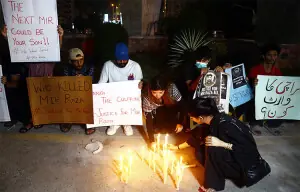
She won some support, but not a great deal of publicity. Until, that is, she decided to take her crusade to the war president’s doorstep during his almost unprecedented five-week vacation at his Prairie Chapel ranch in Crawford, Texas. When she arrived there early this month, with the avowed intention of asking Bush what exactly her son died for, the authorities forced her to stop five miles from the presidential ranch. She set up base on the roadside and Camp Casey, as the site was nicknamed, rapidly became a focus of national attention.
Coincidentally or otherwise, the timing was perfect. Not only is August traditionally a slow-news month in the US, but Sheehan’s protest comes at a time when the American death toll in Iraq is inexorably headed towards the 2,000 mark (although it perhaps needs to be reiterated that the considerably higher number of Iraqi deaths are unquestionably the bigger tragedy). Furthermore, largely as a consequence of mounting evidence that, far from representing a triumph for the forces of freedom and democracy, Iraq is turning into an unmitigated disaster, American public opinion has lately begun to swing against the Bush administration.
In recent months, more than half the respondents in successive opinion polls have noted that it was a mistake to invade Iraq. Rice University’s Professor Rick Stoll points out that “once support for the Vietnam War dipped below 50 per cent, it never came back”. And, without detracting in the least from the tenacity and heroism of the people of Vietnam, it is equally important to remember that domestic opposition to that conflict was crucial in ushering in peace.
The polls also suggest that about one-third of Americans favour an immediate pullout from Iraq. That’s nowhere near a majority, but the figure is much higher than before and decidedly on the rise — unlike Bush’s personal popularity ratings, which are languishing in the mid-30s. He has clearly done himself no favours by refusing to meet Sheehan, saying that while he “sympathized” with her and had “thought long and hard about her position” (which, in all likelihood, is yet another lie, given that there is no evidence the US president is capable of thinking long and hard about anything), he really has better things to do.
Bush and his senior aides have not themselves launched any direct strikes, pre-emptive or otherwise, against Sheehan, but they have let loose their well-primed attack dogs, from the obnoxious radio shock jock Rush Limbaugh and the foul-smelling bunch of broadcasters employed by the putrid Fox News channel to the pathetic Christopher Hitchens, who has accused Sheehan of “spouting piffle” and of having “taken a short course in the Michael Moore school of Iraq analysis”.
Hitchens ought to know a thing or two about spouting piffle, because that has been his primary occupation since 9/11. And Michael Moore’s analysis of Iraq is infinitely sharper and more cogent than anything those of Hitchens’ ilk have come up with in trying to justify their support for large-scale bloodshed. The folk at Fox go beyond piffle: they lie for a living, day in and day out, evidently proud of the lack of subtlety in their propaganda. And Limbaugh, notwithstanding the company he keeps, is one of a kind. He often beats Fox at its own game; this time around he has done it by alleging, without any basis whatsoever, that Sheehan’s is a campaign based on bogus documentation — the implication being that she never lost a son in Iraq.
Sheehan has, not surprisingly, been accused of being a left-wing dupe, anti-Semitist (because she dared to mention Israeli injustices) and anti-American; on a more personal level, much has also been made of the 48-year-old’s impending divorce and the antipathy she attracts from her staunchly Republican in-laws. Such attacks are hardly worthy of comment, but the intensity with which they are being mounted suggests that the warmongers’ party is in panic mode.
Cindy Sheehan has clearly struck a chord among many of her compatriots — not least those who were uncomfortable about the war, but wary of expressing themselves openly lest they be pronounced unpatriotic. Protest has become respectable, even desirable, once again. The media-savvy activist has evoked sympathy from significant sections of the mainstream press and television networks.
In the view of some analysts, the success of the Crawford leg of her campaign suggests that the US has reached tipping point: that is, support for the war, already below the 50 per cent mark, is inexorably in decline. I am not entirely convinced of this. Public opinion can be fickle. For instance, a random act of terrorism, manufactured or otherwise, could swing it in the other direction. The neocons are floundering, but, even though they have been proved wrong at every step, they are not willing to give up. Not just yet.
But then, nor is Sheehan. She left Crawford last Thursday after her mother suffered a stroke, but is expected back this week at the expanding Camp Casey, which continues to attract all manner of peace activists, from other bereaved military parents and state-level politicians to celebrities such as Joan Baez. Sheehan’s campaign, among other things, has exposed — and to some extent filled — the vacuum caused by the absence of a viable political opposition at the congressional level.
With some justification, albeit perhaps a trifle prematurely, Sheehan is being compared with Rosa Parks, the woman whose act of defiance 50 years ago against the American variant of apartheid sparked off the civil rights movement. The New York Daily News columnist Mike Goodwin envisages a future president greeting Cindy Sheehan with the words: “So you’re the little woman who stopped the Iraq war.” He may not be too far off the mark.
Spare a thought, meanwhile, for another bereaved mother who feels grievously wronged, and who keeps asking the same question as Sheehan. From the small Brazilian town of Gonzaga, Maria Otoni de Menezes wants to know why her son had to die. He wasn’t a soldier. He wasn’t even in a war. He was simply trying to catch a train to work when, without warning, seven bullets were pumped into his head at close range. Not by murderous fanatics but by a pair of British policemen.
Leaks during the past week from an independent inquiry into the death of Jean Charles de Menezes on July 22 have revealed that, contrary to earlier accounts and insinuations, there was no reason whatsoever to suspect that he might be a terrorist, save the fact that he emerged from a building under surveillance. It wasn’t a gratuitous random killing, just a case of a dangerous policy shabbily implemented, leading to horrible consequences. It’s true that two weeks earlier 56 other Londoners had been slaughtered in cold blood for even less coherent reasons. But the July 7 perpetrators were Muslim zealots, not officers of the law.
The deadly mistake — hardly likely to inspire confidence among Londoners — was bad enough, but the deliberate obfuscation that followed was even more ominous. There’s little comfort for Mrs de Menezes in the knowledge that British anti-terrorism personnel are being trained by their Israeli counterparts. Even more so than Mrs Sheehan, she needs a few straight answers. But Tony Blair isn’t around to provide them. Like his best friend, he too is on vacation.
E-mail: mahirali1@gmail.com
Reverse swing
AUSTRALIA has acquired a reputation over the last few years for having one of the world’s toughest immigration policies. Asylum seekers who arrive there without proper papers have been automatically bundled off to remote islands or desert camps behind razor wire, where they are sometimes kept for years. Illegal workers and overstayers get much the same treatment. Australia’s determination to keep unwanted migrants out is a message that has gone round the globe.
This policy has brought repeated electoral successes for prime minister John Howard but it has also led to a series of scandals — including wrongful deportations and children growing up in detention — which resulted last month in the resignation of the Australia’s chief immigration official. Less noticeably, the other side of the coin is that the number of people emigrating from Australia has been steadily increasing, and in 2002-03 it topped 50,000 for the first time.
This still leaves a net inflow of around 40,000 people a year but, with low birthrates and unemployment at the lowest level since the 1960s, this is causing demographic and economic problems. The largest group of these permanent departures are professionals — about a quarter of the total — followed by managers and administrators, many of whom are taking their skills elsewhere in search of higher salaries. Half the total are former immigrants returning to the country of their birth, while the others are native-born Australians seeking a new life, for the most part, in places such as New Zealand, Britain or the United States.
In response, Mr Howard is now seeking to step up immigration of “skilled people who fit the bill from anywhere in the world”.
— The Guardian, London
| © DAWN Group of Newspapers, 2005 |