0
0

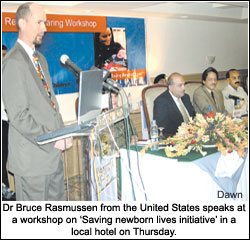 KARACHI, Aug 4: The Sindh Governor, Dr Ishratul Ibad, has taken strong notice of inadequate functioning of some 3,200 basic health units in Sindh. Most of these units are either non-functional or only partially functional hence directly contributing to high neonatal and maternal mortality rates in the province besides adding to the plight of the ailing in general.
In a direct interaction with senior medical professionals, provincial health department authorities and international and national experts here on Thursday during a workshop organized by Save the Children aimed to share results of “Saving Newborn Lives Initiative” the governor was told that while the pilot project initiated under the programme at Hala, with focus on community oriented intervention resulted in significant decline in the number of neonatal deaths this could not be complemented in most parts of the province.
Dr Ibad, in an attempt to procure first hand information regarding impact of Saving NewBorn Lives Initiative in Pakistan started in 2005 as pilot projects in different parts was quite surprised to notice that despite considerably impressive infrastructure more than 80 per cent of deliveries were performed at homes due to the lack of access to qualified professionals in the rural areas.
On the occasion, the governor responding to a well-researched presentation by senior paediatrician, Prof Zulfiqar Bhutta acknowledged that besides provision for easy public accessibility to the skilled medical professionals there was also a need to modify social and cultural attitudes of the masses.
He was of the view that the strategy to combat high neonatal, prenatal, infant mortality as well as maternal deaths and morbidity rates needed to be broadened through meaningful improvement in the macro-economics.
According to Dr Ibad, it was in this very context that the government had chalked out an elaborate programme for poverty alleviation and its consequences could be registered through phenomenal increase in the rates of consumable items as motorcycles, refrigerators so-forth in the rural areas of the province too.
He sought close coordination not only between rural and urban sectors but also within the community to ensure maximum accessibility of people to the facilities but also setting right the priorities within the community as well as at much broader levels.
The governor agreed with the suggestion that policies and strategies needed to be assessed on the basis of outcome and achievements and not on the basis of process that is number of individuals or houses catered instead of actual and long term impact.
Responding to queries raised by Dr Ibad, Prof Bhutta mentioned that 380 villages covered in the Hala district under a pilot project resulted in 26 per cent decline in prenatal mortality rate, demonstrating that major changes could be brought through proper application of community power.
Prof Bhutta explicitly referring to the studies conducted in Pakistan mentioned that the country registering 25,000 maternal deaths each year was exposed to 20 to 30 times higher rates of maternal morbidity and life long complications.
He was supplemented by Dr Bruce, Coordinator, Saving Newborn Lives Initiatives – Pakistan, who mentioned that neonatal mortality rate in Pakistan was almost as high as Afghanistan. Speaking on the occasion, Sindh Health Secretary Prof Naushad Shaikh assured all support to the programme.
He, however, when inquired by the governor regarding public accessibility of public sector facilities acceded that posts for 2,500 doctors were lying vacant.
According to him funds have been sanctioned under the current fiscal year budget for filling no less than 5,000 posts for doctors, however, owing to a ban the procedure was delayed.
The explanation was rejected by Dr Ibad, who reminded that since doctors, and paramedics come under essential service hence the issue of ban simply does not apply on them.
Ms Shaheena Masood on the occasion mentioned that a plan worth Rs31bn had been approved by the prime minister for Mother and Child HealthCare. Sindh health minister also spoke on the occasion. — APP