Local bodies: whose fiefdom?
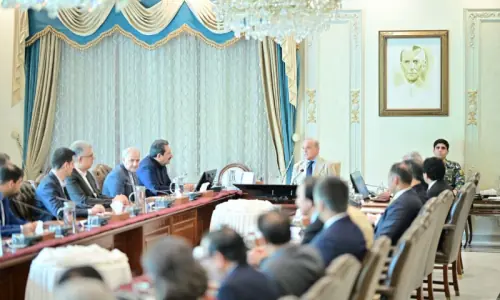
THIS year’s local government elections have generated unprecedented interest among all those who seek power by capturing elective offices. The great rush of candidates for election to the different tiers of local government apart, many heavyweights who never looked at any position less that of an MNA, and including some who have occupied federal ministerial gaddis, are reported to be keen to become nazims of districts.
The chief ministers, especially of Punjab and Sindh, are working overtime to ensure that local government elections are won by their proteges and favourites, as if their future in office depends on this. (They may well be right).
The principal reason for this jump in local bodies’ attraction for ambitious politicos is perhaps a huge increase in the financial resources now at their disposal. In a way this indicates the success of the new local government system. But there is a danger that emphasis on a wider acceptability of the system may divert attention from the fact that the element of devolution in the scheme, which was never very large, has been considerably whittled down as a result of last month’s changes in the provincial local government ordinances.
One calls these ordinances provincial out of traditional regard for the titles of legislative measures though in reality they represent the will of the central authority. The amending enactments too remind us that as the local government ordinances are protected under the LFO-17th amendment, they have been amended under the presidential sanction (of course, in consultation with the prime minister), in accordance with Article 268 of the constitution.
The local government laws of 2001 had proclaimed that it was “expedient to devolve political power and decentralize administration and financial authority to accountable local governments for good governance, effective delivery of services and transparent decision-making through institutionalized participation of the people at grass-roots level.” The amending pieces of legislation have left this preamble untouched but the central authority has now willed that the local bodies should, instead of empowering the people, become fiefdoms of the provincial chief ministers (though in keeping with the current corporate wisdom they are invariably referred to as provincial chief executives).
In the media debate on the amendments, notice has been taken of the replacement of the separate electorates with joint electorate, which was unavoidable because the thinking that had inspired the local government laws of 2001 had been superseded in the LFO, 2002. Whether the agencies responsible for conducting the elections will fully respect this change is, however, doubtful as there are reports of denial of joint electorate benefit to some minority candidates.
Another change that has generated controversy relates to the reduction of union council membership from 21 to 13, entailing a substantial reduction in the level of women’s representation in local councils, which was once touted as proof of their empowerment. The government should be able to understand the implications of a reduction of these seats.
That the changes in the 2001 laws are wide-ranging is evident from the fact that the amendments to the Punjab law number 76 and to the Sindh law 81.
Some of the changes are of a technical nature. For instance, the definition of ‘elector’ has been omitted because the term implied a person whose name was included in the list prepared under the Local Government Ordinance of 2000 possibly because such lists are not considered reliable. It was also necessary to remove maintenance of beaches, etc., from the responsibilities of local governments in Punjab for the simple reason that there are no beaches in the province.
The provision now omitted had probably travelled into the Punjab law from the draft ordinance for Sindh where beaches are of course a major concern of local bodies as well as a significant bone of contention amongst the various claimants to privileges.
The main changes that have been brought about in the local government system involve the provisions for the removal of nazims and setting aside of decisions and resolutions of local governments. The system hitherto was that disciplinary action against a local government had to be sanctioned by a higher elected body. This system has been revised by giving extraordinary powers to the provincial chief executives (chief ministers).
Under the 2001 enactments a chief minister could suspend a district nazim if the latter failed to comply with his directives and the matter had to be ratified by the provincial assembly within 30 days. If the provincial assembly ratified this suspension by a simple majority of its total membership the nazim stood removed from his office. Now a chief minister can suspend a nazim for 90 days and has to refer the matter to the Provincial Local Government Commission. On the recommendation of the Commission the chief minister may take any action against a nazim, including his removal from office.
Further, the 2001 local government laws provided for a nazim’s recall through a process other than a no-confidence move. On a move by the Local Government Commission a provincial Chief Minister could move the provincial assembly for the removal of the district nazim and if the assembly endorsed the motion by a simple majority the nazim ceased to hold office.
In the case of tehsil nazim, the matter was decided by the district council and in the case of the union nazim, the competent forum was the tehsil council. This process which was described as External Recall has been abolished, although there was merit in placing an elected body as the arbiter of the fate of nazims.
The procedure for removal of nazims through votes of no-confidence also has been changed. Hitherto, if a no-confidence move against a district nazim was adopted by a simple majority of the district council’s total membership, the matter was referred to the members of union councils in the district and if their majority voted against the nazim, he ceased to hold office.
A similar provision had been made for tehsil/town nazims. Reference to members of union councils could be justified because they formed the electoral college for the election of nazims. Now the matter will not be referred to union council members but to be effective a no-confidence motion will need to be supported by two- thirds majority. That the new procedure is less democratic and makes a nazim’s removal easier is manifest.
It is quite obvious that instead of dealing with troublesome local governments by chopping their heads off, the government has chosen simple and expeditious ways of setting aside orders of nazims and resolutions of their councils. Hitherto the initiative for setting aside an order of the district nazim had to be taken by the Local Government Commission on whose recommendation the provincial chief minister could set aside the order in question. The procedure has been reversed. Now the chief executives can suspend the district nazim’s order and refer the subject to by the Local Government Commission for endorsement.
Similarly, setting aside of a resolution by a district council hitherto required a decision by the provincial assembly by a simple majority of its total membership. Now reference to a provincial assembly is no longer required, a chief minister can suspend a district council’s resolution and refer the matter to Local Government Commission for the formality of endorsement.
The provincial Local Government Commission which acquires crucial importance in the new scheme of things is a small body of bureaucrats headed by the provincial minister for local government. Two of its members are to be drawn from the general public, one of them nominated by the leader of the house in the provincial assembly and the other by the leader of the opposition. Two eminent technocrats are to be selected by the government. The local government secretary is the ex-officio member and secretary of the commission. Thus, five of the six members of the commission are government nominees — in other words, they represent and are dependent on the chief minister. The commission will be a tool in a chief minister’s hands to take control of the local government network in his province. If the government was not happy with subjecting a provincial chief minister’s diktat to the will of the provincial assembly or the electoral colleges for the election of nazims, it should not have been impossible to assign the extraordinary functions allotted to the Local Government Commission to a judicial tribunal or a forum of independent authority. The choice of chief minister’s surrogates as the final arbiters of the fate of nazims and the decisions taken by them or their councils really shows the extent of retreat from brave declarations about empowering local communities.
That the grant of unbridled powers to chief ministers over the life and death of Nazims has not dampened the enthusiasm of candidates for such offices is easy to understand. If all that a nazim is required to do is to keep the boss in the provincial capital happy, the office becomes more attractive, not less.
The scourge of terrorism
THE shocking London bombings of July 7, and the less deadly repeat performance two weeks later, as also the subsequent bomb explosions in Sharm al Shaikh in Egypt, have brought world media attention on the issue of Islamic extremism.
Since it is also being alleged that three or more of the suspects in the July 7 atrocity were British nationals of Pakistani descent, who had visited Pakistan prior to undertaking their suicide missions, this has drawn international attention to the role of the religious schools (madressahs) in Pakistan and, in general, to the growth of religious extremism in the country.
The image of Islam has received a further blow and Muslims all over the world are increasingly being viewed with suspicion and distrust. Pakistan is facing severe criticism for its acts of omission and commission.
Terrorism, of course, is an entirely reprehensible act, which cannot be justified under any circumstances. UN Secretary-General Kofi Annan presented a report on March 21, 2005, in which terrorism was defined as “any action intended to cause death or serious bodily harm to civilians or non-combatants with the purpose of intimidating a population or compelling a government or an international organization to do or abstain from doing any act.” The London explosions clearly fall in this category. Targeting innocent passengers of buses and subways cannot be justified on any ground whatsoever; irrespective of the fact that many people oppose British involvement in the occupation of Iraq.
However, several observers in Britain itself have raised the pertinent question as to what are the reasons that have drawn these British-raised young men to resort to such suicide bombing, which is surely an act of total desperation. The fact is that there has been a growing sense among Muslims in many parts of the world, including Britain, that grave injustice is being done to the Muslims in several parts of the world.
The prime case, of course, is that of Palestine where Israel has been in unlawful occupation of Arab/Muslim territory for several decades and has turned the Palestinians into refugees in their own homeland. Backed by the West in general and the US in particular, Israel has brazenly defied international opinion, including numerous UN resolutions, to vacate the occupied land and respect the rights of the Palestinians. there are daily acts of Israeli oppression and provocation that add fuel to the fire. The Palestinians are clearly in no position to face the might of Israeli arms. Moreover, Israel is backed by unlimited US financial and diplomatic support. This is what breeds a sense of frustration amongst the Palestinians and Muslims in general, some of whom in desperation have resorted to acts of terrorism.
Furthermore, the US-led invasions of Afghanistan in 2001 and Iraq in 2003 have increased the sense of frustration and anger among Muslims in many parts of the world. They fear that Muslim countries are being targeted one by one, and some see these operations as a forcible occupation of Muslim lands, evoking the memories of the Crusades a thousand years ago. The daily bloodshed in Iraq is seen as evidence of resistance by its people to the military occupation of that country by the US and Britain.
In addition, many Muslims resent the western exploitation of oil resources and imposition of pro-West regimes in the Middle East. Some Muslims are worried about the corrupting influence of western culture on Muslim societies. Others complain of racial or cultural discrimination against Muslims in western countries.
This kind of grievances has been exploited by ruthless extremists like Osama bin Laden to set up terrorist organizations like the Al Qaeda. perhaps their active members are not many, but they seem to have a large number of sympathizers who are giving them financial and moral support, and even sanctuary. For instance, I recently met a leading doctor who called himself a reborn Muslim. This highly educated man expressed admiration for Osama and justified 9/11 on the ground that this act had put a stop to young Saudis going to the US for education and other pursuits that were corrupting the Muslim character of Saudi society.
Of course, there are some Muslims who claim that 9/11 was the doing of the Jews or Israel in order to defame Muslims! There are those who believe that there is no such thing as Al Qaeda and that Osama had nothing to do with 9/11. They are not discouraged by the fact that Osama himself has repeatedly confirmed his involvement in 9/11 and other terrorist acts. Clearly, the claims of such people are no more than self-deception.
It is a sad fact that religious extremism is growing in Muslim societies. This has had both internal and external repercussions. It has led to internal destabilization and serious law and order problems in countries like Pakistan. Sectarian violence has grown alarmingly in Pakistan and, ironically, some of the leading religious leaders themselves have been killed in on-going vendettas. And it has become risky for a Muslim in the Islamic Republic of Pakistan to go to the mosque to offer prayers. Vicious propaganda is being carried on against the other sects contrary to Islam’s basic teaching that “all Muslims are brothers.”
Then, there is the external dimension of extremism in Muslim societies. For some time, a deliberate “hate America” campaign is being conducted by some sections. Young people are being indoctrinated to believe that all that is wrong in the Muslim world is due to the US policies. This has evidently led some of them to resort to terrorism of the kind seen in London recently.
The perpetrators of such terrorism need to answer the question as to whether the grievances of the Muslim world can be resolved through suicide bombings and other acts of terrorism. On the contrary, it is much more likely that public opinion in western countries, and even in countries like Russia, would further harden against the Muslims. Such acts of terrorism will probably be seized upon by the neocons and reactionary elements in the West and elsewhere to resort to even more heavy-handed methods against Muslim countries. And if there is a “clash of civilizations”, as many people dread, is the world of Islam at the present time in any position to defeat the US or the West or Russia, or even Israel or India?
Issues of survival of Muslims and the independence of Muslim states cannot be left to the convoluted thinking of Islamic extremists and terrorists. Nor should decisions be made on the basis of emotionalism, self-deception and illusions. Whatever our grievances, we cannot afford to lose sight of facts and the ground realities.
Let us take the case of Pakistan’s national interests. The way things are going, Pakistan is increasingly being seen as an exporter of Islamic extremism and terrorism. No doubt, the West and Russia still have faith in President Musharraf as a key barrier against the seizure of power in Pakistan by the Islamic extremists. However, if the latter event were to happen, there is little doubt that Pakistan would be promptly declared a terrorist state and would be exposed to the worst possible threats to its security and survival. The main beneficiary in such a situation would be India.
The worst strategic threat to Pakistan could come if the US were to make a common cause with India and Israel to intimidate or attack Pakistan. Russia is, in any event, a long-term ally of India. Under the circumstances, it is doubtful if China would be willing to come to Pakistan’s rescue, firstly, because China is giving priority to its economic development and is in no mood to join any kind of war; and, secondly, because it too is worried about the threat of Islamic fundamentalism.
There is need also for looking at issues in their totality. Note has already been taken of the unjustified US support for Israel’s aggressive policies. At the same time, it should not be forgotten that whatever concessions Israel has made to the Arabs are also due to US persuasion. Israel vacated the Sinai in the 1970s as a result of the efforts of the US. The Palestinian leadership is now ruling vacated areas of Palestine as a result of the Oslo Accords, sponsored by the US. Of course, in the 1956 war against Egypt, it was the US which had forced Israel to stop its aggression and withdraw.
Elsewhere, it should not be forgotten that in the 1990s, the Muslims of Bosnia and, later on, Kosovo were rescued from Serbian genocide when the US used military force to subdue Yugoslavia. Incidentally, the US had taken this action while bypassing the UN Security Council, which had been blocked by Russian veto. In 2003, the US again bypassed the Security Council when it attacked Iraq for which the Muslim world has quite rightly criticized the US, but no mention is made of bypassing the UN in the case of rescue of Muslims of Bosnia and Kosovo. This is a case of double standards.
In the case of Iraq also, it is an undeniable fact that Saddam Hussein was a bloodthirsty dictator who had put to death several hundred thousand Iraqis during his 30-year misrule. Mass graves containing thousands of such victims have been discovered in Iraq. No one in the Muslim world raised a voice while Saddam was carrying out these atrocities. Saddam had also been guilty of aggression against Iran in 1980 and against Kuwait in 1990.
He did not seek UN Security council approval before attacking these countries. Those who now quite rightly condemn the US for bypassing the Security Council were much less vocal when Saddam had been guilty of the same. This too is a case of double standards.
Saddam’s departure has been a great relief for the long oppressed Shia majority in Iraq, and has been greatly welcomed by the Kurdish Sunni Muslims. these two groups account for nearly 80 per cent of Iraq’s population. They took part in large numbers to elect a representative government. The present Iraqi government has been recognized by the UN and the OIC, and has legitimacy. it is not demanding the immediate withdrawal of US forces.
The opposition to the US military presence is coming from some sections of the 20 per cent Sunni Arab population, aided by foreign Islamic extremists who have entered Iraq, including those willing to carry out suicide missions. It is, therefore, unrealistic to say that the Iraqi people in general are fighting against the US military presence in Iraq.
Eventually, the problem of Islamic extremism would have to be tackled by a twin approach, as advocated by President Musharraf. The Islamic countries have to curb religious fanaticism in their societies whereas the West, India and Russia have to resolve issues where the Muslims are being treated unjustly. There is no other way out of the present crisis.
The writer is a former ambassador.
Why they hate us
There have been thousand of stories about why people hate Americans (789,543 to be exact), but only five as to why the world likes Americans.
I would like to have a shot, though I’m not sure I can fill an entire column.
People like Americans because we have more fat-free food than any country in the world. Not only that, but we also put more vitamins in breakfast cereal and cat and dog food than any civilized nation.
We are admired for our willingness to call a spade a spade, and five diamonds a flush, and also for our skill at playing gin.
That is not to say that we are not loved for our powerful weapons. We know President Bush would never use them unless ...
The world trusts President Bush because it trusts his foreign policy and he believes in God.
Half the people on earth believe in another God, but they are either infidels or Bush haters.
The White House is the place where things happen. The heads of state visit it to discuss all the problems that beset them. Before leaving, they hope the president will give them a goody bag filled with F-16 fighter planes and ground-to-air missiles.
Why does everyone love Americans? It’s because they all love Washington. It is the home of a true democracy, where legislators may angrily debate each other, but at the end of the day they filibuster so they can debate some more the next day.
The American system is so admired because it is concerned with the little people, the poor people, the sick people, the homeless people and, of course, the rich people.
Congress passes laws to help the country become better than it was — if that’s possible. It will listen to everybody, but at the end of the day, its members will vote their consciences — and whoever promises to give them the most money for their next re-election campaign.
One of the things we are number one in is guns. Most countries have strict laws about who can own a gun and who can’t. But in the US, anyone can go into a gun shop or attend a gun show and purchase the weapon of his or her dreams.
People love us because we provide them with Diet Pepsi or Coca Cola, 7-Eleven Stores, Wal-Mart and yellow MacDonald’s arches to remind them we’re the fast food nation of the world.
American youth are admired for their taste in clothes — washed-out jeans, revealing tank shirts and Nike sneakers (which all come from China, but the kids here are the trendsetters).
The same is true for music. No country gives better rock concerts or country music than the US. What makes us even more beloved is we’re the entertainment capital of the universe. The world awaits Hollywood’s next blockbuster film — the scarier the better.
Foreigners can have our television shows, our DVDs, our iPods, our cartoons and our “Desperate Housewives.” America is willing to share the things that make us happy.
We’re held in high esteem for so many reasons. Our dollar is still sought after. Our baseball players all get a living wage, and our leading businessmen get golden parachutes.
These are only a few of the reasons the flag of red, white and blue is admired and beloved from Samara to Timbuktu.
The key word that you will see on every sign all over the United States is “free.” It is the reason everyone here is proud to be an American.—Dawn/Tribune Media Services
The truth about Abu Ghraib
FOR 15 months now the Bush administration has insisted that the horrific photographs of abuse from the Abu Ghraib prison in Iraq were the result of freelance behaviour by low-level personnel and had nothing to do with its policies.
In this the White House has been enthusiastically supported by the Army brass, which has conducted investigations documenting hundreds of cases of prisoner mistreatment in Iraq, Afghanistan and Guantanamo Bay, Cuba, but denies that any of its senior officers are culpable. For some time these implacable positions have been glaringly at odds with the known facts. In the past few days, those facts have grown harder to ignore. The latest evidence has emerged from hearings at Fort Meade about two of those low-level Abu Ghraib guards who are charged with using dogs to terrorize Iraqi detainees.
On Wednesday, the former warden of Abu Ghraib, Maj David DiNenna, testified that the use of dogs for interrogation was recommended by Maj Gen Geoffrey D. Miller, the former commander of the Guantanamo Bay prison who was dispatched by the Pentagon to Abu Ghraib in August 2003 to review the handling and interrogation of prisoners.
On Tuesday, a military interrogator testified that he had been trained in using dogs by a team sent to Iraq by Gen Miller. In statements to investigators and in sworn testimony to Congress last year, Gen Miller denied that he recommended the use of dogs for interrogation, or that they had been used at Guantanamo.
“No methods contrary to the Geneva Convention were presented at any time by the assistance team that I took to [Iraq],” he said under oath on May 19, 2004. Yet Army investigators reported to Congress this month that, under Gen Miller’s supervision at Guantanamo, an al Qaeda suspect named Mohamed Qahtani was threatened with snarling dogs, forced to wear women’s underwear on his head and led by a leash attached to his chains — the very abuse documented in the Abu Ghraib photographs.
The court evidence strongly suggests that Gen Miller lied about his actions, and it merits further investigation by prosecutors and Congress. But the Guantanamo commander was not acting on his own: The interrogation of Mr Qahtani, investigators found, was carried out under rules approved by Defense Secretary Donald H. Rumsfeld on Dec. 2, 2002. After strong protests from military lawyers, the Rumsfeld standards — which explicitly allowed nudity, the use of dogs and shackling — were revised in April 2003. Yet the same practices were later adopted at Abu Ghraib, at least in part at the direct instigation of Gen Miller.
“We understood,” Maj DiNenna testified, “that [Gen Miller] was sent over by the secretary of defense.” The White House and Pentagon have gotten away with their stonewalling largely because of Republican control of Congress. When the Abu Ghraib scandal erupted, GOP leaders such as Sen. John W. Warner (Va.) loudly vowed to get to the bottom of the matter — but once the bottom started to come into view late last year, Mr Warner’s demands for accountability ceased. Mr Rumsfeld and other senior officials have never been the subject of an independent investigation.
A recommendation by the latest Army probe that Gen Miller be reprimanded for his role in the Qahtani interrogation was rejected by Gen Bantz Craddock of Southern Command. The only good news in this shameful story is that a group of Republican senators, though resisting justified Democratic demands for an independent investigation, are attempting to reform the policy of abuse to which the administration still adheres. Six GOP senators led by John McCain (Ariz.) and Lindsey O. Graham (S.C.) have backed an amendment to the defense operations bill that would exclude exceptional interrogation techniques at Guantanamo Bay and ban the use of “cruel, inhumane and degrading” treatment for all prisoners held by the US. The administration contends that detainees held abroad may be subject to such abuse.
Attempts by the White House and Mr Warner to block or gut the legislation failed, and on Tuesday the GOP leadership pulled the defense bill from the floor rather than allow a vote. The administration probably will spend the next month trying to quell this rebellion of conscience and good sense. The nation would be better served if President Bush instead accepted, at last, the truth about Abu Ghraib.
—The Washington Post
Strategic ties with China
BEFORE Chiang Kai-shek destroyed warlords in 1920, westerners heard astonishing stories of the people who lived in that huge tract of land that stretched across Asia from Kashi in the west to Jixi in the east. Sir John Simon, British foreign secretary during the Second World War, once described the place as “a mere geographical expression.”
But it was in this geographical expression, or rather Chunking the war time capital, to be specific, that had in four years withstood 117 Japanese air raids, and tasted the blast of 22,000 bombs. In spite of the devastation, the artist was able to pick out the usual sights and sounds associated with old Cathay — a junk folding its sails in a Shanghai sunset, lofty mist-obscured mountain peaks, deep gorges cut by rushing mountain streams, a flock of cranes flying over a waterfall, mud and wattle cottages in a riverside village.
And the tourist was able to speak of the smell of camphor, sandal wood, lotus and blood, the taste of millet and rice cake, the sound of birdsong, temple bells and clashing swords and the sight of lacquered and tiled pavilions. There was gold, pageantry and armies of peasants in blue and grey trying to find their place in the sun.
All that more or less disappeared with the rise of Mao and Chou and the subsequent emergence of Deng Xiaoping — the architect of modern China. The country is still a self contained universe with its thousands of galaxies of family generations, and visitors still clutter up their homes with odd bits of chinoiserie. But after 50 years of order and discipline, a phrase borrowed from Joseph Stalin, China has become an industrial colossus, a superpower which has replaced the former Soviet Union as America’s main rival for world supremacy.
Currently, the United States is obsessed with the Islamic peril, both actual and imagined. But the general perception, at least in this part of the world, is that this is a temporary phenomenon which will probably sort itself out during the next 10 years. It is the spectre of an all powerful China that is about to clobber Taiwan that is worrying policymakers in Washington. It is a phantom that will not go away.
Nevertheless, the intellectuals in the think tanks, cloistered in seclusion in the granite vastness of the Rockies, have at least been able to get three observations right. The first is that even before its Iraq adventure the United States had endorsed its image of being the most unpopular country in the world whose only friends are Estonia, Israel, Poland and the prime minister of Great Britain.
The second is that in 10 years their country will no longer be the feared military power it is today. And most important of all, China has demonstrated that it is quite capable of standing up to a power that is increasingly being seen as the bully on the block. That’s why the lads in the Pentagon came up with the brilliant idea of fortifying a country with the potential of becoming a superpower — as a bulwark against China.
This is, of course, an over-simplified view. But signing a 10-year defence pact with India to build up its nuclear capability is being seen as the beginning of an alliance that is destined to completely destabilize the South Asian region.
The pertinent question that is being asked is: where does this leave Pakistan — a country that has always been reluctant to cut the umbilical cord with the United States with whom it has had a long military relationship?
This association has witnessed extreme swings, huge ebbs and flows. Noticeably, Pakistan never made attempts to reverse the lows in the Pakistan-United States relationship. It was always the United States which resurrected and exhumed this liaison, not for any benign reasons of building up a badly needed democratic structure in Pakistan, but to use this Asian country to serve American strategic and national security interests.
America’s changing foreign policy has contributed to the growing realization in this country that Pakistan has had only one sincere friend since the country recognized the People’s Republic of China on January 4, 1950, and established diplomatic relations a year later.
Pakistan has always stood by China on all issues important to that country, especially those related to the question of its sovereignty. These include the re-absorption of Hong Kong and Tibet and the return of Taiwan to the mainland, and sensitive human rights issues.
Chinese leadership has never failed to appreciate the steadfast support of Pakistan on issues of their concern. They generously acknowledged the significant role Pakistan played in the early ‘70s, which enabled China to break its isolation from the West and the US. Viewed in the light of global dramatic changes, the continued permanence of Sino-Pakistan relations is remarkable.
“As close as lips and teeth” is how China often described its ties with its oldest friends. Apart from North Korea, the most frequently quoted example was Pakistan. A friendship that withstands the vagaries of time. But anybody who has been studying the China desk closely for the last three years will realize that time also has its vagaries.
During a visit to Beijing in 2003 President Musharraf found that Pakistan may no longer be quite such a special friend of its major arms supplier after all. There was no mention of concluding a deal on a nuclear project among the eight agreements signed after his talks with Chinese President Hu Jintao.
Like North Korea, Pakistan looked like being a victim of China’s newfound desire to be friends with almost everyone. The sting in the tail was that the visit was followed by the news that China was preparing to hold joint military exercises with his country’s arch enemy, India. Beijing had apparently decided the time had come to behave like a superpower and indulge in a little Weltpolitik.
That is, of course, the accepted view in the West: that China is looking at new options. The thinking man in this blighted republic nevertheless realizes that China cannot possibly be held responsible for any lack of warmth that it might display towards its old ally.
After 9/11, Pakistan, under intense American coercion, opted for what apparently appeared to be a complete strategic reversal of its policies. Overnight, the country abandoned the Taliban; hosted nearly 48,000 US troops on Pakistani soil and the use of Pakistani Air Force bases for launching of American military operations against Afghanistan. In the process, Pakistan thus apparently allowed its strategic convergences with China to lapse.
The United States very gracefully sanctified Pakistan’s strategic reversal with glorified labels. Pakistan became ‘a strategic partner in the war against global terrorism’ and ‘a frontline state in the counter-terrorist struggle.’ In the process Mr Bush accorded political legitimacy to the regime of General Musharraf. It was logical to assume that Pakistan’s strategic alliance would undergo a transformation. Fortunately, there is little evidence of that.
By the spring of 2002, there were indications that Pakistan’s strategic alliance with China stood unchanged. The country received IRBMs and missile assemblies from China, signed a defence pact with that country with the focus on joint defence research and production and started an exchange of high level defence personnel.
None of the above developments in the Pakistan-China strategic relationship after 9/11, or Pakistan’s invitation to China for the development and construction of her strategic naval base at Gwadar on the Makran coast contribute in any way to the United States’ global war against terrorism or to the task of bringing back Afghanistan to normalcy. On the contrary, these Pakistan-China developments, as in the period prior to 9/11, create strategic embarrassments for the United States. But that, as a famous British politician would have said, is politics.