0
0

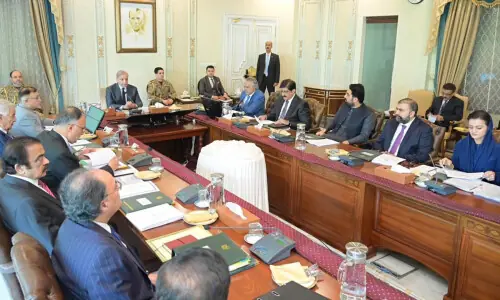
LAHORE, June 9: Punjab Finance Minister Hasnain Bahadur Dareshek on Thursday presented in the provincial assembly a tax free, surplus revenue budget of Rs224.408 billion for the fiscal year 2005-06, indicating a revenue expenditure of Rs157.528 billion.
The opposition boycotted the budget speech to protest against Punjab Assembly Speaker Afzal Sahi’s refusal to send references to the Chief Election Commissioner for disqualification of opposition members who had defected to the treasury. Before walking out of the house, the opposition members raised chants against the speaker, the government, and the defecting members.
The proposed outlay is 24 per cent higher than the current year’s Rs180 billion. The revenue expenditure is 11 per cent higher than the outgoing year’s Rs141.884 billion. It includes Rs8.1 billion to absorb the increase announced by the federal government in the pay and pension of the government employees.
The budget, carrying a current budget surplus of Rs43.127 billion, proposes a record provincial development programme of Rs53 billion, about 22 per cent more than the outgoing year’s spending in this sector.
The development programme will be financed through budgetary surplus and foreign assistance of Rs9.827 billion. The government will spend about 54 per cent more on development next year from its own resources.
In addition, local governments have been given Rs10 billion from the province’s capital budget and semi-autonomous government institutions and agencies another Rs8 billion for uplift projects, raising the total development expenditure to Rs71 billion or 45 per cent of the current revenue expenditure. In the outgoing year, the government anticipates to spend a total of Rs62.849 billion on development.
The government will transfer Rs90 billion, including Rs10 billion for development, to the district governments under the Provincial Finance Commission. The share of the districts has been increased by Rs21.757 billion from the current year’s Rs68.243 billion.
The provincial government proposes to abolish sales tax on certain services like beauty parlours, clinics, slimming centres, laundries and dry cleaners and marriage halls/lawns. The proposal is expected to incur a loss of around Rs11 million.
GENERAL REVENUE RECEIPTS: The provincial government has upped its tax target for the next year by 28 per cent to Rs25.771 billion (direct taxes of Rs9 billion and indirect taxes of Rs16.767 billion) from the current year’s 20.124 billion.
Finance department officials told Dawn that the tax target had swelled because the devolved property tax of Rs4 billion had also been indicated in the next fiscal year’s estimates. The officials said it had been done in the light of the changes proposed recently in the local government. They said the Punjab government would only collect the property tax and would later transfer it to the respective TMAs. The total non-tax revenue for the next year is estimated to be Rs33.124 billion, up by about Rs9 billion from the estimates of Rs24.349 billion for the current year.
Apart from raising Rs58.895 billion from its own resources, the provincial government is anticipating total federal transfers of Rs165.513 billion — Rs131.117 billion from the divisible pool, Rs30.202 billion as grants and Rs4.193 billion as straight transfers.
REVENUE/CAPITAL EXPENDITURE: The province has allocated Rs108.163 billion for general public services, Rs20.836 billion for public order and safety affairs, Rs12.978 billion for economic affairs, Rs822 million for environment protection, Rs2.207 billion for housing and community amenities, Rs5.971 billion (down from Rs8.413 billion allocated in 2004-05) for health, Rs4.976 billion for education and Rs1.114 billion for social protection.
A sum of Rs11.846 billion, down by 27 per cent from the current year’s allocation, has been allocated for debt servicing and another Rs8.2 billion for loans and advances. State trading in medical store will cost Rs13.018 billion.
In his speech, the minister said the budget, prepared in the Medium-Term Budgetary Framework, reflects vision of the government. He said the provincial economy during the current year had grown by 8 per cent for the first time since 1991-92.
He said agriculture had grown by 10.6 per cent and the housing and construction sector by 13.1 per cent this year. He claimed that Punjab had already achieved this year its target of creating one million jobs per annum.
He said the government would issue two funds next year, for which Rs8 billion had been allocated in the budget, to capitalize G.P. Fund and Pension Fund. The measure, he added, would help the government reduce its liability and create a fiscal space of Rs15bn in the next seven years.
Mr Dareshak said the government had set aside Rs9 billion for programmes under the Punjab Education Sector Reforms Programme, which would enter its third year next year. He said the government was focusing its attention on technical and special education.
He said the government was launching a comprehensive health sector reforms programme from the next fiscal. He said Rs3.5 billion had been set aside for health and Rs735 million for population welfare.
The government, he emphasized, was attaching importance to the agriculture sector and taking measures to bring improvement to it. He said Rs925 million would be spent on development projects in the agriculture sector and added that the income of farmers had increased over the past few years as a result of measures introduced by the government.
Mr Dareshak said the government would spend Rs300 million for the sasta atta scheme for the urban poor in view of increased wheat and flour prices.
He also spoke about the government’s efforts to computerize land record, fight pollution, develop IT, promote industry and improve law and order in the province.