0
0

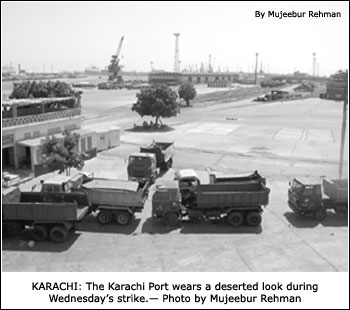
KARACHI, June 1: Industries in Karachi suffered production losses on Wednesday, in some cases up to 60 per cent, on account of thin attendance of workers, especially in the morning shift, because of the strike call given by the Muttahiha Majlis-i-Amal against terrorist attacks and incidents of violence.
 But an office-bearer of the Landhi Association of Trade and Industry gave a different picture, claiming normalcy in the industrial area. “Loss, if any, was within the range of 10 per cent,” he says.
Industrialists in other parts of the city, however, painted a bleak picture. They believed that production losses were massive leading in some cases to 80-90 per cent, as majority of workers opted to stay home.
Due to a complete closure of main wholesale and retail markets, supplies of finished products from the local industries remained completely suspended through out the day. Even the industries could not procure raw materials from the market.
Many industries, especially the export-oriented, had to ask their nightshift staffers and workers to stay on to meet timely shipment requirement of goods to foreign destinations. An official at the Customs Air Freight Unit Export said the entry of export documents had declined by 50 per cent. He was of the view that the situation had almost remained the same at the West and East Wharf’s export examination centres.
Former Site Association of Industry chairman Majyd Aziz claimed that almost all factories in the area operated at 50-60 per cent capacity. He said the export-oriented industries had suffered 20-25 per cent production losses. The strike hit the supply of goods to the market from the industries.
Site Association ex-chairman Nisar Sheikhani was of the view that the production in the industries remained in the range of 40-50 per cent on Wednesday. He said that attendance in the units plunged by 50 per cent in the morning shift.
Situation, however, improved in the evening shift when more workers showed up for work because of transport availability. Landhi Association of Trade and Industry vice-chairman Dawood Usman Jhakoora said the production activity continued unabated all through the day. “I think that the Landhi area has suffered production losses of at most 10 per cent,” he said, attributing the almost normal production level to the presence of workforce living in nearby colonies and localities.
However, Council of Karachi’s Industrial Association Chairman Akbar Farooqui offered a different view, claming that only 10 per cent industries had remained opened in the Korangi industrial area. Similarly, he said that only 10-20 per cent production had been recorded in the units, as a sizable workforce did not turn up.
Korangi Association of Trade and Industry ex-chairman Mian Zahid Hussain said that only 20-25 per cent production had been registered and the attendance registered marked the presence of only 25 per cent workers in almost all the units. He said that many industries had remained shut for the morning and afternoon shifts due to absence of workers. He said the industries returned to full thrust after 5pm when few buses started plying the roads.
F.B. Area Association of Trade and Industry Chairman Rehan Zeeshan said the area witnessed closure of 50 per cent industries, while the rest of units had to suffer huge production losses, as only 20-30 per cent workforce could manage to reach their units. As a result, only 30 per cent production was recorded in these units.
Industrialists in the North Karachi area appeared to be divided on revealing the actual scenario of production. North Karachi Association of Trade and Industry Chairman Syed Azim Ali claimed that the area recorded a 70 per cent production because of good attendance of workers and only garment and textile units suffered some losses, as majority of women workers failed to reach the units because of thin transport.
NKATI ex-chairman Sadiq Mohammad said that 50 per cent of industries remained shut on Wednesday, while the remaining 50 per cent units had registered only 20-25 per cent production.
It is hard to predict the actual losses suffered by the industries in Karachi on Wednesday, but the Karachi Chamber of Commerce and Industry had once estimated a loss of Rs1 billion a day to the national kitty in terms of taxes and duties in case a strike cripples industrial and commercial activities.