0
0

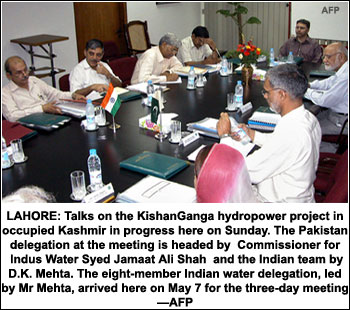 LAHORE, May 8: Pakistan on Friday accepted an Indian proposal to set July 15 as deadline for resolving the Kishanganga hydropower project issue. On the first day of the third meeting on the project held here on Sunday, the Pakistani side called for an early deadline because it did not want “talks to drag on indefinitely”.
The Indian side was of the view that it needed some time to gather technical details of the project to address Pakistan’s concerns. Therefore, it said, the deadline must be ‘realistic’.
But Pakistan insisted that the process should not be allowed to drag on and the two countries must agree on a cut-off date for finding a solution. On its part, Pakistan wanted a deadline in the month of May or June. They, however, agreed to a deadline of July 15.
After the agreement, both sides took up the first of the six questions which Pakistan had raised in the previous meeting. Pakistan had formalized its objections into six questions — three on the design of the project, two on diversion of water and one on the power house – at the last meeting. The first question regarding the design of the project was taken up in the meeting and both sides put forward their viewpoints.
The Indian side is reported to have said that it had come with a mandate to resolve all issues. It is ready to review the whole project if objections were found valid. The Pakistani side, totally convinced about the veracity of its objections, said the Indian sincerity would soon be tested.
It may be mentioned that Pakistan had objected to the construction of the hydropower project on River Neelum, saying the diversion of river water to the Wullar Lake in held Kashmir would contravene provisions of the Indus Basin Treaty.
The diversion will also reduce water flow into Pakistan by 27 per cent, which again is against the spirit of the treaty. The third objection by Pakistan is that it had already started the Neelum-Jehlum project and invested Rs71 million in preparatory works. Any construction on the Neelum river will affect its power generation capacity, which India cannot do under the treaty.
India wanted to tunnel River Neelum water into Wullar Lake and construct a hydropower project there. The Pakistan delegation at the meeting is being led by the head of the Pakistan Commissioner of Indus Water, Syed Jamait Ali Shah, and the Indian side by D. K. Mehta. The talks will be held for two more days and the Indian team is scheduled to return home on Wednesday.