0
0

KARACHI, April 26: Sindh Planning and Development Department in collaboration with the International Union for Conservation of Nature (IUCN) has started preparing Sindh strategy for sustainable development (SSSD). This strategy would provide guidance to government’s planners and policy makers, civil society and private sector in promoting sustainable development within their respective fields.
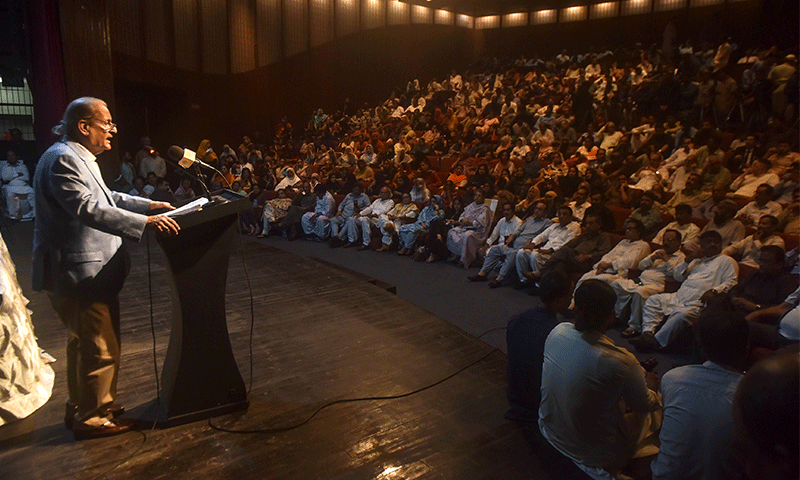
In this regard, consultative workshop to develop sector specific strategies was held here on Tuesday. The strategies were bifurcated as settlements, urbanization, communication and knowledge management, environmental health, minerals, mining, energy, rangelands and livestock sectors.
Speaking at the opening session Planning and Development Special Secretary Ms Rehana Ghulam Ali said the urbanization had put pressure on the existing infrastructure of the province.
She suggested that media and knowledge management could be used as tools for the sustainable development of Sindh.
IUCN vice-president Javed Jabbar emphasized the need for sustainable development.
He said while world was driven by market, consumerism and consumption, there was need to look for new paradigm and articulation.
The Secretary Environment, Shamsul Haq Memon, said other provinces had already developed their strategies and this year Sindh would also be able to develop its strategy for sustainable development.
The head of IUCN Sindh programme, Ali Raza Rizvi, said a series of consultative workshops were held to involve stakeholders in the development process of the strategy.
Nasir Ali Panhwar of IUCN said that the workshop was aimed at determining the future needs and aspirations of the people of Sindh.
Through this intensive workshop, sector specific result-oriented recommendations were harvested which would prove a source material for provincial and federal governments’ policies and plans.
Participants of the workshop forwarded their recommendations to develop sector-wise strategies for Sindh.
urban areas: It was recommended to strengthen the new local body system established by the devolution plan of 2001 that included elimination of bias between the district and provincial governments.
Maps of the cities be drafted and analysis of existing infrastructure be carried out and the documentation was very essential to plan development. To ensure that master plans were developed, and implemented for the cities. The parts of the cities which were left out of previous master plans should be incorporated into the new plans.
A comprehensive traffic plan be developed and implemented.
The participants emphasized proper planning for infrastructure development projects that took into account the needs of urban residents and minimize traffic and pollution hazards.
A realistic plan for sewage disposal and its treatment, promotion of water conservation practices at all levels was also proposed. Strong regulatory bodies were suggested, otherwise privatization itself becomes a problem. No one was looking after consumer interests.
Livestock: Research needs to be conducted on the potential at all levels of the livestock and poultry farming sector. Surveys to identify the characteristics of different livestock systems and to understand the characteristics of different sub-systems of livestock production such as dairy production, meat production, and draught animals, was also proposed.
Increase investment in livestock research and development and the availability of technical manpower.
Ensure that the new technology, especially that imported from abroad accounts for the variability between farm resources and animal practices in Sindh.
Employ non-conventional feed resources such as by-products of sugar and bananas. Livestock is customarily maintained on conventional feeds coming from, natural rangeland vegetation, fodder crops, cereals, and milling by-products in the irrigated areas of the province.—APP