0
0

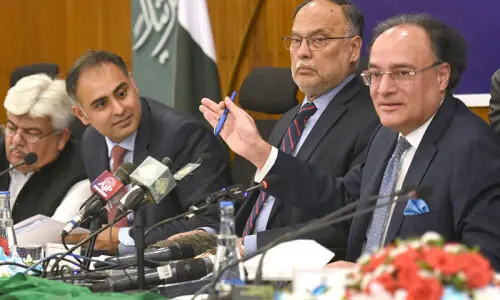
LAHORE, April 25: Declaring that the People’s Party is anti-establishment as a matter of conviction and believes in collective wisdom of the people, Asif Ali Zardari has said his party will settle for nothing short of a complete sway over national affairs to implement its programme of an egalitarian society.
“We have ample time at our command; we can wait; we are ready to give a safe passage to the power-that-be, but we may also warn them this is the last chance (of setting the things right); what we want is complete transfer of power; either we will enjoy complete power or nothing,” Zardari said at a reception hosted on Monday by the Lahore High Court Bar Association.
In his 40-minute address, he invited all political forces to join hands with the PPP to carry out a fight for real democracy that was absolutely necessary in a situation where the federation was at stake and where the establishment had failed to salvage the country from a political and economic impasse.
Zardari said the military rulers had no solution to the national issues; they rather had a tendency of addressing all problems with a bare force which they employed in East Pakistan and lost half of the country. That was why the political forces had to rise above all other considerations to save the country from a further damage, he said.
He said: “We might have committed mistakes in the past, but have also learnt a lot from them. I must say it’s time to forgive and forget all this for the sake of Pakistan, for the sake of its 150 million people half of whom are living in abject poverty and many of whom are committing suicides because they have no bread and are the poorest of the poor.”
He said the PPP had a firm commitment towards ameliorating the lot of these sections of society and wanted cooperation of other political organizations and professional groups like lawyers who had been in the forefront of all democratic movements in the past and were still striving for the rule of law, independence of judiciary, fundamental rights and civil liberties.
The PPP leader demanded that the future elections should be free and fair. This was the only way to establish real democracy in the country and demonstrate that all forces respected the mandate of the people. This alone, he said, would ensure that the state institutions were established on sustainable foundations, and they always gave necessary support to a solution to socio-economic problems.
“As the largest and the most popular party, we offer them (the rulers) to walk home in peace, return to the real job and refrain from meddling in national affairs,” he said.
Zardari said the PPP had a firm faith in collective wisdom of the people. This was the greatest asset for any political organization, and his party alone was in a position to say that the people had an unflinching faith in it. No other political force, particularly those ruling the country, enjoyed the support of the masses, he said, and added that “Benazir Bhutto is bound to return home, and when she is back, she will take the country by a storm”.
He said the PPP had never compromized on principles, and its evidence was the sacrifices the Bhuttos had to offer. He said he had chosen Punjab to be the centre of his political activities because he did not want that this province should be blamed for the follies of others. He said the people of Punjab were as deprived of their rights and suffering from poverty as those of other provinces. “I will reach all nooks and corners of the country, knock at all doors and take all people and political forces in the fight for democracy with a firm hope that democracy and the people will be the ultimate winners.”
Zardari condemned the arrest of PPP workers who had come to receive him on April 16. He said the government had charged political workers with terrorism which was shameful. He demanded their early release.
LHCBA President Fakharunnisa Khokhar said the country lacked democracy and rule of law. Such a situation, she said, had emerged because the judiciary was not independent. Had the judiciary been strong, it would have prevented the establishment from autocratic regimes.