0
0

ISLAMABAD, April 6: With sound macro-economic fundamentals achieved and key sectors strengthened by reforms implemented in the past 4-5 years, Pakistan is expected to sustain strong economic growth of at least 7 per cent over each of the three fiscal years 2005-2007. In financial year 2004, the gross domestic product grew by 6.4 per cent — exceeding the 6 per cent mark for the first time in seven years, says Asian Development Outlook 2005, a report by the Asian Development Bank released by ADB Country Director Marshuk Ali Shah here on Wednesday.
“A robust performance in the real sectors of the economy in the first half of the current fiscal year, the steep rise in imports of machinery and industrial raw materials, and continuing high domestic demand all indicate that GDP growth is likely to improve to 7.0 per cent this year,” the report says.
It envisages strong performance of the agriculture sector, which is expected to grow at 5 per cent this year. Agriculture will benefit from an increased output of cotton and wheat, a surge in imports of machinery, and a rise in agricultural credit.
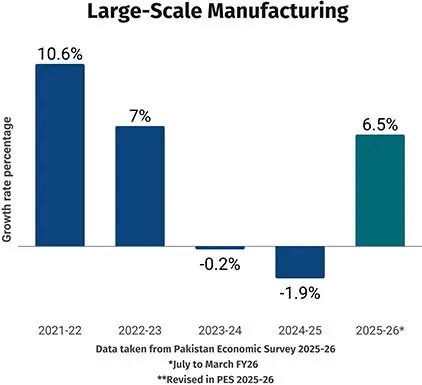
A strong recovery in manufacturing investment during the last fiscal year, continuing high domestic demand, modernization of the textile industry, and cheaper and more abundant cotton are expected to lift industrial growth to 10 per cent.
Expansions in the telecommunications and financial sectors should improve growth in the services sector in FY05, the report says.
Meanwhile, export growth will fall short of import growth by a significant margin, substantially widening the trade deficit in current fiscal year.
One cloud on the economic horizon is higher inflation projected at 7.5pc. But inflation is expected to fall back to 5 per cent in the next financial year.
The current account deficit is expected to stabilize below 2 per cent of GDP. Despite the adverse effects of high oil prices, the fiscal deficit target of 3.1 per cent of GDP should be achieved in current financial year, because of the government’s active debt management policy and tax reform measures, the report says.
“The resulting fiscal space will allow the government to increase investments in physical infrastructure and improve basic social services while the continuing policies over the last four years will boost investor confidence”, it adds.
The financial system, having undergone aggressive reforms and privatization, is well positioned to absorb macroeconomic shocks and mobilize and allocate financial resources more efficiently, the report says.
Banks are extending their lending to new areas such as consumer finance, which is boosting production of consumer durables like automobiles and electronics.
“Banks are also helping growth in agriculture by sharply increasing both production and investment loans to farmers”, says the report.
Talking to reporters after launching the report, Marshuk Ali Shah said that the ADB recommended to the government to take a decision for at least one natural gas import pipeline project to meet its future energy demands.—APP