0
0

THERE has of late been a phenomenal upsurge in some share values in Pakistan’s capital markets, the prices having risen by several hundred per cent since January 2002. According to the statement of the managing director of the Karachi Stock Exchange Moin Fudda made a year ago, among the factors responsible for this rise are ‘improved economic management’ in the country, and “positive change in geopolitical situation; lifting of sanctions; huge inflow of foreign remittances by expatriate Pakistanis; unprecedented surge in foreign exchange reserves; continuity of economic policies and better operational results of blue chip-listed companies.”
However, looked at closely, most of these factors were external factors; rise in expatriate remittances occurred due to the insecurity felt by the overseas Pakistanis subsequent to 9/11. US aid and debts were rescheduled or written off. Then the mantra of ‘macroeconomic stability’.
As far as the real test goes, which is indigenous growth of the industry and the economy, our industrialists have continued to be shy about making new investments, partly on account of a number of factors that have ranged from tremendous rise in utility charges at the behest of the donors, alleged ‘fall’ in return on investment, competition from an influx of cheap Chinese goods, and the fear occasioned by the implementation of WTO regime in 2005.
In Mr Fudda’s words a year ago hung like the proverbial ‘sword of Damocles’ over their heads! And while the government graciously decreased the rate of interest, the prices of assets and manipulated prices of stock market shares has continued to boom, thanks to use of loans obtained for apparently ‘genuine’ purposes by unscrupulous but influential elements to speculate in stock and real estate markets.
The rise in paper value of shares or the tremendous rise in real estate prices thus could hardly justify optimism. Rather, this artificial rise in value could better be described as being due to de-linking of money from value. Now just a week or so ago, the results of this rise in ‘prosperity’ were witnessed at the Karachi Stock Exchange in the form of violence by ‘small ‘investors.’
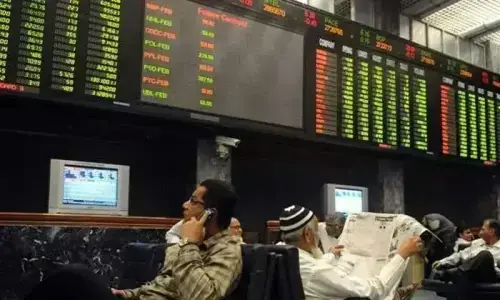
After about three or for weeks of unexplained rapid rise, the share index suddenly plunged. Some shares had gone up within this short span by over 200 per cent! As the downslide started, billions of rupees of the smaller, the inexperienced, the unwary or the greedy vanished into thin air. The result was that on 25th and 26th March, many of these latter ‘investors’ went on the rampage, damaging the property of the stock exchange and demanding probe. The probe was ‘promptly’ instituted.
There is a widespread belief that the market was being manipulated by some big players and the small and the unwary investors—whom the Wall Street axiom calls ‘pigs’—were being cheated of their savings. Though it may be a little cruel to say so, but the so-called ‘small investors’ ought to know that there is no free lunch, greed never got anyone anywhere and hopes of earning money overnight without working can and do backfire!
Let us examine the statement on the recent stock market violence by some ‘wizards’ connected to the stock market. According to the Managing Director of KSE, “initial investigations showed that the market was being manipulated by someone ‘big’ so they could buy shares cheaply from desperate small holders,” though he did not elaborate on the identity of this “someone big.” This is hardly a revelation.
SECP Chairman Tariq Hassan has stated that “the SECP regulated the market and had no control over the irrational behaviour of market participants. The commission was responsible for maintaining transparency and integrity of the trade transactions but not concerned with the outcome of the trade.”
Now how can the stock exchange that cannot function without strict government supervision that is susceptible to fraud and manipulation by the big sharks be a harbinger of good tidings as far as the economy is concerned? Where is the unseen ‘rationality’ of the ‘invisible hand’ of the market that is supposed to sort things out?
Mr Hassan says the SECP would set up a special cell to handle complaints by investors, and promised that the Commission would take “appropriate measures from next week against elements found guilty of indulging in misrepresentation or fraud in trading in the Karachi Stock Exchange (KSE).” What action has been taken in the past, one may ask, and what action can possibly be taken to help those willing to be duped under the temptation of getting easy money?
Now the unpleasant reality. Unemployment has risen in Pakistan during the last few years, and the much-trumpeted rise in foreign exchange reserves has hardly helped generate productive economic activity. The impact of IFI’s conditionalities, most of it inspired by ‘free market’ philosophies, is an important reason behind this. The hype about stocks and lack of genuine economic opportunities have made everyone indulge in the stock game.
Local industrialists are seen grumbling about the very ‘macroeconomic’ policies that the government prides itself on, and that the former Finance Minister (and current Prime Minister) Shaukat Aziz liked to boast of so frequently.
Many independent Pakistani economists disagree with the claim that the stock market ‘boom’ in Pakistan after 9/11 has been a manifestation of the strength of Pakistan’s economy. For this phenomenon, they hold responsible factors already mentioned. These are extraneous to the economy, and are not leading to any real economic growth, still less to meaningful industrial growth.
In fact, the money that has flowed into the country, by whatever route, has failed to translate into new productive schemes and seems to have gone mostly into speculation. The true state of Pakistan’ economy is reflected in the reluctance of investors to engage in productive activity, or set up major industry. Banks, despite liquidity, are reported to be having problems in lending.
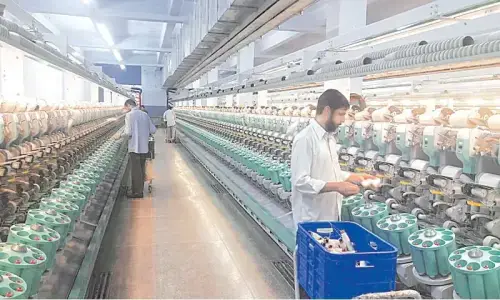
The industry that accounts for most of the exports, viz. the textile industry, is preoccupied with the post-Multi Fibre Arrangement regime. The auto industry is reaping the fruits of protection; banking is preoccupied with serving itself rather than the economy. The much glorified ‘defence industry’ and those industries, institutions and activities run by the military establishment are a protected, pampered lot, whose profitability is assured at the expense of the consumer.
The rise in property prices, and rentals makes entry into business difficult for the small and medium entrepreneurs, the decreased rate of interest notwithstanding. Hence all conventional measures seem to be failing in our specific conditions.
According to some observers, real estate and stock market have become not competitors for the surplus funds of the rapidly rising filthy rich class of the country but accessories to each other! The funds obtained from one are ‘invested’ into the other for quick gains!
Joseph Stiglitz, the former Chief Economist of the World Bank, recommends a return to basic economic principles rather than focus on ephemeral ‘investor psychology.’ Though, he said this, in the context of IMF’s policy of invariably advising developing countries’ governments to ‘tighten their belts’ and transfer everything to the private sector, rather than act on its original mandate, which was to help them increase aggregate demand in the face of economic recession.
This is equally applicable to our current situation in which the government, perhaps out of its own compulsions, has started claiming macroeconomic stability as a great achievement. They seem to regard it as an end itself rather than means to an end. Hence the increase in poverty, unemployment and inflation does not bother them. Unemployment and inflation, when present simultaneously, indicate something grossly wrong somewhere.
The government’s regressive policies have drawn adverse comments even from the World Bank. It has cited the practice of petroleum price fixing by an “Oil Companies Advisory Committee,” whereby the very companies whose interest is in price hike, are authorized to fix the petroleum price! Such a policy would in many countries be regarded as illegal, the WB has emphasized.
Gimmicks like consumer financing through banks, which is open to a small segment of the affluent classes only, is not the superhighway to prosperity the government spokesmen have been chanting recently. If the objective is increase in aggregate demand, job creation through labour intensive industry and infrastructure development is the answer. On the contrary what they are doing is to make Pakistan a mere cog in the global capitalist economy, meant to provide commodity and unskilled and low skilled labour.
General prosperity and indigenous development that go to increase domestic demand, or proper environment to set up competitive industries and service companies is low on their list of priorities. Unless income and assets are distributed more evenly through the populace, and a level playing field provided to various players within the economy, there is not much hope for regeneration of the economy. Economic stagnation and rampaging poverty would be our lot, as being witnessed through increase in the number of beggars in the cities, and the increasingly loud voices against inflation and injustice, not to speak of the increasing sense of insecurity felt by the ruling elite themselves, whose security concerns bring city life to a standstill when they move through the city.
Obsession with financial capital has resulted in failure to muster human capital, both skilled and unskilled available within the country. Their invitations to ‘foreign investors’ to come and ‘invest’ in Pakistan go unheeded as they are unable even to prevent capital flight from the country. The ones that come are usually looking for quick gains—without any long-term commitment.
China has been able to take advantage of ‘foreign investment’ because of its utilization of its vast and cheap skilled and unskilled labour force and success in developing a good infrastructure. It has obtained DFI on its own terms, using its vast market and increasingly affluent population as bait. Thus basically it is using its human capital to make economic gains. It has not pampered a small wealthy privileged class at the expense of the masses.
A few years ago, financial crises followed the liberalization of stock markets in South East Asian countries. Close links between two inherently unstable markets, the stock markets and the foreign currency market is the harvest that is reaped after the financial markets are liberalized too quickly.
In these markets, everything depends on the perceptions of investors and differences in the availability and use of information. During the East Asian crisis, for example, portfolio managers sitting in New York and London started pulling out of Korea as well when the Thai Baht collapsed. They linked Thailand and Korea together.
Rumours of impending economic or political doom are enough to bring about a downslide and dupe small investors in such markets. Even in developed countries, a few words by a politician or the Central Bank Chief often rock the stock market.
In the presence of regressive policies that seem to optimally combine the bad points of both ‘free’ and planned economies, liberalized capital markets and a stagnant economy is the deadly combination that could give rise to worse crisis in the future. This has happened before, courtesy short-term foreign ‘investors’ (read: speculators), in other countries. The crisis, if it comes, would be not merely one of finance or currency but be an economic crisis with social and political implications of its own.