0
0

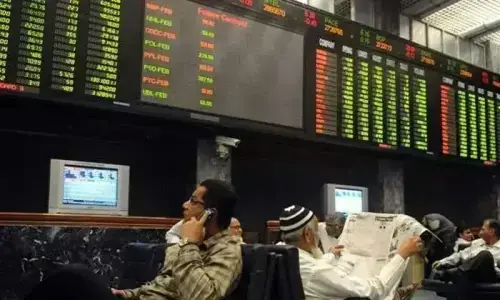
EVERYTHING that could go wrong at the Karachi Stock Exchange in the last two weeks, did. Share prices swooped down. Sellers desperate to offload their holdings scrambled in vain to do so, and failed. The regulators turned shaky, taking decisions and then revoking them. And brokers panicked, resorting to shows of strength and the inevitable blame game. Where some few weeks ago, speculators were boasting at the stock exchange about whether they would buy a Honda Civic VTI at the end of the trading session or the new Toyota Camry, this past fortnight, they were seen in tears in the corridors and on the stairs of the building.
After the chaos of the previous week, which resulted in heightening uncertainty, the KSE decided to raise the cap on the badla rate from 18 per cent to 24 per cent and the State Bank lifted the 20 per cent (of capital) limit on banks participation in the share and badla market allowing them to provide financing and buy shares.
This was done in the hope that those desperate to seek financing to roll over their positions are able to access money and that some institutional buying helps the limping share market gather steam. Meantime, a meeting was held last Sunday afternoon between KSE MD Moin Fudda, broker-turned-banker Jahangir Siddiqui, brokers Arif Habib and Aqeel Karim Dhedhi, and State Life Insurance Corporation chairman Kamal Azfar to discuss the ongoing crisis.
A committee was formed to consider the matter. Nine bankers were invited to the KSE and meetings were held with each one, persuading them to provide financing and help save the market. Institutional investors viewed this as another negative signal.
“These repeated meetings of the big boys just reinforces the common belief that a couple of brokers can drive the market,” a treasurer at a large local bank said. “Who decides who becomes part of the decision-making team?”
NIT chairman Tariq Iqbal Khan also got involved, coordinating a committee to start the buying. Since OGDC was the stock that sparked the downturn, the KSE put out a notice this past Tuesday announcing that the consortium would buy OGDC at Rs117.50 a share from all those who wanted to sell it, with preference given to “small shareholders” with less than 100,000 shares. (That curious definition of small investor meant an investment of Rs11.75 million).
A total of 991 small and eight bigger investors applied and Rs1.4 billion worth of OGDC was bought by the consortium which market players said was made up of AKD Securities, Arif Habib Securities, Jahangir Siddiqui Capital Markets and Javed Omar Vohra Securities, representing themselves and big institutional clients.
Meantime Prime Minister Shaukat Aziz also called a meeting of KSE MD Moin Fudda, Aqeel Dhedhi, Arif Habib, Jahangir Siddiqui, Nasir Bukhari, Tariq Iqbal Khan, and SECP chiefs Tariq Hasan and Shahid Ghaffar in Karachi on Tuesday night seeking views on why the crisis took place and directing to get to the bottom of it.
Wednesday’s settlement day then passed uneventfully with no broker defaults, as expected after the OGDC bailout. However the big sellers returned mercilessly pushing the index down 316 points on Thursday and another 176 points on Friday.
By midweek, market analysts had come back into action making recommendations on attractively priced stocks while brokers forecast that some immediate term volatility notwithstanding, the index would soon stabilize. What lessons should market participants draw from this crisis?
Lesson for investors: Be an investor not a speculator and know the difference. Investors study the company they are investing in. They consider its financial performance, history of dividend payments, growth prospects and state of the industry.
Then, they create a diversified portfolio with a long term vision, often not checking share prices for several days at a time. Speculators buy shares based solely on one number: the share price. In effect, they’re betting that the share price will rise. So they buy on borrowed money, hoping to sell at a higher rate and pay back the original sums. And this inevitably involves following herd behaviour, as with OGDC this time, rather than financial research.
Research clearly shows that in the long run, investing in shares provides higher returns than any other avenues. In the Pakistan market, the annualized return on equities in nominal terms is 20 per cent. But to achieve these gains, diversification and a long term view are critical.
During this episode, if investors had invested in the stock market through open-ended mutual funds, they could have redeemed at any time and not been stuck holding stock they can’t sell.
Lessons for brokers: Exercise conservatism and caution when making repeated bullish investment calls in a galloping market which is racing up at an unnatural pace taking share prices way past their fair values. When this happened between January and March, there was scarcely a bearish broker in sight. Calls to slow down the panic buying at the cost of lower commissions would have made for a far more credible broker community.
Second, once panic began to spread last week, brokers would have done well to develop and then stick to a unanimously agreed course of action which its representatives on the board should have pushed through. Brokers’ expertise is of tremendous value but most of it is usually lost in cliquish behaviour and infighting.
Lessons for regulators: Rather than scrambling to save the market when a crisis hits, ensure systems are in place that minimize the chances of a crisis. Take decisions only when armed with complete information with full consideration of the logic of the decisions and a full range of views from market participants.
After a decision is taken, stick to it and have the mettle to resist outbreaks of rage from big brokers rather than simply giving in to their pressure. That, after all, is the true test of independence.
Secondly, the regulators must realize that risk management involves more than ensuring settlements run smoothly. It is unmitigated leveraged positions which lead to price bubbles. Leverage is the real problem, not the form it comes in.
Overleveraging through badla has shown to cause speculators to overextend themselves repeatedly and cause a market crisis. This time, overleveraging through futures led to the same result. And overleveraging through margin financing must also be managed with the right mechanisms. Leveraging is what has to be properly governed.
The introduction of new rules on Friday after the meeting of the boards of the three bourses and the SECP is a welcome albeit much awaited move. However, forethought and planning before a crisis is the key.
The KSE management’s announcement at a hurriedly called press conference on Wednesday that futures rules would be amended comes too late. When the spreads between the ready and futures counters, were rising, that was the time the front line regulator should have foreseen the crisis. For the KSE management to simply blame foolish speculators for being greedy is hardly the role of the regulator. Speculation is prevalent in every market and to a great extent, adds volumes and depth. The role of the regulator is to monitor that speculation and ensure that systems are strong enough not to let that overpower the entire market.
Similarly, forming a consortium of big brokers to save the market may have worked but is again a temporary and worrying phenomenon. This again may have been an immediate balm but it is an unnatural solution to create an artificial buyer at a price not determined by the market.
The sanctity of price discovery at the market has been hurt. And big brokers, have once again, been invited into the driver’s seat to control the fate of the market.
Then, compliance must be tougher. For example, regulators routinely wash their hands off the margin deposits required to be made by investors, saying it is the responsibility of brokers to ensure this is done. As a result, what happens is that several brokers put up exposure deposits themselves on behalf of their clients. The KSE and SECP will have to first accept that this is their responsibility and then devise a way to ensure that clients are required to make deposits.
Investor awareness also needs to be stepped up on. Whatever efforts the KSE claims to have made are far from good enough, especially in a rising market where participation from the public inevitably widens. The management of the KSE should make an aggressive investor awareness drive through seminars and the media a top priority.
By becoming involved, giving the green signal to the KSE’s decisions and brokers solutions and by coordinating with the SBP to amend regulation and save the market, the SECP no longer remains an objective spectator, despite their distance from the media. It is therefore now difficult for them to become the investigators and their move Thursday to set up an independent task force to review the crisis and suggest measures to improve it is perhaps the only truly welcome move so far.
They should, however, select members who are both independent without any stakes in the market and who have the ability to investigate the matter from all angles on the ground. The committee should also be mandated to examine the role played by the SECP during this crisis and study how the situation might have turned out differently if the Commission had responded differently. Moreover, when the report is turned in one month down the road, the SECP should make public its contents.
As long as stakeholders learn the right lessons from this incident, and the results of an independent investigation are made public, this image may yet change in the future.