NPT conference and Iran
A non proliferation treaty conference will take place in June this year. It promises to be as epoch-making as the conference of 1995 when the Nuclear Non Proliferation Treaty (NPT) was made permanent.
The issues before the June conference will be the very existence of the treaty, North Korea's nuclear programme and the much discussed Iranian nuclear programme.
Also to be discussed will be amendments or additions to the treaty so as to make articles IV and X more stringent, thereby destroying the spirit of the treaty, and also a suggestion to the UN Security Council to pass a resolution making the contents of the treaty universal and not applicable only to the members of the treaty.
This would mean India, Israel, North Korea and Pakistan who are non-signatories to the treaty or have withdrawn from it would have to abide by its conditions and what it represents without recognition of their nuclear weapons power status.
What I have outlined above is the gist of the proposals put forward by the Carnegie Endowment in a two-part report published in 2004. The reason for emphasizing these proposals here is that in the latest round of talks between Iran, Britain, France and Germany, Iran has been asked to dismantle its uranium enrichment programme to the extent of the centrifuges that they possess.
Currently, Iran has suspended its centrifuge enrichment programme temporarily in accordance with its understanding reached in the end of 2004 with the three European powers. These talks are not under the aegis of the IAEA or the UN but are quadrilateral talks.
It would be apt to give the full name and style of the NPT. It is an abbreviation of "Treaty on the Non- Proliferation of Nuclear Weapons". What has to be noted is the hiding of the words 'nuclear weapons' when we say NPT. Thus, the treaty bans nuclear weapons exclusively and nothing else.
Under the NPT's Article IV, there is no restriction on any country possessing an enrichment plant like Iran's. Iran has the right to acquire the equipment it has. But there have been agreements between some states after the NPT came into force in 1970 and outside its ambit.
In 1971, under the auspices of Dr Claude Zangger, a list of items that fell in the ambit of Article III, para 2, of the NPT was developed and this then led to the Nuclear Suppliers Group (NSG) and the Trigger List.
In Article III, para 2, we are told: "Each State Party to the Treaty undertakes not to provide (a) source or special fissionable material, or (b) equipment or material especially designed or prepared for processing, use or production of special fissionable material, to any non-nuclear weapon State for peaceful purposes, unless the source or special fissionable material shall be subject to the safeguards required by this article."
The next paragraph of Article III or para 3 qualifies what it lays out in the preceding paragraph when it says: "The safeguards required by this article shall be implemented in a manner designed to comply with Article IV of this Treaty, and to avoid hampering the economic and technological development of the Parties or international co-operation in the field of peaceful nuclear activities, including the international exchange of nuclear materials and equipment for the processing, use or production of nuclear material for peaceful purposes in accordance with the provisions of this treaty and the principle of safeguarding set for the in the Preamble of the Treaty."
There are 34 states that have acceded to the NSG under Article 3, para 2, and this paragraph is currently held up as the overriding reason for the denying of any nuclear equipment to a state that may want to move forward in the field.
Unhappily, this smacks of chauvinism because the contents of para 3 of Article III and Article IV have been ignored. The threat posed by the Soviet Union is now replaced by imaginary threats to global security by terrorism and "rogue states".
This suspicion is invalid because it takes much more than a fissile nuclear core to make a nuclear device, and to assemble a nuclear device would require factories producing other components that go to make a fissile device.
Iran states that its nuclear programme is for peaceful purposes. Should there be any doubts about that, then these have to be substantiated with facts and not be based on a web of suspicion and lies as was created to justify the invasion of Iraq.
Today, the validity of the Nuclear Suppliers Group has been compromised as states that are not party to it have the capacity to provide the required equipment and, secondly, because scientists, engineers and middlemen from the three signatories to the NSG, Britain, Germany and Switzerland, have been named as participants of Dr A.Q. Khan's "proliferation Wal-Mart" in the Carnegie report.
Perhaps a discussion on a state's rights under the treaty would be in order as most states have acceded to the NPT and not the NSG.
FAZAL HABIB CURMALLY
Karachi
Fixing petroleum prices
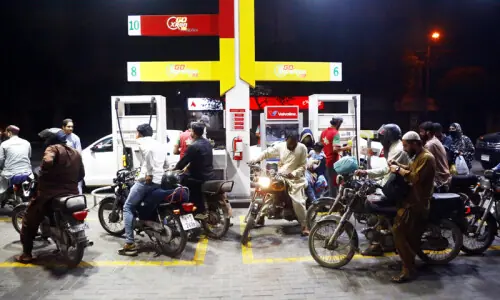
It is heartening to learn that the Senate committee on petroleum and natural resources in now seized of the problem arising out of the existence of the Oil and Gas Regulatory Authority (Ogra) for fixing petroleum prices and the Oil Companies Advisory Committee (Ocac) for the same purpose.
The Oil Companies Advisory Committee fixes petroleum prices on a fortnightly basis. While it is the government's endeavour to deregulate the economy for achieving better results, the experience in this sector so far does not appear to bear this out.
It would indeed be difficult to achieve stability in our economic activities on the basis of fortnightly changes in the prices of petroleum products as this causes imbalance in the prices and budgets of not only our government but also all households.
The changes in petroleum prices have an impact on the overall economy of the country. We all believe in reducing government expenses but it is wrong in principle that jobs in Ogra are occupied by some individuals of the bureaucracy who have nothing to do with the fixation of prices.
This function is being performed by Ocac. In the process, the worst kind of dichotomy is taking place. The principle of empowering oil companies whose principals produce our market crude oil and their refined products is not justified as they have vested interests.
It is alleged, maybe wrongly, that oil companies and their dealers get to know in advance of increases in prices and get their storage tanks filled up in advance at old prices.
On an increase in prices, petroleum products are sold at new prices and extra earnings are then shared between the oil companies and dealers. Oil companies also have their own retail marketing outlets also.
Considering all these factors, it is advisable that the responsibility for fixing the selling prices of petroleum products should be vested in Ogra. This organization should also be housed in some other ministry and not in the ministry of petroleum.
However, Ogra should have access to all the information needed by it. It is understood that the prices of crude and refined products ruling in the international market form the basis of fixing the selling prices.
This does not appear to be correct. It is felt that actual prices paid for imports during a given period should form the basis of such a mechanism. It is suggested that frequent changes, particularly the present practice of fixing prices on a fortnightly basis, should be done away with. In order to avoid hardship to the common man, the period of change should not be less than three to four months.
MOHAMMAD ANWAR KHAN
Karachi
Admission of fallacy
A two year search by 1,000 personnel with a budget of $1 billion has found zero threat in Iraq - no weapon stockpiles, no chemical or biological agents, no nuclear plants, no delivery systems.
When Mr Tony Blair was obliged to admit last summer that he could find no weapons, he promised to produce a weapons programme. Now the search has been closed down by Washington without uncovering any such programme either.
The immediate pressure for calling off the hunt, as US officials have conceded, is the rising danger to any investigator rash enough to venture out of the fortified green zone. Iraq's possession of WMDs was the prime aim for the invasion of Iraq.
In a rare acknowledgement of mistakes, the US secretary of state has said the Bush administration made some 'bad decisions' in Iraq and was unprepared for stabilizing the country.
President George W. Bush recently said in an interview that some of his decisions like the invasion of Iraq had helped Muslim extremists in their public relations battle with the United States.
"I have made some very difficult decisions that made public diplomacy in the Muslim world difficult. One was obviously invading Iraq." In this respect, your editorial (Jan 21) aptly says: "Understandably, the president chose to ignore America's policy towards the Arab-Israel conflict.
Out of fear of Israeli lobby, the president didn't have the courage to admit that America's blind support to Israeli policies has equally been responsible for strengthening Muslim extremists.
One hopes Mr. Bush and Ms Rice will not in future regret 'bad decisions' and exercise restraint instead of going ahead with attacks on Syria and Iran-as demanded by hawks in Washington and Tel Aviv."
PROFESSOR (DR) P. NASIR
Gujrat
Islam and the West
This is with reference to the letter by Mr Ghulam Muhammed (Jan 29) in response to my letter (Jan 26) on the above subject. He conveniently picked all the worldly/historical events to his likings while ignoring the same suffering and misery experienced by people around the world.
In the two world wars, the whole world was decimated, particularly Europe. But Mr Ghulam Muhammed mentioned only how the Ottoman empire and Middle Eastern countries were affected as if these wars were between Muslim and non-Muslim countries.
This was exactly my point in my last letter when I said that the world just couldn't be as simple as "Islam and the West". The correspondent also needs to be reminded that it was we who declared in May 1998 how proud we were that finally the Islamic world (Pakistan) also had a nuclear bomb.
American policies in the Middle East are not any different from policies towards other oil rich countries like Venezuela and Mexico. The US wants to control the oil, not just to have it to remain the dominant force in the world. Does the correspondent think that if the Middle Eastern countries were 'Christian', US policies would have been any different?
As regards Afghanistan, it was the great power from the East, the former Soviet Union, that invaded Afghanistan in 1979, not the West, and created a mess that we are still unable to cope with. The correspondent ignored it because it does not fit into his simple world of "Islam and the West".
KHURRAM HANEEF
New Jersey, USA
Ban on car premium financing
The sbp decision to ban the financing of car premiums is welcome, but with no benefit to the genuine buyer. Recently, I booked an 800cc car. I applied for a car loan, got a cheque from a bank and walked into a car dealer's office (I did not finance the premium).
The dealer accepted the payment only after taking Rs12,000 as "booking fee". One wonders why this money is involved when the buyer is presenting 100 per cent advance payment in the name of the auto assembler.
While I was in the dealer's office, every walk-in customer was being told the following: "Booking of cars against 100 per cent payment is closed." I am sure marketing managers of auto assemblers know the potential that exists in walk-in customers.
My suggestion to the government is: please do some mystery shopping before making any decisions. The latest move will have no effect on speculative buyers, and only the genuine buyer is going to suffer.
KHURRAM HASHEMY
Karachi
Cricket 'panic button'
This is in reply to Mr Anas A. Khan's letter "Cricket 'panic button'" (Jan 28). Regarding the report "Musharraf unhappy with performance, indiscipline" (Jan 25), everyone, including our president, is entitled to their own opinion. However, my advice to the president would be to watch cricket on his TV set and stop imposing his ideas in relations to areas in which he is not an expert.
The Pakistan Cricket Board is finally on the right track. The issue here is that our fans think they can coach the team better than the experts. I respect the PCB chairman for holding his ground and insisting that Inzamamul Haq and Bob Woolmer remain as captain and coach. He is completely justified in not pressing the "panic button".
Consistency should be the name of the game and I believe the PCB is working hard towards this goal. Woolmer is doing a good job. We need his modern coaching style, laptop in tow, to succeed.
Having local coaches like Javed Miandad (as great a batsman as he was) frantically gesturing shots to play from the dressing room, having poor fitness sessions, and a general lack of innovative ideas and diplomacy is ludicrous.
We need to be patient with our team, support it and realize they must be given a chance and opportunity to settle down as a fighting unit. The Australians use statistics, ingenuity and videotapes to mark and study their opponents. I am all for Pakistani coaches, but now is not the time.
May I remind the correspondent that the Pakistan team has had local coaches before, with little or no benefit? Petty feuds and bitter rivalries have made their relationships with their players unprofessional and unmanageable.
The best thing that the PCB has done is to provide consistency and an unbiased foreign coach. Fielding has improved, attitude has markedly improved and, although we have lost the series badly, the outcome does not show us the reality of the situation.
We have beaten India consistently since Woolmer came, we made it to the semis of the ICC Knockout, we have been giving Australia a fight in The Netherlands, and in the one-day series. The emergence of Salman Butt, the depth of our all-rounders and Inzamam's batting consistency are all things we can look forward to.
As far as captains go, Inzamam may not be the greatest leader on the field; he plays very defensively, the field is not well thought out, etc. There is no doubt however that he is the best batsman and the most respected player on our squad and therefore the best leader.
His fighting spirit has been evident in the one-day series. It is not him that is the problem, but the players he leads. Shoaib Akhtar is so disappointingly unfocussed. Other players spend their lives trying to play one match to represent their country and Shoaib just backs of, loses interest and admits defeat tamely.
Youhana and Shoaib really need to be dropped for a game or two to remind them that past laurels are not an assurance for a position on the playing XI. The management has been rewarding good performances with more chances to play on the XI (Butt, Akmal, Rana), so we need to apply the same rules for the senior players.
As a final thought, Kamran's century was good, but bring in Younis Khan as wicket keeper as he is too talented to be wasted as 12th man in one-days.
OMAR HAQ
Boston, MA., USA
Enforcing law and order
In order to achieve security, we have to enforce law and order. How do we do that? There is one and only one way - that nobody should ever be exempt from the law under any circumstances.
Anybody masterminding terrorist activities like blowing up bridges, rail tracks and roads, killing innocent people, damaging public and government property, destroying natural resources and national assets, smearing national interests in Pakistan or abroad and sabotaging Pakistan's image must not be given any quarters.
Better late than never. We should have installed army bases in Balochistan a long time ago. Depending on the size and immediate need, there should be an army base at every 250km, especially in Balochistan and North and South Waziristan.
These army installations should be set up over a period of time, with at least 50 per cent local people's involvement. If we want the country free from the clutches of sardars, chaudhrys, maliks and waderas, we must immediately start educational programmes across the country.
CONCERNED PAKISTANI
Los Angeles, USA
What breeds corruption
This has reference to the letter "What breads corruption" by Mr Shahryar Khan Baseer (Jan 25). I support his idea but would also like to add that pay is not the only factor that causes corruption. There are many other factors as well.
In my view, besides economic reasons, corruption prospers when there is a dormant and powerless legislature and political system, poorly managed executive bodies, low literacy rates, ineffective legal systems and judiciary and last but not least the unwillingness among many of us to support the accountability process.
Furthermore, the genesis of corruption is too deep to eradicate this menace at once. Increasing pays of public servants can diminish corruption a great deal if this increase is conditioned with high levels of competency and service delivery. At the same time we must seek to find ways to have an unbiased accountability process.
ZIA UL ISLAM
Peshawar
AKU exam board
This refers to Senator Tanvir Khalid's letter "AKU exam board" (Jan 30). I fully agree with the legislator's concerns. I think The Aga Khan Network has done a tremendous job and contributed to both the educational and healthcare sectors of our country.
I hope that the AKU examination board will provide a much better alternative to our students.
KARIM SUCHWANI
Karachi
(II)
Senator Tanvir Khalid's argument in favour of the AKU board is surprisingly immature. Just because the government cannot do something right does not mean it should hand over the job to someone else.
Yes, the standard of the government's education board leaves much to be desired, but the solution is that the government should reform its board rather than hand it over to a third party.
If the senator's logic is to be accepted, then by that same logic, the municipality should also be handed over to whichever organization we feel can do a better job because there are certainly far more problems with city administration in this country than there are with the education board.
It is very true that the AKU provides quality medical care to thousands of people, but that hardly gives it the right to decide what the youth of the country should or should not know.
Health services and education are two separate fields, governed by completely different sets of parameters. Moreover, it is not the competence of the AKU that is being questioned, but rather its impartiality in matters of religion.
ZAIN MANKANI
Karachi