A test of true faith
"Ramazan is the month in which was sent down the Quran," which is a "guidance to all mankind," says The divine proclamation. (2:185). The call is irresistible. Those who have attained such a state of piety that their "skins tremble" when they listen to the Quran so that "their skins and their hearts do soften to the celebration of Allah's praises" (39:23), are a class apart.
They are the ones who, not only say by word of mouth, "Truly, my prayer and my service of sacrifice, my life and my death are (all) for Allah ...." (6:162), but demonstrate it in practical life. So, when Ramazan comes they recall the Message, "O ye who believe! Fasting is prescribed for you" (2:183), they prostrate themselves like obedient servants and say, "We hear and we obey" (2:285). "Not for them to question, why."
Such people rejoice at the advent of Ramazan, for which they had been waiting in eager expectation for eleven months. They spend the month in fasting, reciting the Quran, giving alms and in prolonged prayers, particularly in the late hours of the night, when man can communicate with Allah in absolute quiet.
But this should not at all be understood to mean that such people skip their normal chores and duties during the month. On the contrary, they perform all those acts of piety side by side with their normal daily business, reflecting the prayer, "Our Lord! Give us good in this world and good in the hereafter." (2:201).
However, all believers are not at the same level of piety. Most of us are ordinary, sinful, people. Actually, we are "Muslims," not "Momins," in the real sense of the term. To us applies the anecdote of some desert Arabs who had claimed, "We believe (aamanna)," only to be reminded "Ye have no faith. But say 'We have submitted our wills to Allah (aslamna),' because faith has not yet entered your hearts." (49:14).
The Ramazan fast is for the whole month - thirty days or twenty-nine, at a stretch. No break is permissible except in certain clearly defined cases. It was natural that this command to trigger the feeling among some people that this stressful duty was imposed on the followers of Prophet Muhammad (S.A.W.), only. Therefore, to put their minds at rest, believers were reminded that such was not the case.
Ramazan fast was not an innovation exclusively for the ummah. Fasting was ordained on others before Islam - the Jews and Christians. "O ye who believe, fasting is prescribed to you as it was prescribed to those before you," Allah pointed out. He even explained the purpose behind prescribing the fasting, namely, "that ye may (learn) self-restraint." (2:183).
But a few other questions would still bother the common Muslim. For example, "even if it had to be thirty days, why consecutively? Why not allow the period to be spread out all over the year, at the individual's own will?"
Turning to the question of consecutive fasting versus its alternative, first, the former is more convenient if you ask anyone who fasts this way. The reason is simple. When people all around are fasting, and food and drink are not on display, it creates a congenial ambience. So an individual who fasts becomes a part of the crowd. He forgets the pressure of hunger or thirst and completes his fast without any discomfort.
By contrast, if one were to fast at any other time, he would feel singled out, and become self-conscious. He would also experience the stress of resisting food and drink when it will be available aplenty, all over the place. If he is a smoker, the "aroma" of tobacco when others around him are smoking would hit his olfactory senses to torment him. And above all it would not be possible to offer taraweeh prayer in a congregation and listen to the recitation of Quran.
Besides, in case of consecutive fasting, after the initial few days, it would become a routine. A sort of habit would form after one has adjusted to the new schedule of daily meals. On the other hand if one were to observe the fast by fits and starts, every time it would be new exercise, and he would feel its rigour more acutely.
Another very tangible benefit of a full month of fasting is that it reduces air pollution to the lowest level. There is no smoking either inside offices and stores or in the open. This result could not be achieved by spreading out the thirty days over the full year.
And finally, due to its full month of fasting, Ramazan is a "culture." It touches every Muslim and turns him towards piety, so that even those who do not offer prayers at other time during the year, offer congregational prayers during this month.
Ramazan also creates its own peculiar ambience. Mosques wear a festive look and overflow with people offering prayers. Even little children throng to the mosques. In the afternoons everything wakes up into activity. Nights are full of life as stores and eateries keep open till late hours. Nothing of this kind can happen if it is not a full month of fasting.
But, far more importantly, consecutive fasting is necessary to discover the wisdom of the Divine purpose, namely, "that ye may (learn) self-restraint." Evidently one can't "learn" any lesson in one sitting or casual, occasional sittings, and especially a lesson such as self-restraint. Every lesson requires practice to imbibe its benefits and understand its virtue. The same applies to self-control. Indeed, the virtues of self-restraint have been lauded through the ages in all religions and societies.
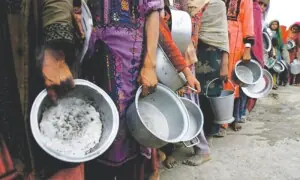
Many Muslims spend money to feed the poor, but in a detached sort of way. They do not know the agony of a hungry stomach and a thirsty throat. Ramazan fast offers them the unique opportunity to voluntarily undergo the experience so they may genuinely feel for the poor.
Fasting is not starvation. Starvation means suffering from lack of food. But in the case of fasting there is no lack of food. It is a case of self-denial. It is a lesson in self-restraint which is Allah's declared purpose behind prescribing Ramazan fasting. And even yet, it has been made as convenient as could be. Thus, between the breaking of one fast and the start of the next, people are free to eat and drink and partake of whatever bounties Allah has endowed him/her with including performing their marital functions.
Fasting has many benefits both in the physical and the spiritual spheres. On the practical side, it has been admitted to be one of the oldest therapies. Hippocrates believed that in fasting the body heals itself. Eminent physiologists have hailed fasting as "the single greatest natural healing therapy", and nature's universal "remedy" for many physical problems. These problems include hypertension and heart disease, allergies, diabetes, and cancer. Fasting has a therapeutic and preventive effect for many of these conditions. The most common everyday application of fasting is in the case of indigestion.
Hardship there is in fasting. No question about that. Fast begins from the time when "the white thread of dawn appears to you distinct from its black thread, until night appears" (2:187). During this period of at least twelve hours, (longer during summer) not a grain of food, nor a drop of water, must pass down the throat. Every Muslim, who is at his home, is bound by the command, (2:185), except sick people, women during their period and those on a journey. But they must complete the count later.
But then, Ramazan is a test of faith. And every test, even the most mundane one, imposes some hardship. It is also a rewarding experience, both for the purification of the soul, for which it acts like a catharsis, and for the prevention and cure of many a physical ailment. The length of time it requires to go without food and drink may appear too discouraging to a prospective entrant. But that is true of every adventure. No lecture can convey the real purport of Ramazan fast, as fasting itself.
Dealing with US anxieties
As the Soviet occupation of Afghanistan drew to a close towards the end of the 1980s, President George Bush Sr who was seeking re-election for a second term made a prophetic statement the full implications of which could not but have been farthest from his own mind.
He said: "Long after the last Soviet soldier leaves Afghanistan, the US-Pakistan partnership will endure as an important bilateral and regional association. The US and Pakistan have an historic relationship which I will preserve and further strengthen if I am elected."
This thought was to assume reality during the tenure of his son and almost draw Pakistan into an unprecedented role. The younger George Bush in 2002 decided to declare a war against what he called international terrorism, following the events of 9/11. US secretary of state Colin Powell, recalled in a statement the other day: "I called President Musharraf two days after 9/11 and he agreed that it was time for him to make a strategic choice and he made that choice: Mr Powell also recalled: "We have transformed our relationship with India and forged a new partnership with Pakistan."
While in the earlier phase of its relationship with Pakistan, during the cold war crisis, the US mainly concerned itself with providing Pakistan with arms and military equipment, its main concern in the recent months has been to secure partners for its war against terrorism, the main battle grounds of which have been Afghanistan and Iran.
In the earlier phase it had its watchdogs stationed in Pakistan to ensure that the target (the Soviet Union) was not lost sight of; at present its envoys visit Pakistan every now and then to ensure that Pakistan's focus stays on what the US regards as international terrorism. While earlier Pakistan made no secret of its response to America's strategic objectives, in the present phase it cannot afford to be too overt in its response to President Bush's expectations.
While stemming the tide of terrorism is in Pakistan's own interest, and President Musharraf is only too conscious of that, the overwhelming sentiment of Pakistan's Muslim population has no sympathy for President Bush's war against terrorism. Pakistani critics of President Musharraf are fully exploiting the anti-war and anti-Bush sentiment of the people. President Bush's harsh and hamhanded handling of the situation first in Afghanistan and now in Iraq has given them ammunition for consolidating their position against the US.
Incredible as it may seem Saddam Hussein's popularity with the Pakistanis grew to an unprecedented level as the US-led coalition's noose tightened around his neck.
It may sound unbelievable but while before the invasion of Iraq, Pakistanis hardly ever looked upon him as a Muslim, today he is virtually idolized as a 'ghazi' by the orthodox elements.
President Musharraf has no choice but to be circumspect in his support for the US-led war against terrorism and the average Pakistani is not inclined to accept as credible the charge of terrorism against the Taliban or the Iraqis.
Quite understandably Pakistan feels rather peeved every time a visitor from outside gives a sermon asking Pakistan to do a little more about fighting against terrorism. During his meeting with the Pakistan prime minister while on a two-day visit to Pakistan earlier this month, German Chancellor Gerhard Shroeder lauded Pakistan's anti-terror efforts but also called for "greater cooperation among the international community to win the war against terrorists."
Prime Minister Shaukat Aziz endorsed Schroeder's views, describing terrorism as a challenge for the world.
However, the same day the Pakistan foreign office spokesman, without directly referring to the German Chancellor's observation, said that Pakistan has taken exception to unending assertion by visiting foreign leaders that Pakistan should do more to combat terrorism. In a somewhat angry tone he said: "Telling us to do more hurts our sensibilities because no country has done more than us in this war..... Pakistan has waged a war on terrorism in the supreme national interest and not appease the West."
Gen Pervez Musharraf was himself apparently not too happy at the reported remark of visiting United States' assistant secretary of state Ms Christina Rocca to the effect that Pakistan should be doing more (for the US-sponsored war against terrorism). She was on one of her periodic visits to monitor the progress on the extent to which Pakistan feels involved in the war.
President Musharraf expected Ms Rocca to remember that Pakistan was one of the first countries in the region to respond positively to President Bush's expressed concern about the security of the world community in the aftermath of the 9/11 event. The President could not have been more explicit, particularly as he knew that a considerable section of the Pakistanis was bound not to be quite sympathetic to President Bush's perception.
Since the decision to align with the US policy, Pakistan has experienced a backlash of bomb blasts, random attacks on the gatherings in mosques, imambargahs, and other public places for which religious fanatics have been held responsible. The acts of violence are apparently an expression of anger against Pakistan joining forces with the Americans and against the US-led military operation in Afghanistan and Iraq. US secretary of state Colin Powell's subsequent statement praised Pakistan's "strategic choice" in deciding to work in close partnership with the US.
In fact, Mr Powell went rather overboard, perhaps in his excitement to ensure that Ms Rocca's faux pas has not caused any lasting damage. He made the rather enigmatic statement that "now we are working in close partnership with President Musharraf as we help him to move his country forward at a pace that Pakistani people can absorb."
Ms Rocca and her colleagues must understand that as it is Pakistan has to tread the path very carefully because a pro-US tilt in its policy is not easy for it to sustain and with the overwhelming pro-Iraq and even pro-Saddam sentiment/dominating the minds of the vast majority of the Pakistani people it is not possible for Pakistan to opt for being drawn into the Iraq war.
It is possible that because of his known admiration for Turkey, Gen Pervez Musharraf might be perceived in the West as a modern day Ataturk who could detach himself from Islam and the popular sentiments of the Muslim people.
Implications of two offices
After the enactment of the legislation that allows President Musharraf to hold the two offices of the president and the COAS concurrently and the recent appointments of the VCOAS and Chairman Joint Chiefs of Staff Committee, it is evident that president will retain his uniform beyond the end of December 2004. Perhaps he is waiting to further gauge the national reaction or waiting for the US presidential elections to be over to make the final announcement.
It is extremely important to recognize the implications of this constitutional aberration. Regrettably, it is an admission of a reality by the ruling establishment that the present political edifice is incapable of surviving without President Musharraf retaining the two positions. This may well be a valid assumption as the ruling party has not gelled and remains a collection of disparate groups with individual interests dominating, without a collective aim or a common programme binding them.
A tight embrace by President Musharraf binds them superficially and once it is loosened they are likely to lapse into infighting and disintegrate. Similarly, at least two provincial governments - Sindh and Balochistan will collapse the day the military's crutch is removed. Shaukat Aziz too will cease to exercise effective control as prime minister because he depends on the president and the army backing him for his political existence.
Indeed, the president, besides holding the two offices, is also partly functioning as the chief executive - a role which essentially belongs to the prime minister. And as the National Security Council is structured, the real power rests with the COAS and if the president were to doff his uniform, he may find his authority diminished and may not be in a position to influence policy the way he has been doing for the last five years. This is because his most important constituency is the nine corps commanders and principal staff officers at the GHQ and not the PML-led coalition.
The whole system thus revolves round one person, a condition that is fundamentally incompatible with democracy and inherently risky for the nation. Parliament is adequate testimony not only of the lack of democratic credentials of the party in power but also the extent of decline in the body politic of the country.
Additionally, the image of Pakistan, which already is so low that it will receive another serious setback and president's image and credibility in the western world, as a liberal and enlightened reformer, will seriously suffer. Pakistan will be bracketed with countries having military dictators like Burma or some Middle East countries. Even Afghanistan in comparison might look good with an elected president.
Although it is a different matter that in the prevailing geopolitical environment the US and the western world, for reasons of political expediency, may temporarily close their eyes to our breach of democracy and may even certify us to have passed their "test of legitimacy". It is, however, not to please foreigners that the people of Pakistan yearn for democracy, but as a matter of their right and for public good.
The oft-repeated argument that for the common people it is inconsequential if there is democracy or dictatorship does not bear close scrutiny. It is merely a cover by the ruling elite to perpetuate themselves and to continue exploiting the masses. Success of democracy in Pakistan would give a big boost to empowerment of women, religious and ethnic minorities and other under-privileged classes.
No wonder in many Muslim countries women and minorities are the most exploited and suppressed sections. Even by South Asian standards, Pakistan trails behind in women's emancipation, primarily because of lack of education and democracy. Furthermore, the curse of sectarianism, extremism and narrow nationalism that besets our country can be more effectively countered if sufficient space is provided to mainstream political forces.
President Musharraf's initiative to galvanize the Islamic world for undertaking internal reform and modernization can only succeed if there is a genuine representative constitutional government in his own country.
The central question that emerges from the present dilemma is whether President Musharraf should seek more power or greater support from the people. All of our military rulers and even our civilian prime minister, Nawaz Sharif, wielded enormous power and, in case of the latter, his appetite for amassing power until the last day was insatiable, yet it could not rescue them from a catastrophic downfall.
President Musharraf now has all the three positions of the prime minister, VCOAS and CJCSC filled by persons of his own choice and is equipped with Article 58- 2(B) that empowers him to dissolve parliament and appoint and remove the service chiefs, but still he wants to remain the army chief.
There is a lesson to be drawn from all this for our military and political leaders to grasp. Pakistan cannot continue in this state of political wilderness. Its leaders have to develop a political system that diffuses power and which provides greater sense of participation, ensures accountability and provides institutional stability. Creating a political culture that fosters voluntary cooperation and places limits on the power of the state and individuals is the best course for actualizing the vitality of the nation.
A state will always remain prone to crisis and instability in which civilian prime ministers are apprehensive of the military and where military rulers have scant regard for the politicians. The concept among our current military leadership that the army is the centre of gravity of the nation and should remain so to ensure stability and national cohesion has to change. Military, undoubtedly, is an important and indispensable element in defending the integrity of the nation from external threats but the centre of gravity has to shift to the people of Pakistan and to their representatives in parliament.
The logic that the prevailing regional and global strategic landscape, particularly the fight against terror and the peace process with India, requires the president to continue in uniform, does not appear very convincing. In fact, the campaign against terror can be very effective if it is fought with the full support of the people. After all, most of the countries fighting terror have civilian leadership and are using the military only as a part of their over-all strategy.
Similarly, negotiations with India, particularly over Kashmir, would demand a national consensus. A settlement of the issue will be greatly facilitated if the people are fully in the picture, with their leaders involved in the process and they have the necessary backing of political parties. It is often said that rational decision-making in a democracy calls for an ability to harmonize competing strategic visions and interests. Pakistan's support for the Kashmir cause is also likely to carry more weight both within Kashmir and with the international community if it has better democratic credentials.
Prudence demands that the president should allow political parties of all hues - PPP, PML-N and MMA, to start functioning without undue interference so that the country can engage in normal political activity and strengthen its political institutions. Moreover, the PML coalition, which is the main pillar of support for him should not be managed from outside but allowed to evolve through its own political dynamic under which it could freely elect its leaders. And the prime minister, cabinet and parliament should be given the freedom to make decisions that lie in their domain of responsibility so that the people can hold them accountable.
What is needed is to revert to the original spirit of the 1973 Constitution so that the government, instead of heavily leaning on the military, draws strength from the people and parliament, which would place the country on a firmer foundation. By pursuing a more inclusive rather than an exclusive path the political leadership can feel confident to lead the nation and address the real problems facing the people. Currently, our military and political ruling elite is too preoccupied with advancing its self-interest and protecting the fragile structure of governance.
The writer is a retired Lt-general.